ASUS ProArt P16 Reviews Show RTX Spark GPU at 43 W in Games
PC Gamer measured 43 W average GPU draw against 97 W for a Razer Blade 14 with an RTX 5070; Windows Central, Engadget and others weigh price, emulated games and battery life.
4 min readAI-assisted
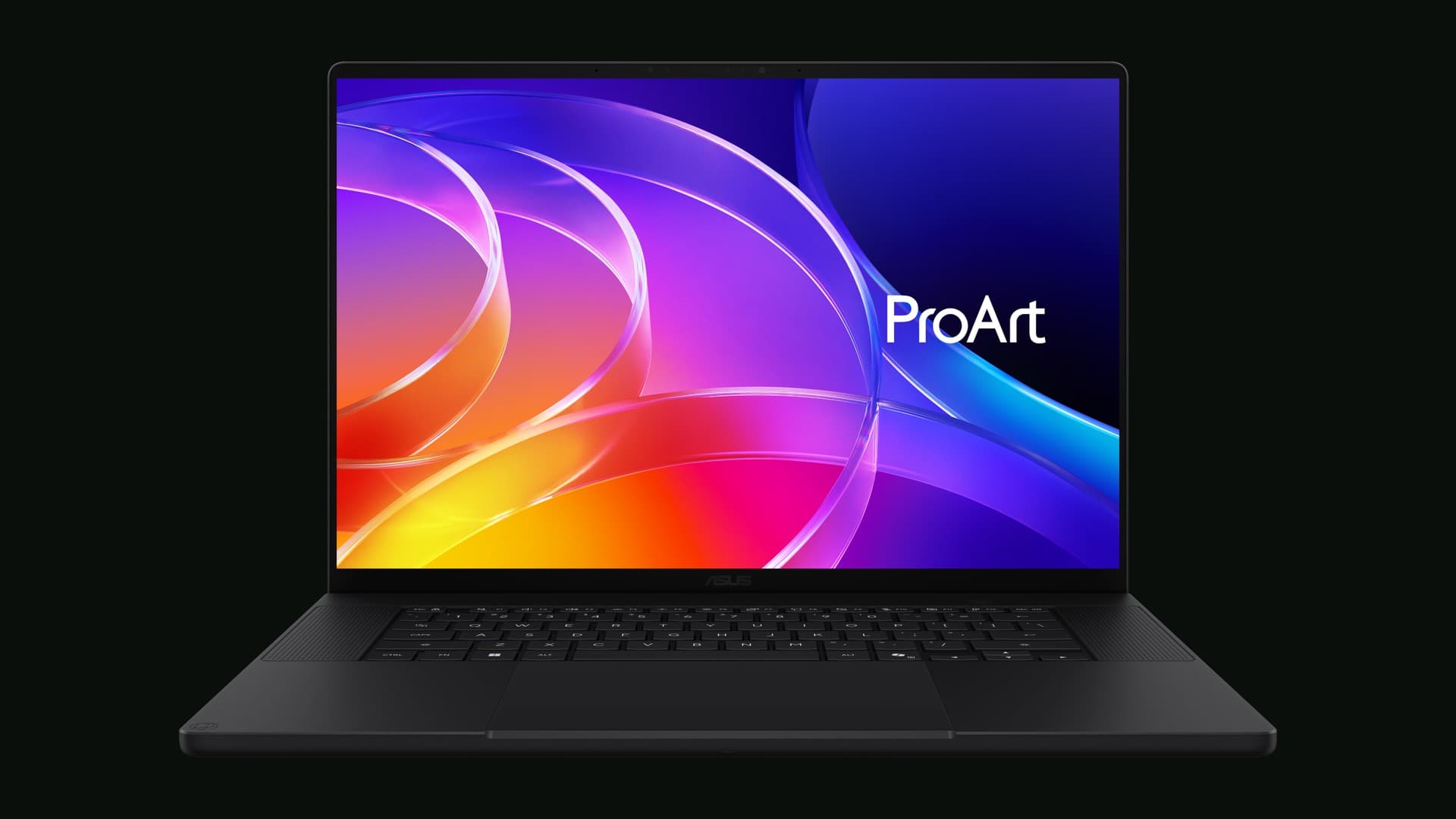
ASUS press image of the ProArt P16 (H7607), fitted to 16:9 on a dark background. The photo is the vendor's, not a test unit.
Image: ASUS
Source · Press image from the ASUS newsroom, used for news reporting.
Reviews of the ASUS ProArt P16 find NVIDIA's RTX Spark N1X games near RTX 5070-laptop level in some titles on far less power: PC Gamer measured 43 W average GPU draw in Metro Exodus Enhanced Edition at 1080p, against 97 W on a Razer Blade 14 with an RTX 5070.
ASUS lists the ProArt P16 (H7607) with the RTX Spark N1X, a 20-core CPU and a 6,144-core Blackwell RTX GPU, up to 128 GB of LPDDR5X soldered on board, a 99.9 Wh battery and a weight of 1.77 kg. NVIDIA's own spec table rates the laptop chip at 45-80 W TDP. NVIDIA says RTX Spark with 128 GB of unified memory runs models of up to 120 billion parameters, and Windows Central reports that ASUS says the same of this configuration. That is a vendor claim, and none of the reviews read for this piece reports testing a model that large. As Voltgrid reported when the platform launched, its graphics are strong and its CPU cores are older.
What Reviewers Measured on the ProArt P16
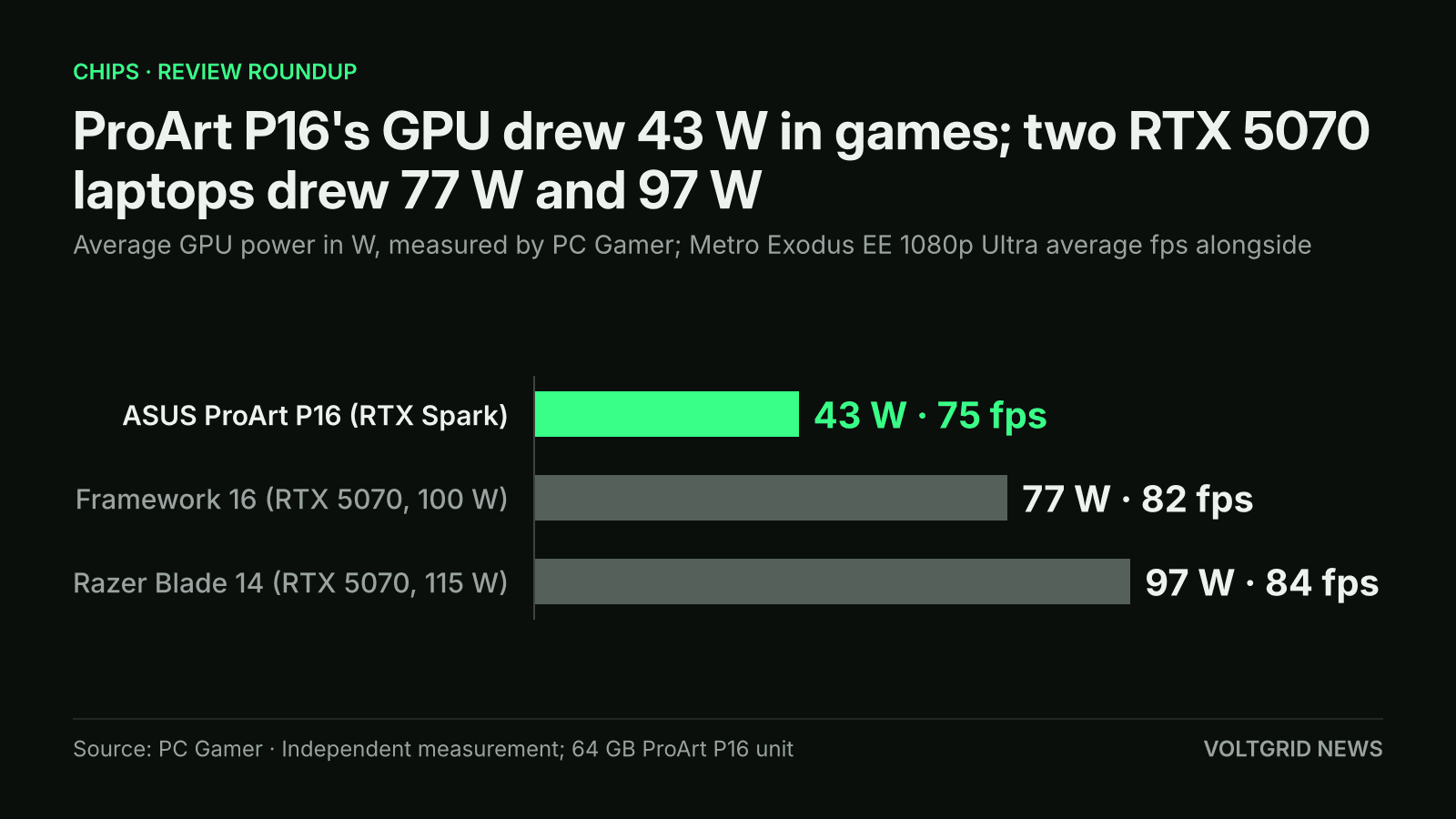
PC Gamer measured 43 W average GPU power on the ProArt P16 against 77 W and 97 W on two RTX 5070 laptops; fps is Metro Exodus EE at 1080p Ultra.
Illustration (AI-generated)
Graphics are the headline. PC Gamer ran its 64 GB unit against a Framework 16 with an RTX 5070 at 100 W and a Blade 14 with an RTX 5070 at 115 W. In Metro Exodus Enhanced Edition at 1080p Ultra, the ProArt averaged 75 fps against 82 and 84 fps. PC Gamer said the Blade drew more than double the power while running about 12% faster. Average GPU clocks were 1,906 MHz on the ProArt against 2,421 and 2,589 MHz on the two RTX 5070 machines.
Windows Central compared three laptops built on the same chip. The ProArt scored 11,840 in 3DMark Time Spy, around 7% and 9% behind Microsoft's Surface Laptop Ultra (12,771) and HP's OmniBook Ultra 16 (13,080). In the heavier Time Spy Extreme it led, at 6,006 against 5,857 and 5,492. Trusted Reviews, testing a separate 64 GB unit, recorded 11,763 in Time Spy.
On AI work, Engadget's 128 GB unit scored 3,895 in UL Procyon AI Computer Vision 2 against 3,267 for a MacBook Pro with M5 Max, and 1,519 in Procyon AI Image Generation, about 600 points above the Mac. Engadget also ran a Qwen3.8 27B model that it said occupies 42 GB of memory. Trusted Reviews ran MLPerf Client on the GPU and measured Llama 3.1 8B at 54.3 tokens/s with Windows ML and 53.7 tokens/s with llama.cpp.
Where Reviewers Disagree
Battery life is the widest spread, and it comes from the workload, not from conflicting results. PC Gamer's PCMark 10 gaming loop, which runs 3DMark Fire Strike under emulation, lasted 86 minutes against 131 and 134 minutes for the RTX 5070 laptops. Windows Central's battery report averaged 9 h 58 min of mixed real-world use over several weeks. Engadget measured 10 h 51 min in PCMark 10 Applications, and Trusted Reviews 13 h 55 min looping 1080p video at 150 nits.
Gaming depends on the game. In CPU-bound Baldur's Gate 3, PC Gamer measured 42 fps against 69 and 65 fps, and blamed both Microsoft's Prism emulation layer and the CPU cores' single-thread speed. In Black Myth: Wukong it found parity, at 66 fps against 64 and 65 fps. PC Gamer also reported anti-cheat gaps and battery drain in sleep. Windows Central measured under 1% battery loss over 14 hours of standby.
Power mode matters less than it might. Notebookcheck, in its Oct 16 review, measured Cyberpunk 2077 at QHD Ultra at 43.2 fps in Whisper mode (50/35 W) and 56.8 fps in Performance mode (85/70 W), and 56.2 fps on battery. Engadget likewise saw no drop when unplugged.
What It Means for Local AI Buyers
The defining choice is unified memory: the CPU and GPU draw on one pool of LPDDR5X instead of a separate, smaller graphics memory. That is why a laptop can hold a 42 GB model at all. The trade-off is speed. ServeTheHome reported up to 300 GB/s from a 256-bit LPDDR5X-9400 bus; NVIDIA's RTX Spark page lists no bandwidth, and its separate DGX Spark is rated at 273 GB/s. PC Gamer noted that this is lower bandwidth than the 8 GB of GDDR7 on a mobile RTX 5070. Capacity decides which models fit; bandwidth decides how fast they answer.
Price buys that memory. Windows Central lists the 64 GB, 1 TB model at $4,399.99 and the 128 GB, 2 TB, 4K model at $6,999.99 in the U.S., with Best Buy models from $2,799 with 24 GB. Windows Central also measured SSD reads of around 7,300 MB/s, against 10,389 MB/s on the HP and 14,647 MB/s on the Surface. Voltgrid News also covered the NVIDIA DGX Spark 64GB partner sale.
Why Unified Memory Sets What Fits
Unified memory means the CPU and GPU share one pool of LPDDR5X instead of the GPU holding its own small graphics memory. ASUS lists up to 128 GB on the ProArt P16, against the 8 GB of GDDR7 that PC Gamer cites for a mobile RTX 5070, which is why Engadget could load a model it said takes 42 GB.
Width and speed set the other half. ServeTheHome reported that the chip's 256-bit LPDDR5X-9400 bus gives up to 300 GB/s, a figure NVIDIA's RTX Spark page does not list; NVIDIA rates its separate DGX Spark at 273 GB/s. Every generated token requires reading the model's weights, so capacity decides what fits and bandwidth caps how fast it answers, which makes a large local model usable on a thin laptop but slower than on a discrete card.
Verdict and What to Watch
The reviews point the same way. The ProArt P16 suits developers, creators and local AI users who need large GPU-addressable memory and CUDA in a thin 16-inch laptop. It does not suit buyers who mainly game; Engadget pointed to an RTX 5070 Zephyrus G16 at $2,124. Still unproven are the 120-billion-parameter claim, like-for-like tokens/s across RTX Spark laptops and wall power under sustained AI load. Next come Windows Central's full HP OmniBook Ultra 16 review and the compact RTX Spark desktops NVIDIA says go on sale in November.
Sources
- 01ASUS's ProArt P16 RTX Spark review: The best RTX Spark laptop I've tested — but it's built for people who can actually use all of itWindows Central · windowscentral.com
- 02Asus ProArt P16 (RTX Spark) reviewPC Gamer · pcgamer.com
- 03ASUS ProArt P16 review: A sleek showcase for NVIDIA's RTX SparkEngadget · engadget.com
- 04ProArt P16 (H7607) Tech SpecsASUS · asus.com
- 05Asus ProArt P16 RTX Spark Laptop Review - The future of multimedia laptops?Notebookcheck · notebookcheck.net
- 06Asus ProArt P16 (2026, RTX Spark) ReviewTrusted Reviews · trustedreviews.com