NVIDIA DGX Station Puts 252 GB of HBM3e and 1.6 kW Beside the Desk
NVIDIA says DGX Station now ships from seven OEMs. Two independent labs find the GB300 tower is a multi-user inference node that needs its own 20A circuit, not a personal PC; NVIDIA lists no price, and one retailer listing starts at $94,930.
6 min readAI-assisted
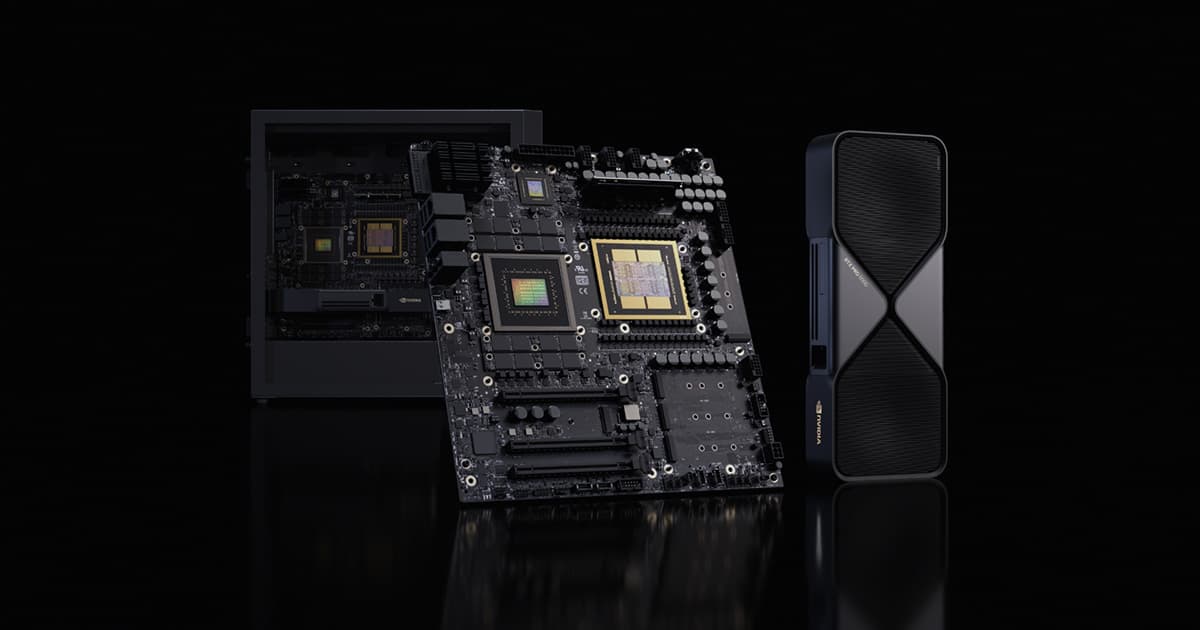
NVIDIA's product image of the DGX Station: the GB300 baseboard, the deskside chassis and the optional RTX PRO GPU. It is a render of the reference design, not of a partner's tower.
Image: NVIDIA
Source · Press image from the NVIDIA website, used for news reporting.
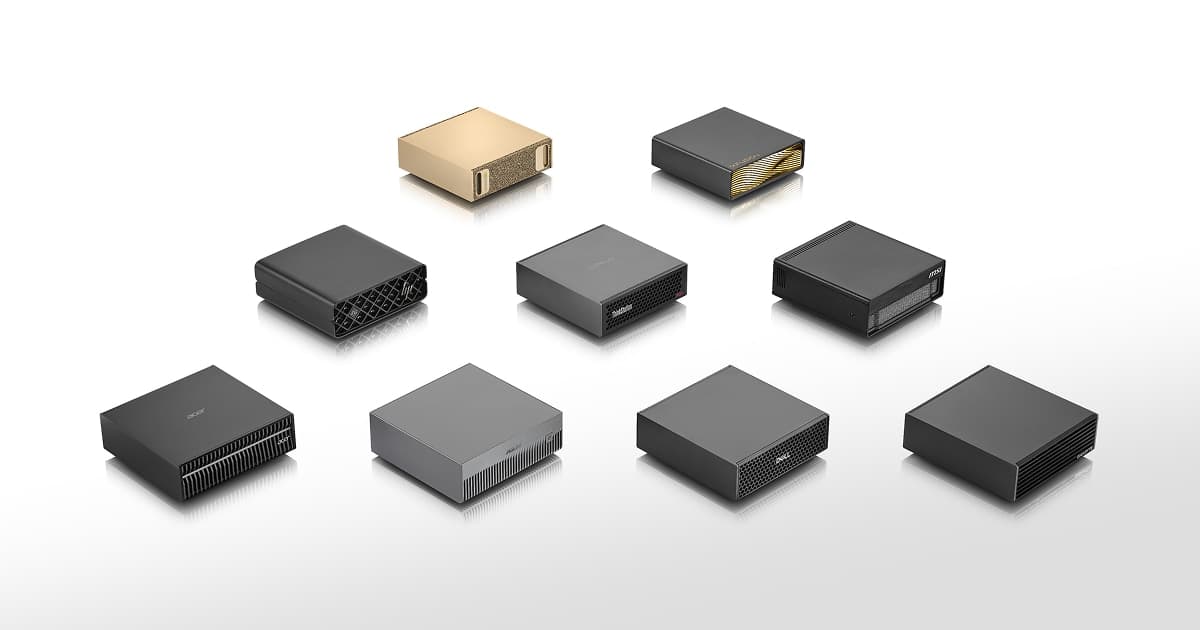
NVIDIA's DGX Station, a deskside tower built on one GB300 Grace Blackwell Ultra superchip with 252 GB of HBM3e, is shipping from seven system makers, NVIDIA said on Oct. 21. ServeTheHome published its second review of the platform on Oct. 23.
The partners are ASUS, Dell Technologies, GIGABYTE, HP, MSI, Supermicro and Exxact. A Windows edition is due in December from six of them, according to NVIDIA. DGX Station sits above the GB10-based DGX Spark. It uses a Blackwell Ultra GPU, the architecture NVIDIA sells in GB300 NVL72 racks, here in one tower with a 1,600 W power supply.
The buyer is a team that wants to run large open models privately, tune kernels on the GPU it will deploy to, or serve agents around the clock without booking cluster time. NVIDIA says one unit can serve more than 30 users at speeds comparable to cloud models. Two independent labs, ServeTheHome and StorageReview, have now published measured results. Their numbers support the multi-user case, though neither tested NVIDIA's 30-user claim as stated.
DGX Station Specs and the GB300 Superchip
NVIDIA's spec page lists a 72-core Grace CPU using Arm Neoverse V2 cores, joined to one Blackwell Ultra GPU by a 900 GB/s NVLink-C2C link. The GPU has 252 GB of HBM3e at 7.1 TB/s. The CPU has 496 GB of LPDDR5X at 396 GB/s. NVIDIA adds the two together and calls the result 748 GB of coherent memory.
That figure is the one to understand. It is two memory tiers, not one pool of fast memory. Model weights in HBM stream to the GPU at 7.1 TB/s. Weights that spill into the CPU's memory arrive at under 400 GB/s. StorageReview measured 6,875 GB/s for HBM reads, and 390 GB/s moving data from Grace memory into HBM. It found the CPU's memory, not the 900 GB/s link, sets that ceiling. So the big pool decides which models load at all, and the HBM decides how fast they run. ServeTheHome also reports that NVIDIA's 2025 spec called for 288 GB of HBM3e at 8 TB/s. It reads the shipping figures as consistent with seven of eight memory stacks enabled. That is its inference, not NVIDIA's statement.
The compute figures need careful labels. NVIDIA's table lists FP4 as "20 | 15" PFLOPS. A footnote says all Tensor Core figures include sparsity unless noted, and a "without sparsity" note is attached to the 15. The 20 PFLOPS in NVIDIA's headline is the sparse number. StorageReview's best sustained dense matrix-multiply result was 6,134 TFLOPS in NVFP4. That is a measured rate on a real workload, not the same metric as a peak spec.
NVIDIA's fixed baseboard adds a ConnectX-8 SuperNIC with two 400 Gb/s ports, up to seven Multi-Instance GPU partitions, and room for one optional RTX PRO card. Without that card, the only display output is the management controller's port. Storage is the one spec where the sources conflict. NVIDIA's page lists four M.2 Gen 5 slots. ServeTheHome's table for the MSI unit lists two Gen6 x4 and two Gen5 x4 slots. StorageReview describes the same MSI model as four PCIe 5.0 x4 slots, two on the CPU and two behind the SuperNIC's switch. No source explains the gap.
How DGX Station Compares With Spark and Mac Studio
Against NVIDIA's own DGX Spark, the step is large. NVIDIA lists Spark with 128 GB of LPDDR5X at 273 GB/s and 200 Gbps networking. In StorageReview's vLLM runs, the MSI XpertStation WS300 peaked at 9,294 output tokens per second on GPT-OSS-120B in a sweep of up to 128 streams, though StorageReview does not say the peak came at 128. An RTX PRO 6000 workstation card reached 3,384 and a DGX Spark 500. As Voltgrid reported on the DGX Spark 64 GB partner sale, even Spark now costs several thousand dollars, with a 64 GB version from $4,999.
Apple's Mac Studio with M5 Ultra is the large-memory desktop alternative. Apple lists up to 512 GB of unified memory at 1.2 TB/s, from $5,499, with the 512 GB version due in late October, Apple said in August. Set like against like, that is 512 GB of unified memory at 1.2 TB/s, against 252 GB of HBM3e at 7.1 TB/s plus 496 GB of LPDDR5X at 396 GB/s on DGX Station, and on a different software stack. Voltgrid found no published head-to-head of the two machines as of Oct. 24. NVIDIA's GB300 NVL72 puts 72 Blackwell Ultra GPUs and 36 Grace CPUs in one liquid-cooled rack, with 800 Gb/s of ConnectX-8 networking per GPU. DGX Station uses the same architecture in a single-GPU tower. Amazon is reportedly taking GB300 racks faster than it can power them.
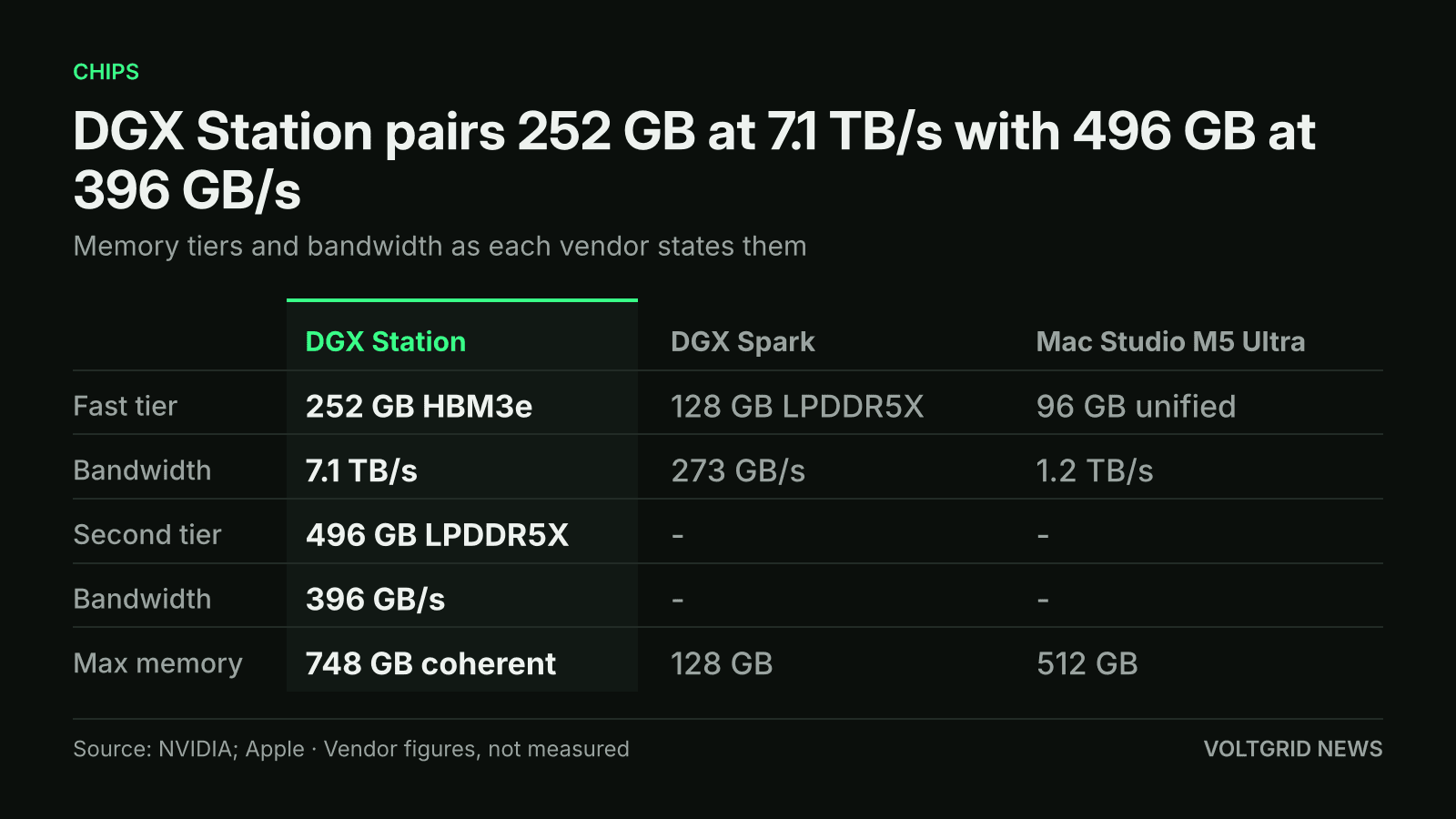
On vendor figures, DGX Station is the only one of the three with two memory tiers; Apple lists 1.2 TB/s and NVIDIA lists 273 GB/s for Spark.
Illustration (AI-generated)
Why Memory Bandwidth Sets Decode Speed
A language model writes one token at a time, and each token needs the weights read from memory again. In that decode phase, speed is usually capped by how fast memory delivers data, not by peak compute. ServeTheHome found that prefill, the compute-heavy phase, crossed the link to Grace memory well, while decode is where HBM is wanted. StorageReview ran a 433 GB model with 216 GB of experts in Grace memory at 36 output tokens per second for one stream, using speculative decoding at a best-case setting.
What reviewers measured so far
The headline results are aggregate throughput across many users, not single-user speed. ServeTheHome measured well over 26,000 tokens per second on Qwen3.6-35B-A3B in NVFP4 at 512 concurrent users on a GIGABYTE W775-V10-L01, with prompts of 24 to 30 tokens and 1,024-token outputs. On MSI's tower, several Qwen3.8 Flash Next tool-call runs passed 3,000 tokens per second at 32 users and were still rising.
The memory tiers show up in StorageReview's offload tests. GLM-5.2, a 433 GB checkpoint with 216 GB of experts held in CPU memory, ran at 36 output tokens per second for one stream and 139 at 32 streams. Those runs used speculative decoding at a fixed acceptance rate, which StorageReview calls best-case. ServeTheHome likewise found that prefill crosses the CPU-GPU link well, while decode wants HBM.
Networking is the other asset. ServeTheHome linked two stations and measured 784.3 Gbps between the GPUs over two 400G links. Between the Grace CPUs it measured only 229.0 Gbps, limited by the CPU's PCIe Gen5 x8 link to the SuperNIC. The two labs' results also agree across OEM boxes. StorageReview found ASUS's ExpertCenter Pro ET900N G3 within 2% of the MSI on 24 of 28 tests, and its ASUS review credits the result to NVIDIA's fixed baseboard.
Power is the deployment constraint. ServeTheHome measured idle power never below 250 W and noise of 46 to 49 dBA at full load. It says the 1,600 W supply effectively needs a dedicated 20A circuit. StorageReview logged 1,292 W on the GPU alone on the MSI unit, at a peak of 71C. Neither lab published full-load wall power as a number.
DGX Station Price, Availability and Software
NVIDIA has published no list price, and StorageReview says MSI has not either. Tom's Hardware found an Exxact configuration listed from $94,930 in August, rising to $108,350 with an RTX PRO 6000. ServeTheHome describes the MSI unit as a $100K-plus system. The Linux version runs Ubuntu with NVIDIA's AI tools. NVIDIA's Oct. 21 update added NVIDIA Sync support and seven management integrations, including Microsoft Intune and Tanium, and said NVIDIA Cloud Functions is coming in early access to Linux DGX Station. StorageReview notes that the Arm host will rule out some toolchains.
What to watch
The Windows edition, due in December from ASUS, Dell, GIGABYTE, HP, MSI and Supermicro, is the next milestone, along with NVIDIA's promised support for Siemens, Synopsys and Dassault Systemes software. Still missing are an OEM list price, a wall-power figure under full inference load, an answer on the storage spec, and a measured comparison with a 512 GB Mac Studio.
Sources
- 01NVIDIA local AI update: RTX Spark, DGX Spark and DGX StationNVIDIA · blogs.nvidia.com
- 02MSI XpertStation WS300 Review NVIDIA DGX Station GB300ServeTheHome · servethehome.com
- 03NVIDIA DGX StationNVIDIA · nvidia.com
- 04Gigabyte W775-V10-L01 Hands-on Bringing NVIDIA GB300 DesksideServeTheHome · servethehome.com
- 05Mac Studio - Technical SpecificationsApple · apple.com
- 06MSI XpertStation WS300 Review: 748GB of Coherent Memory and 20 PetaFLOPS on a DeskStorageReview · storagereview.com