LG Energy Solution Vertech AEROS Claims Up to 90% Less Downtime
LG Energy Solution Vertech launched AEROS Intelligence on Nov. 12, claiming up to 90% less downtime on some repairs and a 1.5-year delay to battery augmentation; the figures are unverified vendor claims.
2 min read
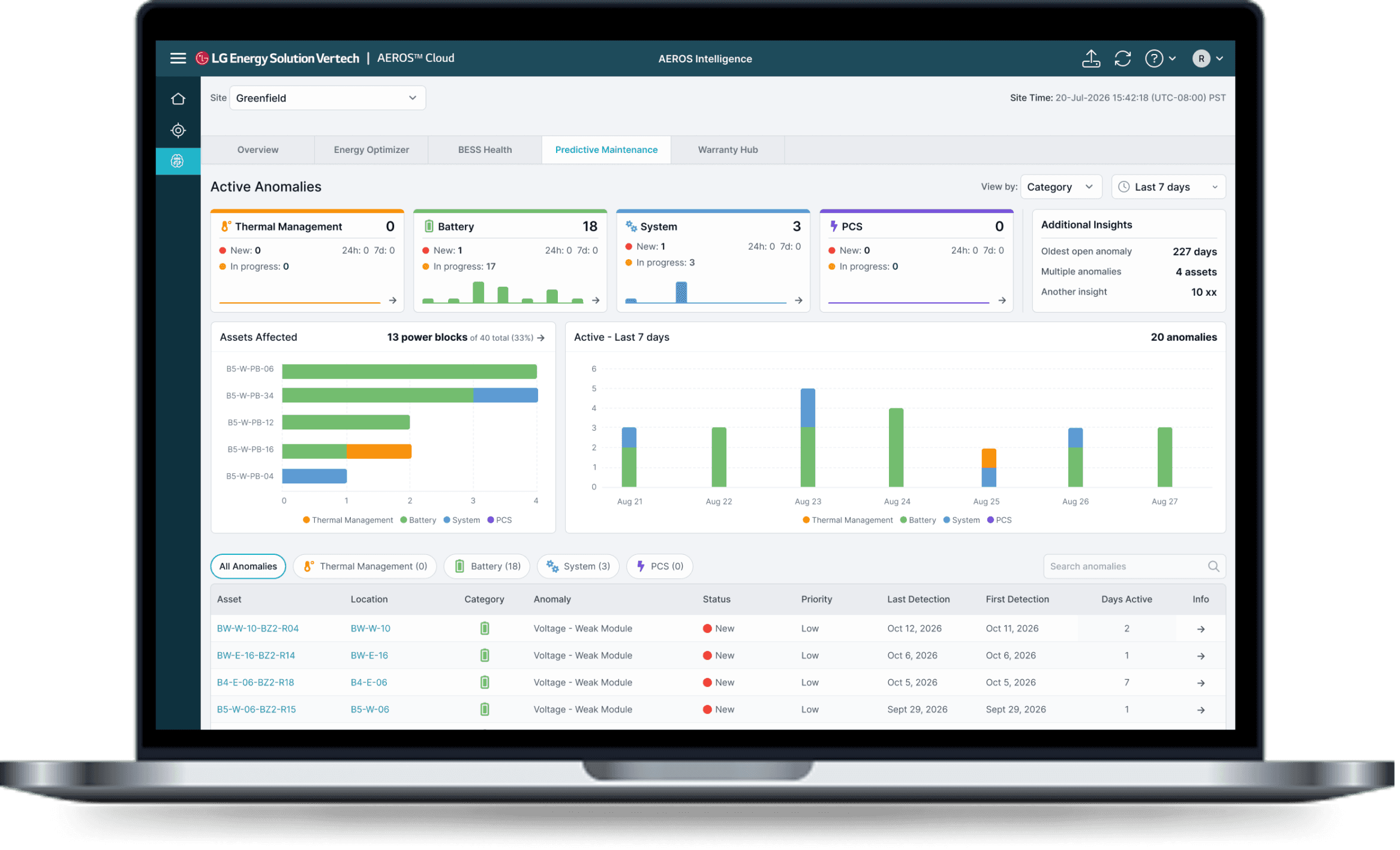
AEROS Intelligence, the analytics platform LG Energy Solution Vertech launched Nov. 12. Product screenshot with sample data, not a customer site.
Image: LG Energy Solution Vertech
Source · Product image from the LG Energy Solution Vertech website, used for news reporting.
LG Energy Solution's US storage arm, LG Energy Solution Vertech, launched AEROS Intelligence on Nov. 12, an analytics platform that it says cuts downtime on some corrective maintenance by up to 90%.
The company's PR Newswire release, datelined Westborough, Massachusetts, says AEROS Intelligence is the analytics layer of the AEROS software suite, alongside AEROS Onsite for real-time plant controls and AEROS Cloud for monitoring and reporting. It has four modules: BESS Health, Predictive Maintenance, Energy Optimizer and Warranty Hub. Vertech says the platform combines LG Energy Solution battery design data with more than 17 years of operating fleet data. Korean outlet TheElec, which dated LG Energy Solution's statement Nov. 13, reported the same figures.
Two numbers carry the claim, and both are vendor figures with no independent test. Vertech says the Energy Optimizer cuts state-of-charge prediction error by about 30% to 50% against its previous system. It also says BESS Health and Warranty Hub together can help owners defer battery augmentation, the later purchase of extra cells to restore capacity, by around 1.5 years. The release gives no fleet size, no MWh under management and no named customer.
Vertech's three headline claims for AEROS Intelligence. All are vendor figures; the company has not published test conditions.
Graphic: Voltgrid News
What the 90% figure covers
The wording differs between the two reports. The Vertech release limits the 90% to downtime on "some corrective maintenance actions". TheElec's summary says the platform can reduce maintenance time by up to 90%. The release is the primary document, so the narrower reading is the safer one, and Vertech has not said which actions qualify or what baseline it measured against.
Why it matters for cell supply
Deferring augmentation matters because augmentation is cell demand that arrives years after the first order. If an operator can hold warranty-compliant capacity for 1.5 years longer, that purchase moves later, which is a cost saving for the owner and a timing shift for the cell maker. Vertech does not quantify the saving beyond "millions in capital value", and this is Voltgrid's reading of the claim, not a figure from either report.
The launch also continues LG Energy Solution's move from cell supplier to full-system provider. TheElec reports that the company's North American ESS order backlog stood at about 160 GWh at the end of the third quarter, and that it plans to lift production capacity from more than 50 GWh at the end of this year to more than 70 GWh by the end of next year. As Voltgrid reported, most North American volume through 2028 is already committed. Software that keeps those systems within warranty terms protects the integrator's own contracts, which are sold through a single system-level agreement.
What is not confirmed yet
Vertech has not published the test conditions behind the 90%, the 30% to 50% error reduction or the 1.5-year deferral, nor a baseline system size. It has not said how many sites run AEROS Intelligence today or whether the figures come from field data or modelling. Watch for a named customer or a MWh count in the coming weeks, which would turn these claims into a measurable result.
Sources
- Published
- Sources
- 2 cited