Korea Battery Makers' Q3 Operating Profit KRW 1.08T, KRW 539.4B US Credit
LG Energy Solution, Samsung SDI and SK On posted a combined Q3 operating profit of KRW 1,083.3 billion; KRW 539.4 billion is US credit at two of them, and the total is after SK On's KRW 80.5 billion loss.
Hardware & Analysis DeskEdited by Ege Erten
8 min readAI-assisted
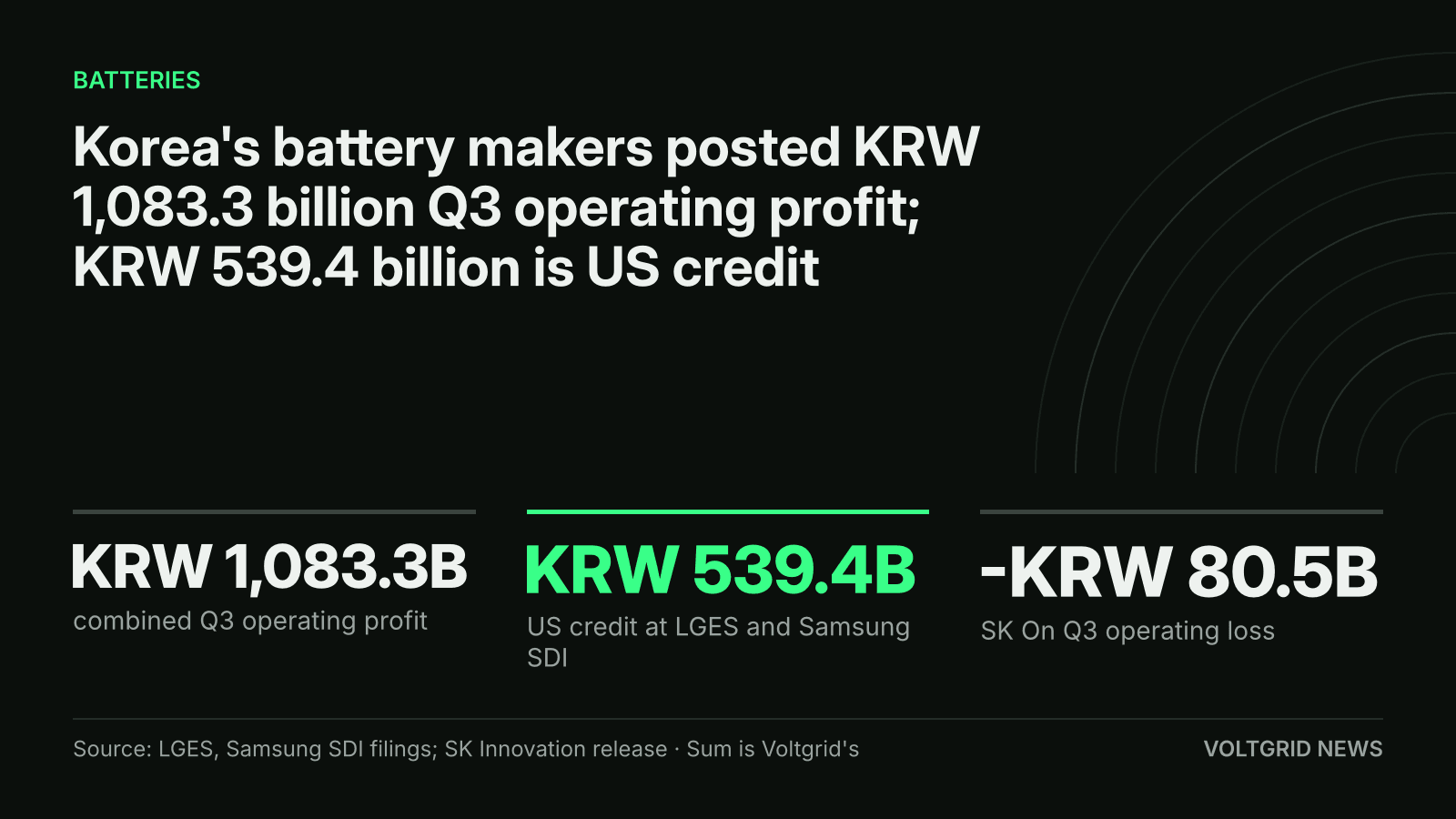
Two of the three makers disclose a US production credit: KRW 539.4 billion of Q3 operating profit.
Voltgrid News
Illustration (AI-generated)
LG Energy Solution, Samsung SDI and SK On posted a combined KRW 1.083 trillion of Q3 2026 operating profit, and the two that disclose US production credits booked KRW 539.4 billion of it.
Energy storage systems (ESS) are carrying LG Energy Solution (LGES) and Samsung SDI while electric-vehicle demand stalls, but nearly half of their combined profit is a US tax credit, and SK On still lost money. Lithium iron phosphate (LFP) supply and CATL and BYD decide how long that lasts.
Korea Battery Makers' Q3 Profit: About Half Is US Credit
LGES's results release, dated Nov. 2 and covered in Korea on Nov. 3, gives an operating profit of KRW 756 billion on revenue of KRW 9.6 trillion, a 7.8% margin. The release says revenue includes a North America production incentive of KRW 416.9 billion; its regulatory filing calls the incentive an estimate and says operating profit includes it too. Excluding the incentive, the filing gives operating profit of KRW 339.1 billion, a 3.7% margin on revenue of KRW 9.23 trillion. The credit therefore equals 55% of reported operating profit (416.9 divided by 756.0), a share we computed. Below the operating line LGES still lost money: its filing shows a pre-tax loss of KRW 231.2 billion and a net loss of KRW 296.9 billion. Management also said a one-time customer volume compensation payment in Q3 will not recur, Herald Business reported; no amount was given. That payment is inside Q3 profit, so the ex-credit figure overstates the underlying run rate. Our earlier LGES results story has the detail.
The credit is Section 45X of the US tax code, which pays battery makers for what they build in America: $35 per kilowatt-hour of cells and $10 per kilowatt-hour of modules. LGES and Samsung SDI count it in revenue and operating profit. Samsung SDI's filing names Section 45X alone; LGES's describes its figure as a North America production incentive under Section 45X and other programs, and gives no split.
Samsung SDI's operating profit was KRW 407.8 billion, its highest in 12 quarters, on revenue of KRW 4.69 trillion, the company said in its results release. Its regulatory filing says revenue and operating profit include KRW 122.5 billion of Section 45X credit, so excluding it operating profit was KRW 285.3 billion (407.8 minus 122.5). The credit is 30% of the total, so the swing from a KRW 591.3 billion loss a year earlier is real but smaller on that basis.
SK On's battery business, part of SK Innovation, posted an operating loss of KRW 80.5 billion on revenue of KRW 1.53 trillion, per SK Innovation's Oct. 29 release. The loss is KRW 44.3 billion narrower than a year earlier, DigitalToday reported, but the second quarter's KRW 821.8 billion profit included large one-time gains, according to Edaily, and SK Innovation's release cites their absence for the swing back to a loss. The release gives no credit figure, so SK On cannot be placed on the same footing. Our SK On story covers its ESS conversions.
US credit is KRW 416.9 billion of LGES's KRW 756.0 billion Q3 operating profit; SK On lost KRW 80.5 billion and discloses no credit. LGES's ex-credit figure is its own; Samsung SDI's is our subtraction.
Voltgrid News
Illustration (AI-generated)
The three results sum to KRW 1,083.3 billion (756.0 plus 407.8 minus 80.5), against a combined loss of KRW 114.8 billion a year earlier (LGES's profit of 601.3 minus Samsung SDI's loss of 591.3 and SK On's loss of 124.8). The two disclosed credits (416.9 plus 122.5) total KRW 539.4 billion. That is 49.8% of the three-company sum, a floor, since SK On's loss is already in the denominator and any SK On credit would raise it. For the two companies that disclose, it is 46.3% of their combined KRW 1,163.8 billion (539.4 divided by 1,163.8).
Energy Storage Order Books: LGES Cites 160 GWh
LGES said on its Nov. 3 call that its ESS order backlog was 160 GWh at the end of September, Herald Business reported. Its Q3 2025 release put it at about 120 GWh, so it grew 33% in a year. LGES said North American ESS volume through 2028 is largely committed on planned capacity and that expected demand exceeds supply, so new talks target later years, per SBS News. The release targets over 70 GWh of North American ESS capacity by the end of 2027; on the call LGES put the end-2026 base at more than 50 GWh, Herald Business and SBS News reported.
For Q4, LGES guides ESS shipments up about 40% from Q3 and revenue up about 10%, with narrower margins.
Samsung SDI says in its release that it secured more than 60 GWh of ESS orders in 2026 alone in its US business. Those are 2026 orders, not a backlog, so they do not compare with LGES's 160 GWh. It plans long-term grid-scale ESS and uninterruptible power supply contracts by the end of 2026; its orders include a 1 GWh deal with Alpha Omega Power.
The one ESS contract named in SK Innovation's Q3 release is about 9 GWh of LFP pouch cells for NeoVolta, supplied over five years from 2027, DigitalToday reported. SK On's first US storage order, announced in September 2025, was 1 GWh for Flatiron Energy Development with a right of first offer on a further 6.2 GWh through 2030, per the Korea Times. SK On estimates 2026 North American ESS demand at 80 to 100 GWh, DigitalToday reported, and is converting 3 GWh of capacity at its Seosan plant to LFP storage lines, per the Korea Herald.
LGES reports a 160 GWh ESS backlog; Samsung SDI's over 60 GWh are 2026 US orders and SK On's 9 GWh is one contract, so the bars are not like for like.
Voltgrid News
Illustration (AI-generated)
Korea's LFP Supply Chain: Contracted, but a 2027 Story
The credit now carries a condition. Under the law that governs it, at least 60% of the direct material cost of battery components sold in 2026 must come from non-prohibited-foreign-entity (non-PFE) sources, rising to 65% in 2027, 70% in 2028, 80% in 2029 and 85% after 2029. The Korea Herald, citing the International Energy Agency, says China makes over 98% of the world's LFP cathode and cells. For the LFP storage cells driving the growth, staying eligible means buying cathode outside China, where very little is made today.
The Korean answer is a run of contracts. L&F signed KRW 1.035 trillion of LFP cathode for LGES for 2028 to 2031, Seoul Economic Daily reported, after deals with Samsung SDI (about KRW 1.6 trillion, from 2027) and SK On (about KRW 160 billion). POSCO Future M has about KRW 6 trillion with Samsung SDI for 2027 to 2032 and about KRW 1.1 trillion with SK On for 2027 to 2029, per the Korea Herald. Together those five priced contracts come to about KRW 9.9 trillion (1.035 plus 1.6 plus 0.16 plus 6.0 plus 1.1). POSCO Future M's 720,000-ton memorandum with LGES for 2027 to 2033 covers cathode and anode materials together, LFP among them, with no split given; it is not priced and is not yet a contract, and a formal one is targeted within the year.
Five priced LFP cathode contracts total about KRW 9.9 trillion; LGES's 160 GWh backlog is reported from its call.
Voltgrid News
Illustration (AI-generated)
Capacity is the constraint. L&F's LFP agreements total 250,000 tons, equivalent to about 100 GWh of storage cells, the Korea Times reported on Nov. 9; L&F plans 120,000 tons a year of capacity by the second half of 2028. POSCO Future M is building a dedicated plant through a joint venture with Chinese precursor maker CNGR, with production targeted for 2027 and eventual capacity of up to 50,000 tons a year. Neither company has said whether that tie affects non-PFE status. Samsung SDI is converting a third US LFP line at StarPlus Energy.
CATL and BYD Competition and the Skipped Tender
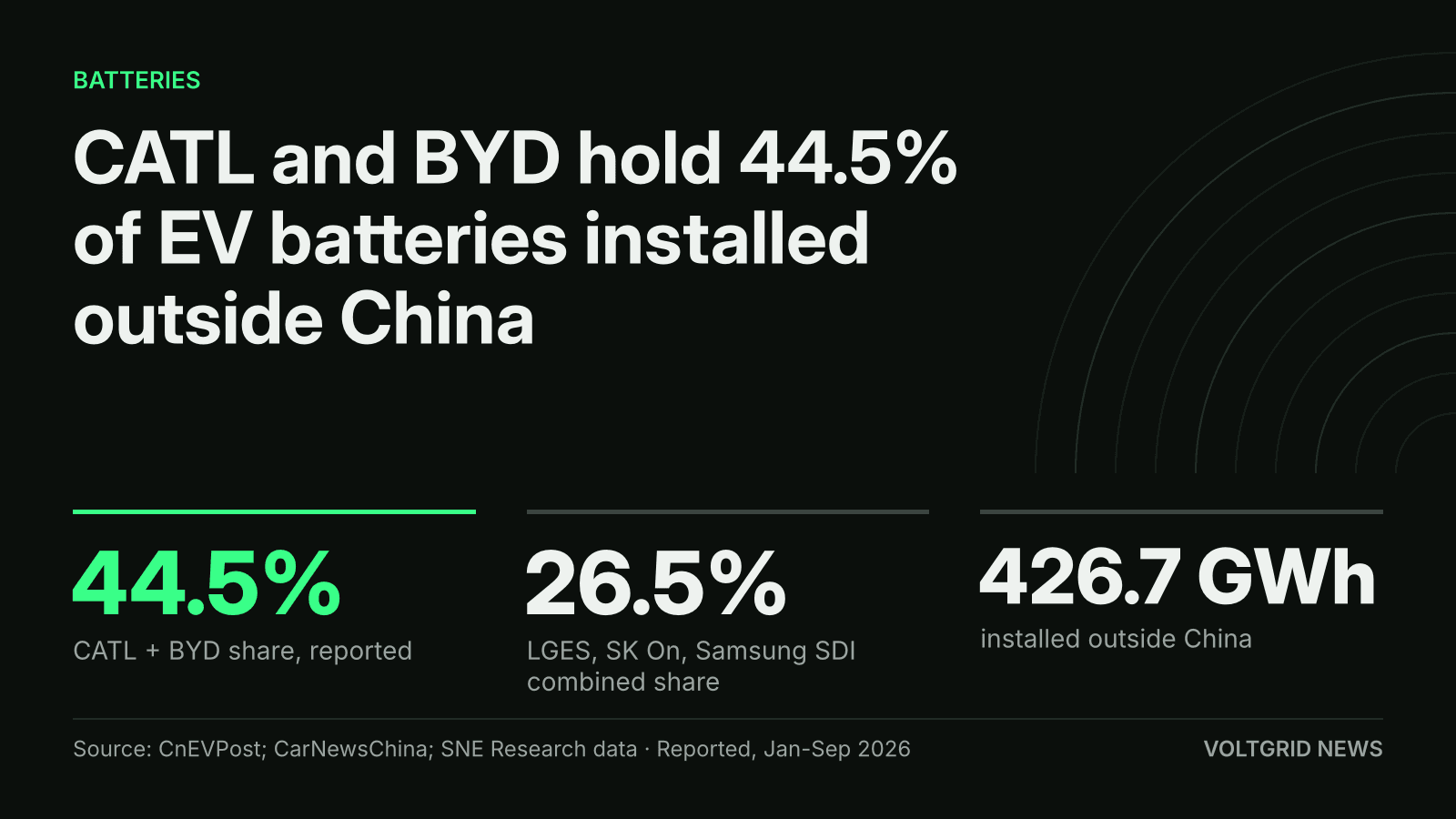
CATL and BYD installed 189.6 GWh of the 426.7 GWh of EV batteries fitted outside China from January to September, a combined share SNE Research puts at 44.5% (33.7% plus 10.8%), CnEVPost reported. LGES, SK On and Samsung SDI fell to 26.5% from 38.2%, and their North American volume roughly halved to 28.1 GWh from 56.1 GWh. Our installs report has the company split.
Storage is a different measure. SNE Research data carried by CnEVPost put global ESS shipments at 461.3 GWh in the first half, led by CATL at 125.0 GWh (27.1%), then EVE Energy at 48.0 GWh, Hithium at 46.2 GWh and BYD at 35.7 GWh (7.7%). LGES shipped 12.0 GWh, up 357%, and Samsung SDI 6.4 GWh, a combined 18.4 GWh and 4.0% share. China took 202.5 GWh (43.9%) and North America 75.9 GWh (16.5%).
LGES said on Nov. 5 it did not bid in Korea's third ESS central contract tender, 1,180 MW, or 7,080 MWh according to Asia Business Daily, choosing not to chase volume on price, Seoul Economic Daily reported. Bid prices fell from the 30-won range per kWh in the first round to the 20-won range in the second, per the Korea Herald. Our tender story has the details. That leaves Samsung SDI, which won 75.8% of round one, and SK On, which won 50.3% of round two, per the Korea Herald.
What it means: for engineers and buyers, LGES says its North American ESS volume is largely committed through 2028, so new projects face allocation, not just price. For investors, the credit is 55% of LGES's operating profit and 30% of Samsung SDI's, both computed from their filings, SK On's release gives none, and the non-PFE threshold rises every year to 2030. The risk, Kim Pil-soo, an automotive engineering professor at Daelim University, told the Korea Herald, is that Chinese LFP keeps its cost and scale lead and the opening closes if Korean firms do not cut costs.
What to Watch, and What Is Not Confirmed
The Korea Power Exchange is expected to name preferred bidders for the third tender in November, Seoul Economic Daily reported; documents were due Nov. 11, per MoneyToday, and no result was out by Nov. 12. By the end of 2026, LGES targets over 50 GWh of North American ESS capacity, POSCO Future M and LGES aim to sign the formal supply contract, and Samsung SDI aims to finalize long-term grid-scale ESS and uninterruptible power supply contracts. LGES's Q4 results will test its guide of a rise of about 40% in ESS shipments from Q3 with narrower margins; LGES has not announced the date. POSCO Future M's LFP supply to LGES is due to start in early 2027 under the memorandum, which is not yet a contract. SK On's NeoVolta cells begin in 2027, the first large volume (about 9 GWh against Flatiron's 1 GWh) that would show whether its ESS pivot can turn a loss into a profit.
Not confirmed: LGES's 160 GWh backlog rests on Herald Business's report of the call, not on the release. SK On's release gives no credit figure, backlog or EV-versus-ESS split. LGES's and Samsung SDI's results are preliminary and unaudited, and LGES calls its incentive an estimate.
Sources
- 01Global ESS Shipments Reach 461GWh in 1H26, Up 71%SNE Research · sneresearch.com
- 02LG Energy Solution Q3 2025 results releaseLG Energy Solution · inside.lgensol.com
- 0326 U.S.C. 7701 (prohibited foreign entity thresholds)Cornell Legal Information Institute · law.cornell.edu
- 04Samsung SDI Q3 2026 results filingDART (Korea FSS) · dart.fss.or.kr
- 05LG Energy Solution Q3 2026 results filing (amended)DART (Korea FSS) · dart.fss.or.kr
- 06Samsung SDI Q3 2026 results releaseSamsung SDI · news.samsungsdi.com