QuantumScape Osprey Cell Claims 1,000 Cycles to ~80% at 1 atm
QuantumScape says its Osprey all-solid-state cells kept about 80% capacity after 1,000 full cycles at one atmosphere. The data come from small lab cells, and no Osprey timeline exists.
Energy & Cooling DeskEdited by Ege Erten
2 min readAI-assisted
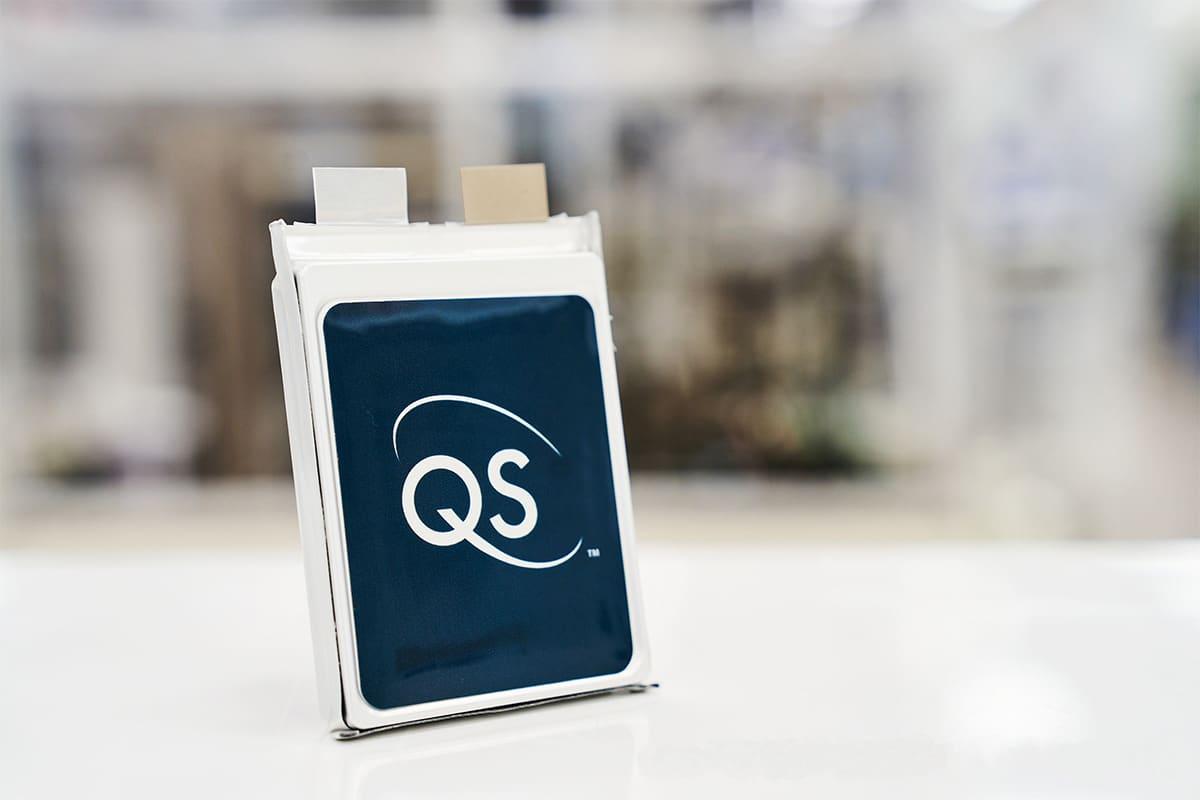
A QuantumScape 24-layer prototype cell from an earlier company photo; it is not an Osprey cell (QuantumScape).
Image: QuantumScape
Source · Press image from the QuantumScape newsroom, used for news reporting.
QuantumScape said on Nov. 11 that its new Osprey all-solid-state cells completed 1,000 full charge cycles with about 80% capacity retention at one atmosphere (1 atm) of stack pressure.
The company announced Osprey in a GlobeNewswire release as an open platform that pairs its ceramic separator and anode-free lithium-metal design with a solid sulfide cathode. These are QuantumScape's own figures from early testing, not independent measurements. The release also cites a five-minute charge from 10% to 80%, operation below -20 °C (-4 °F) and projected energy density of up to about 1,100 Wh/L.
Electrek, which read the accompanying white paper, reports that the 1,000-cycle result came from a 2-layer cell with a 50 x 65 mm cathode, cycled at 1C charge and 1C discharge from 0 to 100% state of charge at 30 °C. Cathode loading was 5.5 mAh/cm². Electrek estimates such a cell at roughly 0.3 to 0.4 Ah, against about 5 Ah for QuantumScape's QSE-5 sample cell.
Why one atmosphere matters for packs
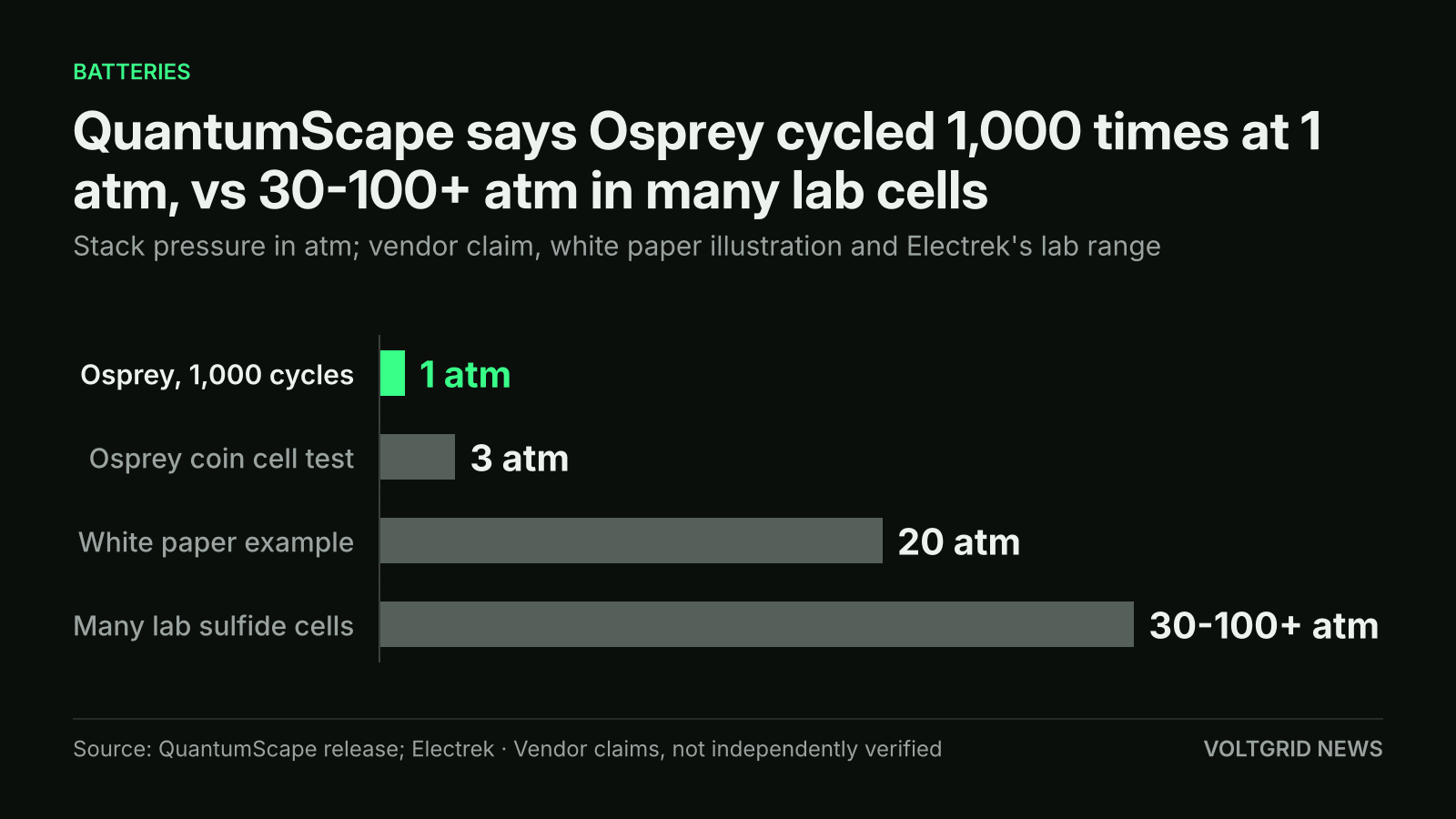
QuantumScape says Osprey reached 1,000 cycles at 1 atm; many lab sulfide cells run at 30-100+ atm (vendor claim, per Electrek).
Illustration (AI-generated)
Sulfide all-solid-state cells usually need heavy clamping to keep their layers in contact. Electrek notes that many lab sulfide cells run at 30 to 100+ atm, and that the white paper says 20 atm on a single 10 x 24.2 cm cell equals about 5,000 kg of force. Holding that across a pack takes steel end plates and tie rods, which add weight, volume and cost. A cell that cycles at 1 atm would remove much of that hardware. That is why the pressure figure, not the headline cycle count alone, is what automakers will test.
What the white paper conditions change
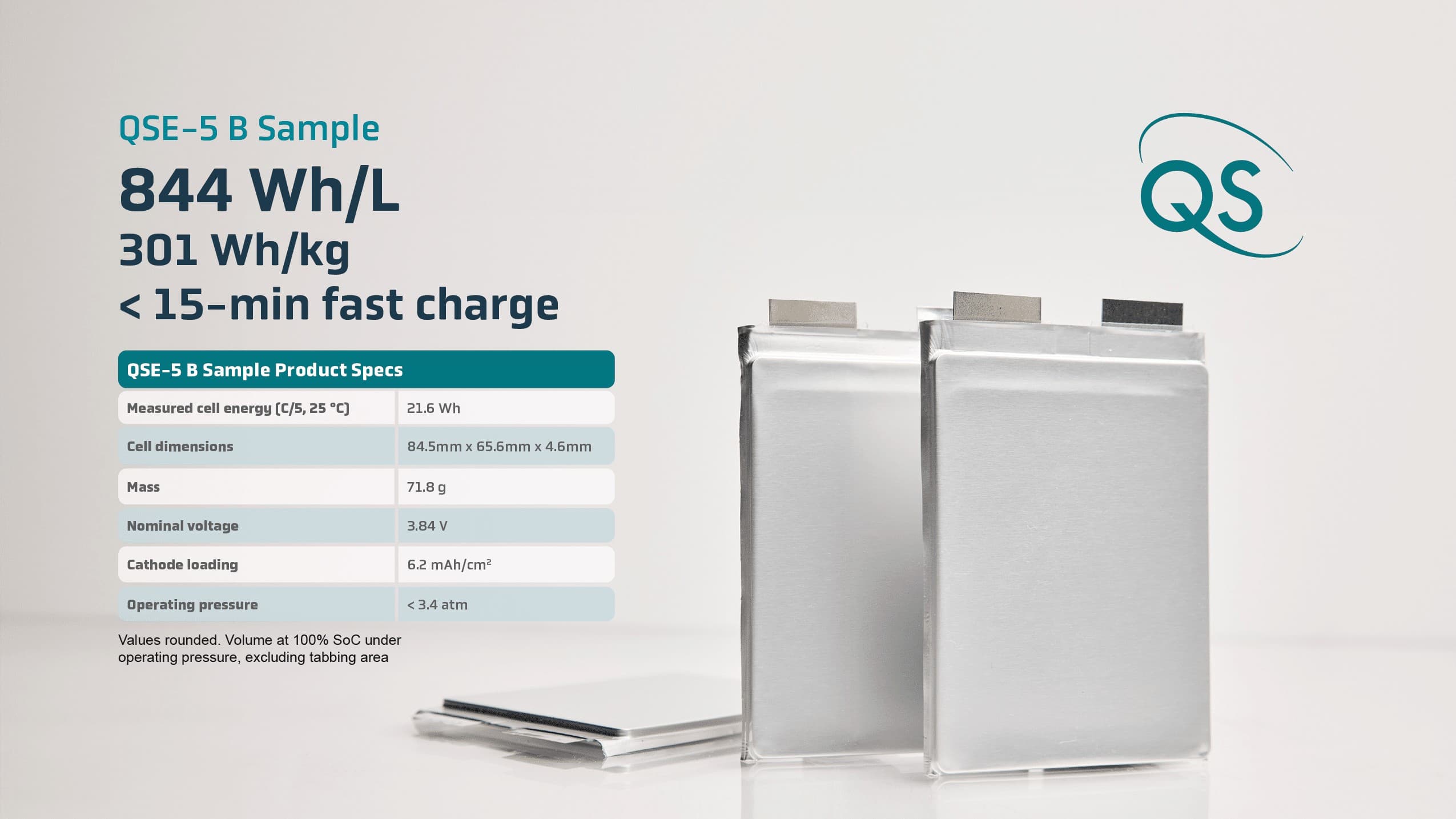
Electrek says the release oversells some numbers. The five-minute charge was run at 10C in a 2-layer cell at 80 °C, and no room-temperature fast-charge result was published. The -20 °C result came from a single-layer cell with a 21 x 21 mm cathode discharged at C/3, which kept 68% of its room-temperature capacity. The ~1,100 Wh/L figure is a projection; the supporting test used an 11 mm coin-size cell at 3 atm for 100 cycles. For comparison, Electrek lists QSE-5 at 844 Wh/L and 301 Wh/kg.
Business model and the sulfide race
QuantumScape says Osprey opens licensing and co-development options for current customers and for developers of sulfide-based cells, and that it has tested the platform with all-solid cathodes made by its automotive customers. Cells on its current QSE platform, which Electrek describes as using a liquid catholyte, are shipping to customers now; Electrek reports a 100 MWh line targeting 2028 production for QSE-5.
Rivals are on earlier clocks. Electrek lists Samsung SDI targeting sulfide mass production in the second half of 2027, BYD planning small-batch output in 2027 and Toyota aiming for 2027 to 2028. CATL also targets small-scale sulfide output in 2027, as Voltgrid reported from its investor reply, with large-scale manufacturing around 2030.
What is not confirmed yet
No outside lab has verified the Osprey data. The white paper says the process has been shown at laboratory scale, and Electrek reports that it describes higher-throughput processes as still in development. QuantumScape has given no timeline for Osprey, and no licensee has been named. The release itself lists, as a risk, whether early-test results can be replicated in commercial cell formats or at scale. Electrek also points out that 80% after 1,000 cycles sits below the 95% that PowerCo confirmed for early QSE cells in 2024, though the chemistry and stage differ.