CATL Sulfide All-Solid-State Cells Reach 20 Ah Samples, Target 500 Wh/kg
CATL told investors its sulfide all-solid-state cells reached 20 Ah samples, with a target of about 500 Wh/kg. Small-batch output stays set for 2027 and mass production for about 2030.
2 min readAI-assisted
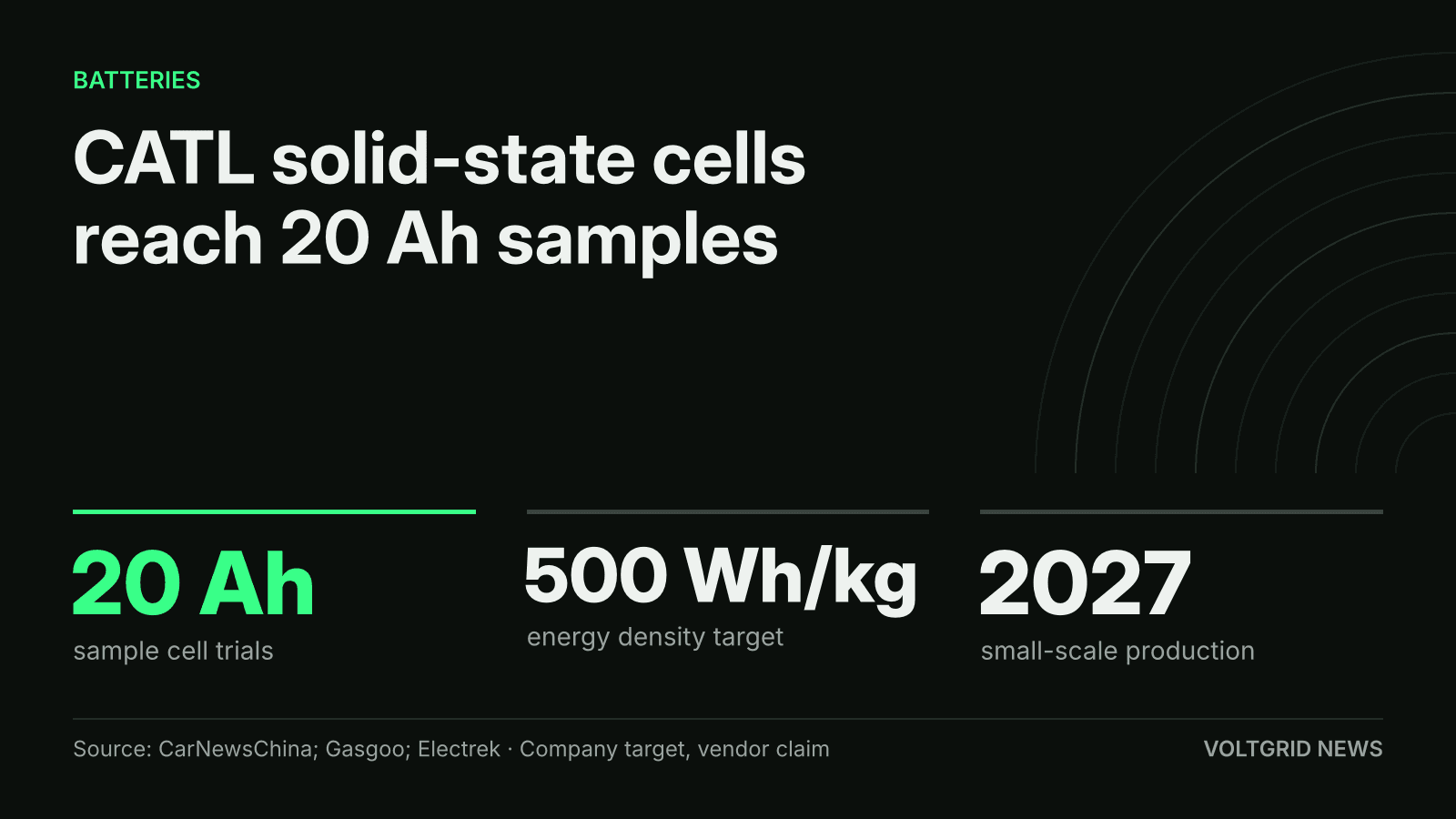
CATL's 500 Wh/kg figure is a target, not a confirmed production-cell specification, according to CarNewsChina.
Illustration (AI-generated)
CATL said on Oct. 27 that its sulfide all-solid-state cells have moved from a 10 Ah-class validation platform to 20 Ah sample trials, with an energy-density target of about 500 Wh/kg, according to CarNewsChina and Gasgoo.
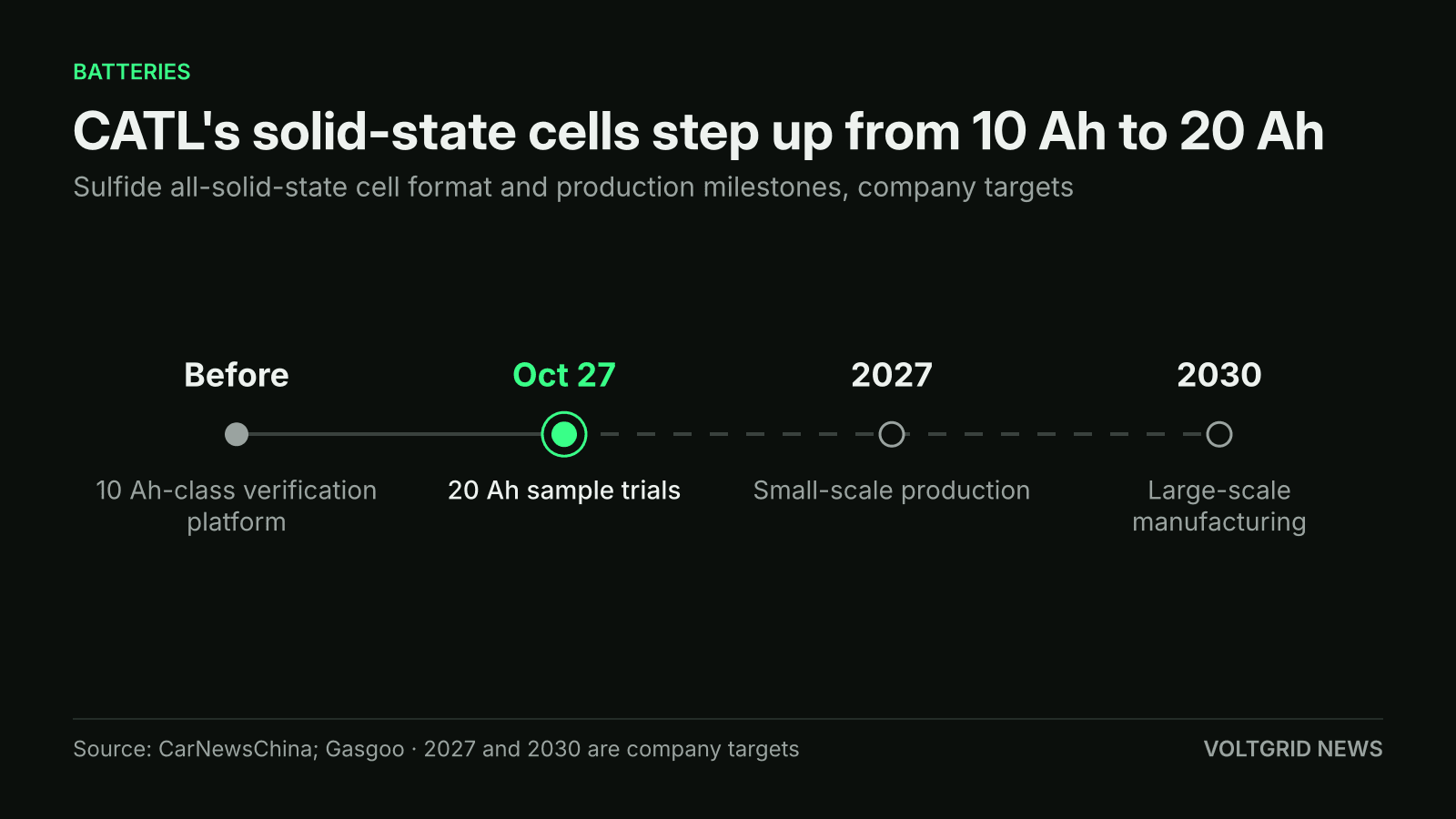
CATL's 2027 and 2030 dates are company targets, according to CarNewsChina and Gasgoo.
Illustration (AI-generated)
The company gave the update in reply to investors on the Shenzhen Stock Exchange's interactive platform. It repeated that small-scale production is planned for 2027, with large-scale manufacturing around 2030. Gasgoo tied the reply to CATL's Hefei sulfide solid-state pilot base, and said the solid-state R&D team now exceeds 1,000 people.
Electrek described the cells as having entered 20 Ah trial production. CarNewsChina, by contrast, says CATL has not disclosed expected trial output, customers or a vehicle launch date, so the wording of the company's own reply is the safer guide. The timeline was already covered in Voltgrid's report on CATL's 2027 target; the cell size and density target are the new detail.
What 20 Ah and 500 Wh/kg do and do not show
A 20 Ah sample is a step up from a 10 Ah-class platform, but it is a lab-scale format, not a production cell. The 500 Wh/kg figure is a programme target. CarNewsChina notes that CATL has not confirmed it as a production-cell specification, and the reports read do not say at which level, cell or pack, it is measured. That matters because pack figures run lower than cell figures.
CarNewsChina also notes that such a density can involve lithium-metal or anode-less designs, and that CATL has not said which anode the 20 Ah cells use. Sulfide electrolytes conduct lithium ions well, but keeping stable contact between solid layers as electrodes swell and shrink remains a hurdle, and sulfides must be shielded from moisture because they can release toxic hydrogen sulfide.
Gasgoo put CATL's 2025 R&D spending at 22.147 billion yuan, up 19.02% from a year earlier. Chairman Robin Zeng said at the Summer Davos forum in June that all-solid-state technology sits at level 4 on a 1-to-9 readiness scale.
How rivals compare
CarNewsChina lists Toyota and Idemitsu aiming to commercialise sulfide-based cells for battery-electric vehicles between 2027 and 2028, and Samsung SDI targeting mass production in the second half of 2027. Those milestones are not like for like: CATL's 2027 date is for small batches, while Samsung SDI's is for mass production. Voltgrid has also covered QuantumScape's plan for a 100 MWh solid-state cell line, with production targeted for 2028.
For storage buyers, nothing in the update points to a stationary or data-center product. Grid-scale and backup systems being ordered now rely on today's lithium-ion chemistries.
What is not confirmed yet
CATL has not published trial output, a customer, an anode design or the level at which 500 Wh/kg is measured. Cycle life, charge rate and manufacturing yield for the 20 Ah cells are also undisclosed, and those figures will decide whether the 2027 small-batch date holds.