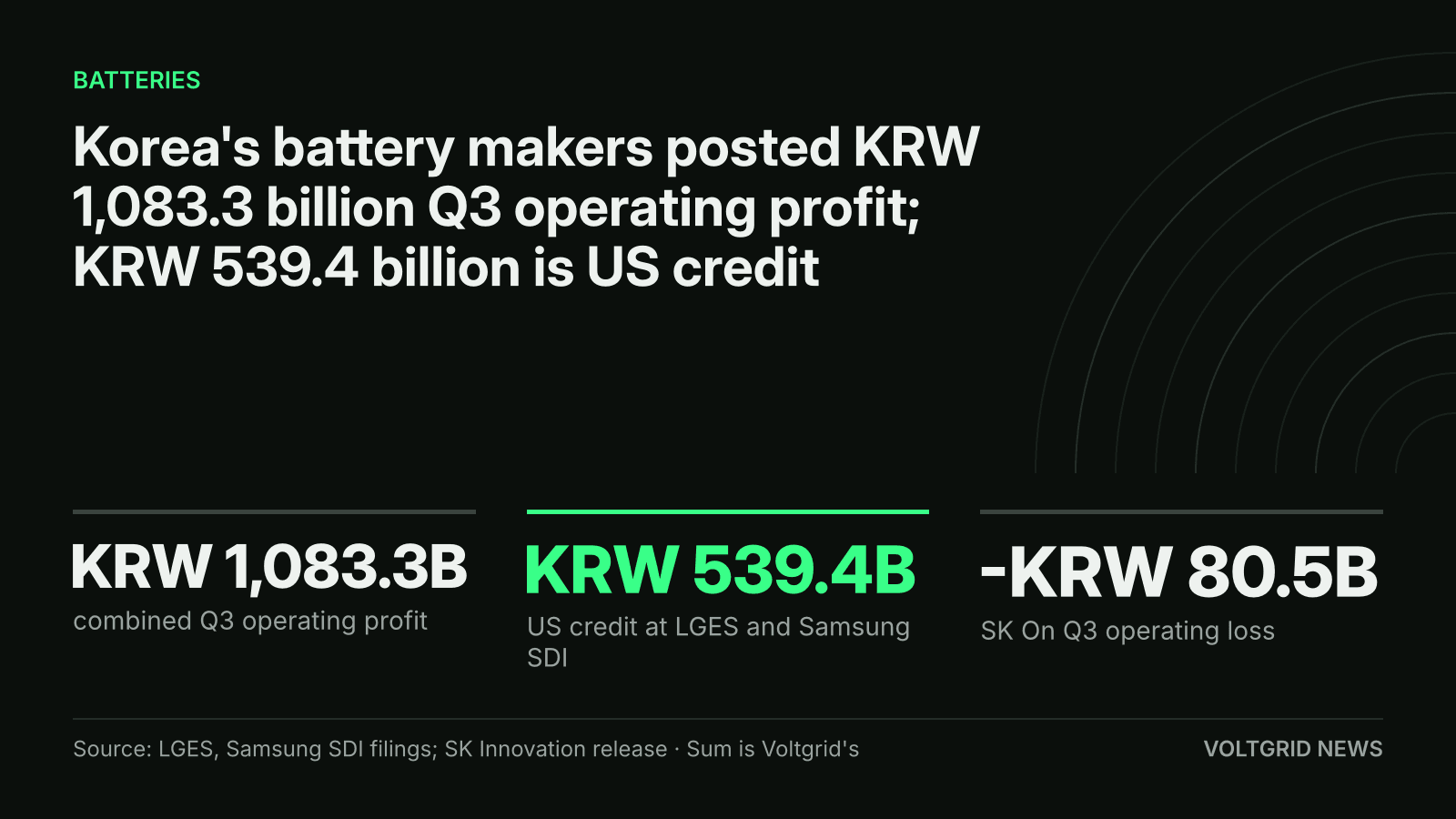
AI Grid Batteries: LGES 160 GWh Backlog, 782 MWh Tied to Data Centers
LG Energy Solution reports a 160 GWh ESS backlog and Samsung SDI more than 60 GWh of 2026 orders, yet three batteries tied to data centers with disclosed sizes total 782 MWh, 600 MWh of it running.
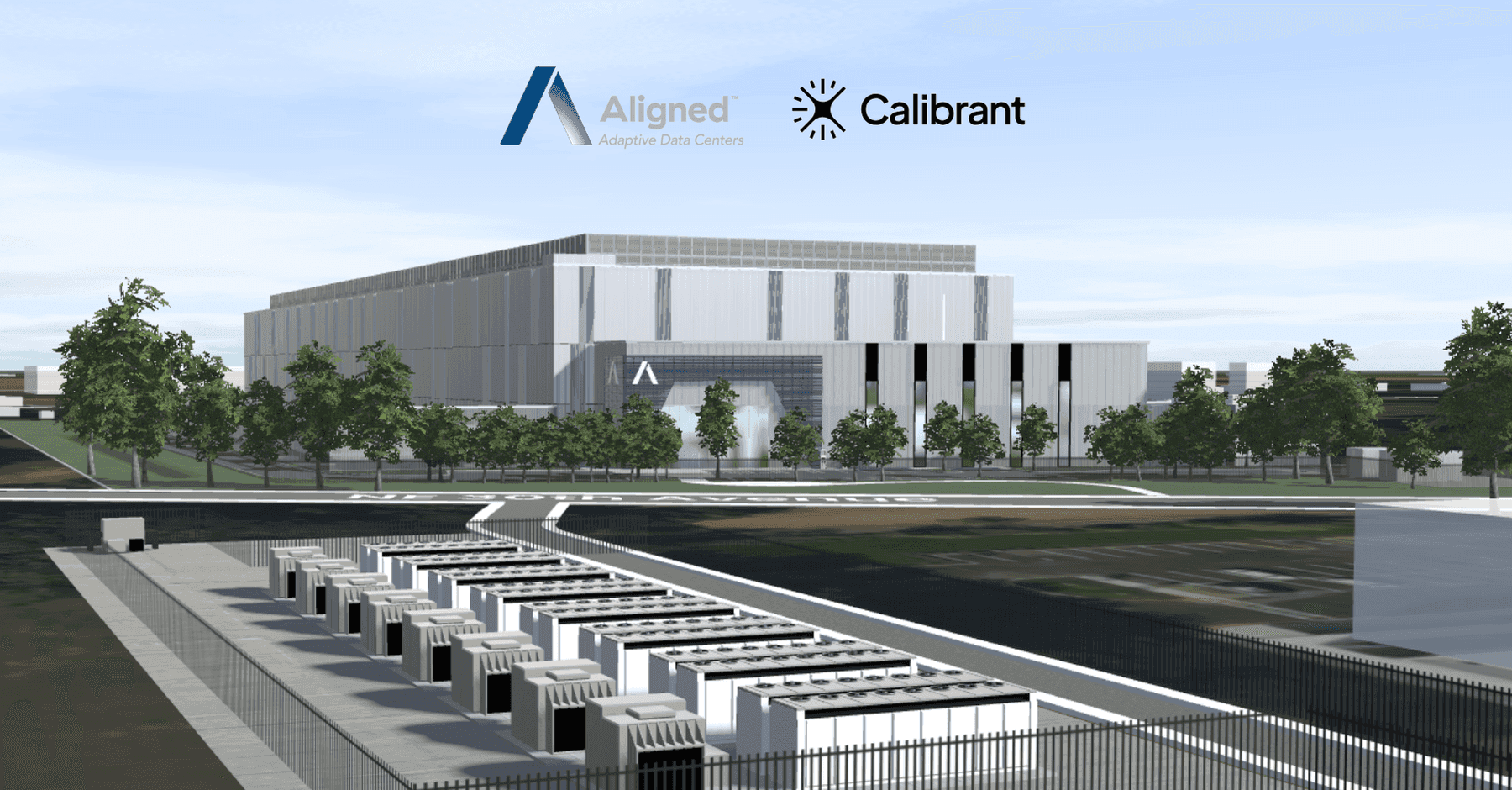
A rendering of the 31 MW / 62 MWh battery Aligned and Calibrant planned for an Aligned campus in the Pacific Northwest.
Image: Calibrant Energy / Aligned Data Centers
Source · Press image from the Calibrant Energy newsroom, used for news reporting.
Battery makers report ESS order books in tens of gigawatt-hours; batteries tied to data centers with a named customer add up to far less. LG Energy Solution (LGES) said on Nov. 3 that its energy storage system (ESS) backlog was about 160 GWh at the end of the third quarter, and Samsung SDI said on Oct. 29 that it had won more than 60 GWh of ESS orders this year. Three batteries tied to data centers with disclosed sizes total 782 MWh on Voltgrid's arithmetic, and the largest is a grid battery contracted to a utility, not a plant on a campus. The gap is partly one of disclosure: Samsung SDI's orders centre on the US utility market, iNews24 reported, LGES has not split its backlog by customer, and buyers are rarely named.
Backlogs first, and what the units mean
A battery has two sizes. Its power rating, in megawatts (MW), says how fast it can push electricity into the grid. Its energy rating, in megawatt-hours (MWh), says how much it holds. Divide the second by the first and you get how long it can run flat out: 600 MWh at 150 MW is four hours. A maker's backlog is something else again. It counts orders signed but not yet delivered, in gigawatt-hours (1 GWh is 1,000 MWh) or in dollars, and it says nothing about where or when those batteries will be switched on.
LGES gave the backlog on its earnings call, in a transcript published by TheElec. The company said most of the volume it can make through 2028, on currently planned capacity, is already committed. It named three groups in its talks for later years: utilities, AI data center operators buying through them, and hyperscalers that want to buy systems directly for behind-the-meter use, on their own side of the grid connection. It also said it had signed its first direct supply agreement with a major technology company, without naming the customer or size, as Voltgrid reported.
Samsung SDI's figure is a different measure. Its Oct. 29 earnings release says it secured more than 60 GWh of ESS orders this year in its US ESS business, and credits ESS and battery backup units for AI data centers for lifting its battery unit. That is orders won in 2026, not a backlog at a date, so it cannot be added to LGES's 160 GWh, and Samsung SDI has not said how much of it is for data centers. Voltgrid's report has the call detail.
Fluence reports its backlog in dollars and gigawatts, not GWh: about $6.4 billion as of June 30, a company record, and 12.6 GW contracted, with a pipeline of 45.6 GW / 163.7 GWh, its Aug. 5 results show. It also reported about $850 million of data center business through July, including about $550 million of hyperscaler awards. On Sept. 16 Fluence cut its fiscal 2026 revenue guidance to about $2.4 billion from a prior midpoint of about $3.0 billion, and guided to an adjusted EBITDA loss of about $200 million, blaming delays at its Houston contract-manufacturing plant. Its finance chief said the key priority is "converting our backlog into revenue and cash." Tesla's Oct. 22 filing shows 36.0 GWh of storage deployed in the first nine months of 2026; its shareholder letter, as Electrek read it, cites a backlog it did not quantify.
Batteries tied to data centers: 782 MWh named, 181 MW rated
The largest is Faraday in Utah County. Lydian Energy said on Nov. 10 that its 150 MW / 600 MWh, four-hour lithium-iron-phosphate battery began operating on Sept. 18. It sits next to the 525 MW Faraday solar plant and shares its substation, and it delivers 600 MWh of contracted storage capacity to the utility PacifiCorp under a Schedule 34 contract "in support of" Meta's Eagle Mountain data center operations. It is a grid battery tied to a data center by contract, not one on the campus, and the release does not say Meta owns or runs it. Lydian's February financing release described the same phase as 150 MW / 733 MWh, a difference Lydian has not explained, as Voltgrid reported. A second phase of up to 375 MW / 1,500 MWh would be 2.5 times the first.
In the Pacific Northwest, Aligned Data Centers and Calibrant Energy said in October 2025 that a 31 MW / 62 MWh battery would be operational in 2026 at an Aligned campus, to bring the data center online sooner. We found no later confirmation that it is running. In PJM, the grid operator for much of the Mid-Atlantic, Calibrant said on Nov. 10 that it had closed a $145 million debt facility that includes a 120 MWh system for a hyperscale data center, with site mobilization under way; no MW rating, site or customer was given, as Voltgrid reported. Calibrant's wider portfolio is more than 5.9 GWh in operation, in construction or under exclusive development agreements.
Adding the three: 600 MWh at Faraday, 62 MWh at Aligned and 120 MWh in PJM is 782 MWh. Only Faraday and Aligned give both ratings, so 181 MW (150 plus 31) is the power that can be counted. Faraday alone is 77% of the energy (600 divided by 782), and it is the only one confirmed running. Against LGES's 160 GWh backlog, the 782 MWh is under 0.5% (782 divided by 160,000). The comparison is loose, since a backlog is unbuilt orders and these are plants, but it shows how little of the order book is visible in named data center deals.
Three batteries tied to data centers total 782 MWh; Faraday, contracted to PacifiCorp in support of Meta, is the only one running.
Chart: Voltgrid News
Illustration (AI-generated)
Subsidies, tenders and tariffs
India's cabinet approved on Nov. 4 a Rs 14,500 crore viability gap funding (VGF) scheme for 92 GWh of grid-scale storage yet to be commissioned, according to the government's release: 60 GWh of pumped hydro, 30 GWh of batteries and 2 GWh of other technologies, with Rs 97,600 crore of estimated investment. The release says the 92 GWh equals 170% of India's present-day grid-scale storage, against a need of 411 GWh by 2031-32. VGF covers about 14.9% of the investment (14,500 divided by 97,600), and batteries are 32.6% of the energy target (30 divided by 92). LGES's 160 GWh backlog is 5.3 times India's 30 GWh battery target, on different bases: unbuilt orders against a subsidy target. Battery projects need at least 40% domestic content, and no bidding dates are public. Voltgrid's earlier report covers the scheme.
LG Energy Solution's 160 GWh backlog dwarfs India's 30 GWh battery target and Korea's 7.08 GWh tender; the bases differ.
Chart: Voltgrid News
Illustration (AI-generated)
South Korea's third ESS central contract market is 1,180 MW, which at the six-hour duration the tender sets equals 7,080 MWh (7.08 GWh), with winners to finish building by February 2029. It is larger than the first two rounds combined, though outlets differ on their size: 1,128 MW awarded (563 plus 565) according to Money Today, or 1,080 MW tendered (540 each) according to Asia Economy. Asia Economy put the shares of those two rounds at 56% for Samsung SDI, 25% for SK On and 19% for LGES. LGES said on Nov. 5 that it did not bid in the third, as Voltgrid reported. Alongside an 18-item battery deregulation package, the government will pursue "in stages" an exemption for ESS from grid-usage fees, Kyeonggi Ilbo reported; no fee level or start date has been given, as Voltgrid reported.
In the US the subsidy is partly a tariff story. Under the US Trade Representative's final Section 301 notice of September 2024, the tariff on Chinese non-EV lithium-ion batteries rose from 7.5% to 25% for goods entered from Jan. 1, 2026; we found no later change. Tesla's 10-Q, filed Oct. 22, shows the other direction: after the Supreme Court invalidated certain IEEPA tariffs in February, Tesla recorded $526 million of IEEPA tariff refunds it is due as a cut to energy cost of revenues, and $339 million it owes to certain storage customers as a cut to energy revenue. The $339 million is 63% of the $534 million fall in energy revenue (339 divided by 534).
What it means for data center builders and investors
For a data center developer, the useful reading is allocation. LGES says demand exceeds what it can supply and it will rank projects by strategic importance, and Samsung SDI's ESS chief Cho Yong-hwi said on the Oct. 29 call, iNews24 reported, that orders already secured fill its StarPlus Energy plant in the US and its Ulsan lines through 2028. Cells for a campus battery ordered now compete with utility orders already on the books. LGES also says the share of prohibited-foreign-entity material allowed for US production credits falls from 40% this year to 35% or less next year, which favours makers with US plants. For investors, the test is turning backlog into revenue. Fluence held a record $6.4 billion backlog at June 30 and still cut its revenue guidance by about $0.6 billion (from a $3.0 billion midpoint to $2.4 billion) on factory delays. Tesla's energy generation and storage revenue fell 16%, mainly on tariff refunds and a lower Megapack selling price, as our Tesla report covered.
What to watch
The Korea Power Exchange is due to name preferred bidders for the third tender this month, according to Asia Economy; none had been named in what we found as of Nov. 13. Fluence has not dated its fiscal fourth-quarter report, the first to show whether the Houston delays are easing. LGES guided to fourth-quarter ESS shipments about 40% above the third quarter. The Aligned and Calibrant battery is due in 2026. Lydian is developing Faraday BESS 2 with a fourth-quarter 2028 target; no financing or offtake contract for it has been announced. Korea's third-round winners must finish building by February 2029, and India has not published bidding dates.
Sources
- 01Fluence Energy announces revised guidance for fiscal year 2026Fluence Energymfn.se
- 02Tesla Form 10-Q for the quarter ended Sept. 30, 2026SEC / Teslasec.gov
- 03Lydian Energy Brings 150 MW Faraday Battery Storage Project Online in Utah (Business Wire)Lydian Energy via Business Wirefinance.yahoo.com
- 04Fact Sheet: President Biden Takes Action to Protect American Workers and Businesses from China's Unfair Trade PracticesThe White Housebidenwhitehouse.archives.gov
- 05Fluence Energy, Inc. reports third quarter fiscal 2026 results (Form 8-K exhibit)Fluence Energy / SECsec.gov
- 06Aligned and Calibrant to Deploy First-of-its-Kind On-Site Battery Storage ProjectCalibrant Energy / Aligned Data Centerscalibrantenergy.com
- Editor
- Ege Erten
- Published
- Sources
- 6 cited
- Standards
- AI-assisted