CATL Tener Sodium: 30+ MWh Block, 7.5 MW, Overseas Summer 2027
CATL's Tener Sodium four-hour block lists 95% round-trip efficiency and 9.2% lower EPC costs than LFP, ESS News reports, with overseas delivery due summer 2027.
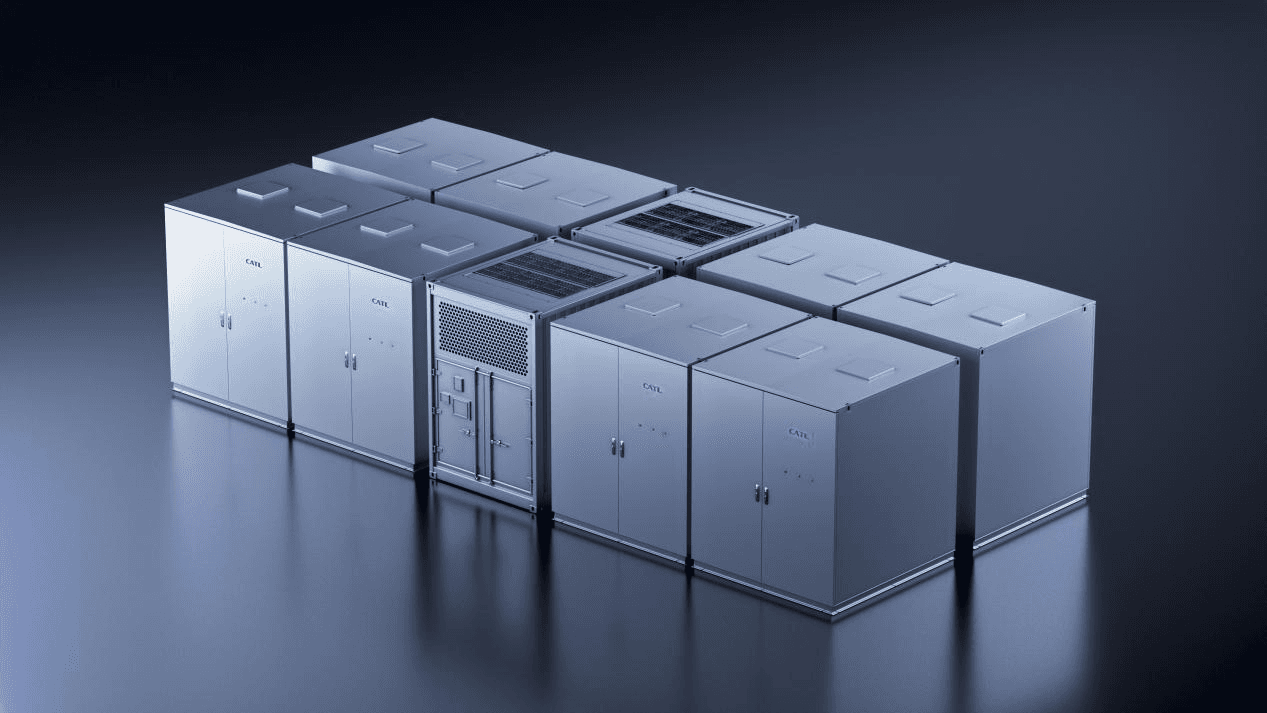
CATL's Tener Sodium storage block, in an image from the company's June 22, 2026 launch release. CATL's own rendering, not a site photo.
Image: CATL
Source · Press image from the CATL newsroom, used for news reporting.
CATL's four-hour Tener Sodium storage block is rated at more than 30 MWh and up to 7.5 MW, according to spec sheets the company showed in an Oct. 29 webinar, ESS News reported on Nov. 13.
CATL says the system is already being delivered in China and gave an overseas delivery window of summer 2027. In its June 22 launch release, the company put global deliveries at June 2027 and expected cumulative shipments of 1 GWh by the end of 2026. The sodium-ion block is built from two, four, six or eight cabinets of roughly 44 to 45 metric tons each, about 4 MWh per cabinet in the eight-cabinet version, ESS News said. That is heavier than the roughly 42 tonnes CATL quoted per module at launch.
For developers, the pitch is land and cooling rather than raw energy density. In CATL's own model of a 500 MWh project, 16 Tener Sodium blocks replace 23 blocks of its EnerX 0.25P lithium iron phosphate (LFP) system. The site shrinks from about 9,700 m² to 6,630 m², roughly 32%, and CATL estimates engineering, procurement and construction (EPC) costs 9.2% lower. That estimate leaves out transport, the substation and what CATL labels DC/AC side costs, so it is not a delivered-price comparison. As Voltgrid News reported, CATL's 3 GWh memorandum with Germany's Intilion names no price either.
In CATL's own model, a 500 MWh site needs 6,630 m² with Tener Sodium against about 9,700 m² with EnerX LFP, roughly 32% less (vendor figures).
Illustration (AI-generated)
Specs CATL has now published
The rated energy is 30+ MWh at a charge and discharge rate of up to 0.25P, which works out to 7.5 MW for four hours. CATL lists 95% round-trip efficiency at 25°C and 0.25P, and 70% state of health after 20 years at one cycle a day. The webinar's degradation curves showed 71.3% retention after 20 years at one cycle a day, and the presenter called those older estimates.
The battery is liquid-cooled and operates from -35°C to +55°C, with a DC voltage range of 612 V to 1,387.2 V. At launch CATL claimed 15,000 cycles at 25°C, more than 10,000 at 45°C and above 92% capacity retention at -20°C. These are vendor figures, and no test conditions beyond the temperatures have been published.
Against its LFP EnerX system, CATL says the sodium-ion cells give off 27.2% less heat per unit of energy at the start of life and 32.7% less at end of life. For a 50 MWh station it puts DC-side refrigeration at 490 kW against 720 kW, and noise at 65 dB(A) against 75 dB(A). The block's footprint is 158.5 m² against 180.6 m² for EnerX, or 0.197 MWh/m² against 0.125 MWh/m². The system pairs with CATL's own 265 kW Terapower converter, which CATL says reaches at least 99.2% peak efficiency.
How it fits CATL's wider storage line
CATL plans the same cabinets and layout for an LFP version, which the presenter put at around 50 MWh across eight cabinets, and developers could pick the chemistry during project design. CATL is prioritising sodium-ion certification, with the LFP version to follow. The company's lithium-based Tener+ 9 MWh system, shown in Melbourne on Oct. 28, sits at a different point on the same product ladder.
What is not confirmed yet
CATL has not published a price per kWh or a delivered cost for Tener Sodium, and the 9.2% EPC saving comes from its own scenario. ESS News noted that a 3.5 m cabinet height exceeds a standard high-cube shipping container, so the shipping method and cost remain open. The presenter said CATL is receiving "a lot of orders" but named no customer or volume. The June release gives June 2027 for global deliveries, while the webinar reporting says summer 2027 after an August 2027 production window, so the exact overseas start date is still unclear.
Sources
- Editor
- Ege Erten
- Published
- Sources
- 2 cited
- Standards
- AI-assisted