Fall Battery Lab Results: Two Cells Reach 1,000 Cycles, at 1 atm and 10 atm
Fraunhofer ISE's 25 Ah pouch cells passed 1,000 cycles at about 10 atm, QuantumScape's small cell 1,000 at 1 atm; others ran 50 to 200-plus. A daily-cycling grid model implies about 5,500 over 15 years.
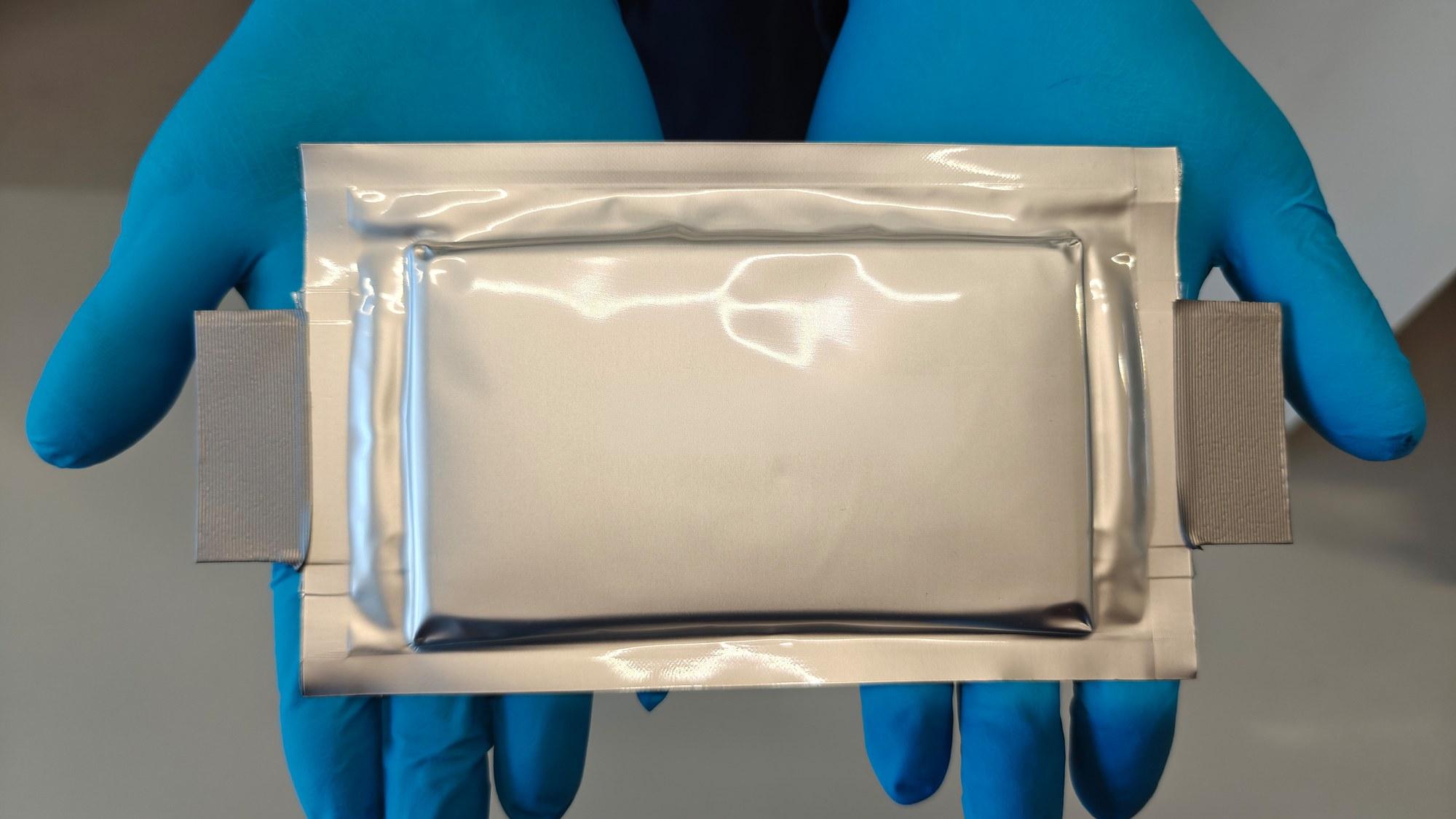
A silicon-anode pouch cell from Fraunhofer ISE's StrOboBatt project; the institute's 25 Ah cells kept over 83% of capacity after more than 1,000 cycles at 1C.
Image: Fraunhofer ISE
Source · Press image from the Fraunhofer ISE newsroom (© Fraunhofer ISE), used for news reporting.
Several battery results published since late October share one habit: each headline number comes with test conditions that a car or a grid site would not meet. Two reached a four-figure cycle count. Fraunhofer ISE's 25 Ah silicon-anode pouch cells kept over 83% of their capacity after more than 1,000 cycles under about 10 atm of clamping, and QuantumScape says a small two-layer Osprey cell kept about 80% after 1,000 cycles at 1 atm. That equals the 1,000-cycle count in the US Advanced Battery Consortium's (USABC) electric-vehicle goals, but not its test, which counts dynamic-profile cycles with a fast charge every cycle. Grid storage is modeled differently again: about one cycle a day for 15 years, about 5,500 cycles by our arithmetic, with cells added over the system's life.
What a cycle-life claim actually says
A battery's cycle count means little without the test behind it. One cycle is a full charge and discharge, and the count usually stops when the cell falls to a set share of its starting capacity, such as the 80% that QuantumScape and CATL quote. The C-rate says how fast each cycle runs: 1C fills or empties a cell in one hour, 2C in 30 minutes and 4C in 15 minutes, according to KAIST's release. Depth of discharge says how much of the capacity each cycle uses. Surrey's catalyst test, for instance, limited the charge released in each cycle on purpose, its release says, so its 92 cycles are not full-depth cycles. So 1,000 one-hour cycles of a small cell held at 30 °C and 1,000 fast-charge cycles of a car-sized cell are different results, even though the number is the same.
Format and conditions shift the result again. A coin cell is a button-sized test cell, like the 11 mm one behind QuantumScape's 1,100 Wh/L projection; a pouch cell is a flat, foil-wrapped format, like Fraunhofer ISE's 25 Ah cells. Electrek notes that batteries charge much faster when hot, and that sulfide solid-state cells usually need heavy clamping, or stack pressure, to keep their layers in contact. Silicon swells and shrinks as it takes up lithium, according to Fraunhofer ISE.
Pressure changes results. Fraunhofer ISE said on Oct. 20 that its cells reached their 1,000-plus cycles at 1,000 kilopascals (kPa) of axial pressure, about 9.9 atmospheres (1,000 kPa / 101.3 kPa per atm), and lost usable capacity significantly faster at 300 kPa, about 3.0 atm, as Voltgrid reported. The cells were cycled at 1C; the release gives no test temperature.
Lithium-metal and solid-state: KAIST at 4C, QuantumScape at 1 atm
KAIST, the Korea Advanced Institute of Science and Technology, said on Nov. 9 that a lithium-metal cell with its liquid-crystal polymer separator kept 94% of its initial capacity after 100 cycles at a 4C charging rate. The paper is in ACS Nano. KAIST's 15 minutes for 4C is a property of the rate, not a measured charge time. The release names no cell size, cathode or energy density, as Voltgrid reported.
QuantumScape said on Nov. 11 that its Osprey all-solid-state cells completed 1,000 cycles with about 80% capacity retention at 1 atm of stack pressure, as Voltgrid reported. That is the company's own data, not independently measured. The test conditions below are as Electrek reported them from the accompanying white paper: a two-layer cell with a 50 x 65 mm cathode, cycled at 1C charge and 1C discharge from 0% to 100% state of charge at 30 °C. Electrek estimates that cell at roughly 0.3 to 0.4 Ah. At -20 °C a single-layer cell discharged at C/3 kept 68% of its room-temperature capacity, about 52% of its energy, Electrek reports, below the USABC goal of more than 70% of specific energy at -20 °C.
Fraunhofer ISE and QuantumScape both reached 1,000 cycles at 1C, but in a 25 Ah pouch at 9.9 atm and a 0.3-0.4 Ah cell at 1 atm.
Chart: Voltgrid News
Illustration (AI-generated)
The two results answer different questions: fast charging with a lithium-metal anode, and long life with a sulfide electrolyte at low pressure. KAIST's paper is peer-reviewed. Electrek points out that Osprey's 80% after 1,000 cycles sits below the 95% that PowerCo confirmed for early QuantumScape cells in 2024, with a different chemistry and stage.
Beyond the usual cell: Surrey's Li-CO2 catalyst and sodium-ion
The University of Surrey said on Nov. 11 that iron-molybdenum catalysts for lithium-CO2 batteries recovered 93% of their charge on recharge and completed 92 cycles, in the Journal of Power Sources. A lithium-CO2 battery uses carbon dioxide in its discharge reaction; the catalyst speeds that reaction up. The release says commercial lithium-ion cells still beat lithium-CO2 on reliability and lifespan, and Dr Daniel Commandeur said there is still a long way to go, as Voltgrid reported.
Sodium-ion is further along, with evidence of a different kind. At the materials end, Surrey also reported on Oct. 21 that some titanium-containing sodium manganese oxide cathodes kept over 90% of capacity after 100 cycles, a materials library the university calls groundwork. At the product end are company claims. CATL presented a sodium-ion storage cell in April at about 160 Wh/kg with a cycle life of more than 15,000 cycles at 80% retention and an operating range of -40 °C to 70 °C, according to ESS News; that is CATL's figure, with no stated rate, temperature or depth of discharge. CATL said on June 23 that deliveries of its sodium-ion storage systems in China would begin in September, with cumulative shipments expected to reach 1 GWh by the end of 2026 and international deliveries from June 2027. Neither source gives independent test data; no delivery had been publicly confirmed by Nov. 13. EVE Energy's claims of up to 10,000 cycles for a two-wheeler sodium-ion pack, reported by Gasgoo, are likewise the company's own.
Two other Korean cathode results fit the pattern. POSTECH reported keeping 98.4% of its initial performance after more than 200 cycles in a manganese-rich cathode, without giving cell format or test temperature, and Hanbat National University reported about 90% after 50 cycles in a disordered lithium-rich cathode.
The gap to products: what EV and grid batteries need
For a car, the USABC's light-duty EV goals (Oct. 6, 2025 version) set cell-level end-of-life targets at 30 °C: 1,000 cycles on the consortium's dynamic stress test, each with a fast charge; 15 years of calendar life; 300 Wh/kg and 700 Wh/L of usable energy; 80% of usable energy in 10 minutes at 30 °C and in 30 minutes at -10 °C; and more than 70% of specific energy at -20 °C.
Counting cycles only, against the USABC's 1,000: KAIST's 100 cycles are 10%, Surrey's 92 partial-depth cycles are 9.2%, POSTECH's more than 200 are over 20% and Hanbat's 50 are 5%. Fraunhofer ISE's more than 1,000 cycles and QuantumScape's 1,000 reach the 1,000-cycle count, though not the USABC test, which charges fast on every cycle: their runs ended at over 83% and about 80% retention, both at 1C, in cells of 25 Ah and an estimated 0.3 to 0.4 Ah, at 9.9 atm and 1 atm. On charge speed, 80% in 10 minutes is an average rate of 4.8C (0.8 / (10/60 h)), a little above the 4C that KAIST rates for a full charge in theory. On energy, Electrek lists QuantumScape's 5 Ah QSE-5 at 301 Wh/kg and 844 Wh/L, level with the USABC's 300 Wh/kg and above its 700 Wh/L, though the consortium's figures are usable energy at end of life and QuantumScape's are ratings for new cells. Fraunhofer ISE's pouch cells reached 280 Wh/kg in a research format.
Two results reach the USABC's 1,000-cycle count, though not its fast-charge test; POSTECH, KAIST, Surrey and Hanbat ran 50 to 200-plus.
Chart: Voltgrid News
Illustration (AI-generated)
In the field, Ford said on Nov. 9 that about 36,000 model-year 2021 Mustang Mach-E cars average 92% battery health after roughly five years, as Voltgrid reported. An 8-point loss over 5.2 years is about 1.5 points a year on average, though Ford published no year-by-year curve.
Grid storage is modeled on a different basis. The 2025 Annual Technology Baseline from the National Laboratory of the Rockies (NLR, formerly NREL) models a utility-scale battery, by default a 4-hour system, at approximately one cycle a day over a 15-year life, with augmentation costs included so the system keeps its rated capacity. By our arithmetic that is about 5,500 cycles (365 x 15 = 5,475), or 5.5 times the USABC count. But it is a system figure that assumes cells are added over time and discharge over about four hours, a rate near C/4, not a cell test. CATL's claimed 15,000 cycles for its sodium storage cell would be 2.7 times that count (15,000 / 5,475), again a company claim with no stated test conditions.
For engineers and investors, the test line matters more than the headline count. Of the fall's two four-figure results, one came from a 25 Ah pouch cell that needed about 10 atm of clamping, and the other ran at 1 atm in a cell Electrek puts at under half an amp-hour. For data-center operators sizing backup or peak-shaving batteries, none of the lab results is a purchasing option, and CATL's sodium-ion storage system is the only product here with a stated delivery date.
What to watch
For sodium-ion storage, CATL expects cumulative shipments to reach 1 GWh by the end of 2026 and international deliveries to begin in June 2027; a confirmed delivery or an independent test report would turn its 15,000-cycle claim into data.
For sulfide solid-state, the clocks run from 2027. CATL said on Oct. 27 that it plans small-scale production in 2027 and large-scale manufacturing around 2030, as Voltgrid reported. Electrek lists Samsung SDI aiming for sulfide mass production in the second half of 2027, BYD planning small-batch output in 2027 and Toyota aiming for 2027 to 2028. QuantumScape's 100 MWh line is targeted for 2028 QSE-5 production, per Electrek. QuantumScape has given no timeline for Osprey; Electrek reports that the white paper says the process has been demonstrated "at laboratory scale" and that "significant work remains in process engineering."
For the university results, the next test is a larger cell. Surrey said its next challenge is delivering the same performance over much longer periods, and none of the university releases gives a date for a commercial cell. Until a cell in a real pack's format, pressure and temperature reports its cycle count, treat each as a materials result.
Sources
- 01A closer look at CATL's new sodium-ion batteryESS Newsess-news.com
- 02USABC EV Performance Targets (light-duty, version Oct. 6, 2025)USABC / USCARuscar.org
- 03Fraunhofer ISE Successfully Tests High-Energy Battery Cells with Silicon-Rich Anodes Over 1,000 CyclesFraunhofer ISEise.fraunhofer.de
- 04CATL unveils TENER Sodium energy storage system in MunichCATL via PR Newswireaap.com.au
- Editor
- Ege Erten
- Published
- Sources
- 4 cited
- Standards
- AI-assisted