Cornell Chip Cuts Trapped-Ion Laser Cooling to 150 Microseconds
Cornell engineers cooled a trapped calcium ion to near its ground state in about 150 microseconds, versus roughly 500 for a conventional setup, but so far only for a single ion.
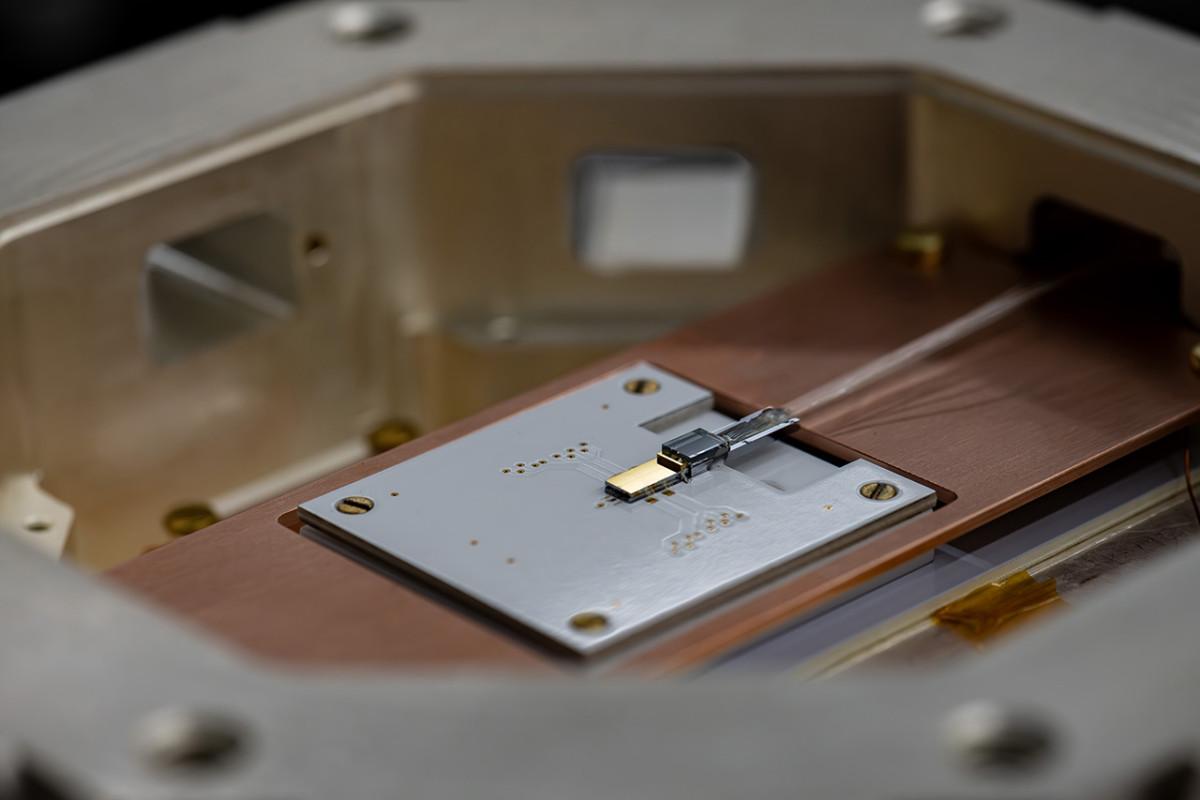
Optical fibers feed an ion trap device (gold) mounted on a carrier board; integrated photonics in the device deliver laser light used to cool trapped ions.
Image: Photonics and Quantum Electronics Group at Cornell
Source · Press image from the Cornell Chronicle, used for news reporting.
Cornell University engineers have cooled a trapped calcium ion to near its quantum ground state in about 150 microseconds, against roughly 500 microseconds with a conventional laser arrangement, the university said on Nov. 12.
Cornell reports about 150 microseconds to cool the ion near its ground state, against about 500 with a conventional laser arrangement, on one ion.
Illustration (AI-generated)
The work, led by Karan Mehta, assistant professor of electrical and computer engineering, appeared on Nov. 9 in the journal PRX Quantum. Interesting Engineering describes the result as about three times faster cooling. The same method also cooled all three measured motion modes of the ion together, across a range of about 5 megahertz, where conventional schemes often need a separate cooling step for each mode.
Cooling matters because a trapped-ion quantum computer holds each qubit in a single charged atom suspended in electromagnetic fields. Even tiny unwanted motion of the atom disturbs a calculation, so lasers must repeatedly cool it to near its lowest energy state. Mehta said the logic operations might look like the slow part, but cooling to near the ground state "ends up being a major bottleneck in leading systems," and Cornell says it can eat a large share of operating time.
How the chip cools the ion
The team sent two laser beams through the chip in opposite directions to form a standing wave, a fixed pattern of bright and dark bands, much like the still nodes on a plucked guitar string. They held the ion at a dark point, a node, which suppresses the light interactions that would otherwise heat it. Combined with a method called electromagnetically induced transparency (EIT) cooling, this brought the targeted motion to an average of about 0.05 phonons, the quanta of vibration, according to the authors' abstract on arXiv.
The team also cooled the ion below the conventional Doppler limit, which Cornell says confirms a long-standing theoretical prediction. The optical parts are built into the chip, which routes wavelengths from ultraviolet to near-infrared and was packaged to run at cryogenic temperatures. The chips were fabricated commercially in the Netherlands through a collaboration with ETH Zurich.
Why it matters for bigger machines
Putting the optics on the chip is one way groups are trying to add many more qubits without a sprawling arrangement of external lasers. Mehta's point is that the same integration that helps scaling also speeds a basic operation. Voltgrid News has followed other quantum hardware work, such as the 120-qubit error correction platform from IBM, AMD and Oak Ridge, and the Stanford chip that sorts laser light shows the same push to control light on a chip.
What is not confirmed yet
The experiment used a single ion, not a multi-ion processor. Cornell says only that the approach is applicable to larger trapped-ion computers; no multi-ion result or end-to-end speedup of a quantum algorithm has been shown. The 150 and 500 microsecond figures come from the researchers' own comparison on one ion and one set of modes. The journal page itself was not readable when this was written, so the technical numbers here are taken from the authors' arXiv abstract, Cornell's release and Interesting Engineering's report.
The work was supported by the National Science Foundation, the Army Research Office and the Alfred P. Sloan Foundation.
Sources
- 01Integrated-photonics standing-wave cooling of trapped ions (authors' preprint)arXivarxiv.org
- 02Chip-based lasers cool trapped ions 3x faster for quantum computingInteresting Engineeringinterestingengineering.com
- 03Researchers develop faster laser cooling for quantum computersCornell Chroniclenews.cornell.edu
- Desk
- Science Desk
- Editor
- Ege Erten
- Published
- Sources
- 3 cited
- Standards
- AI-assisted