Stanford Photonic Chip Sorts Mixed Laser Light Into 2–3 Pure Beams
Stanford engineers and collaborators built a fingernail-sized silicon photonic chip that splits mixed laser light into separate beams, a Nature Photonics result for imaging and sensing.
Science DeskEdited by Ege Erten
2 min readAI-assisted
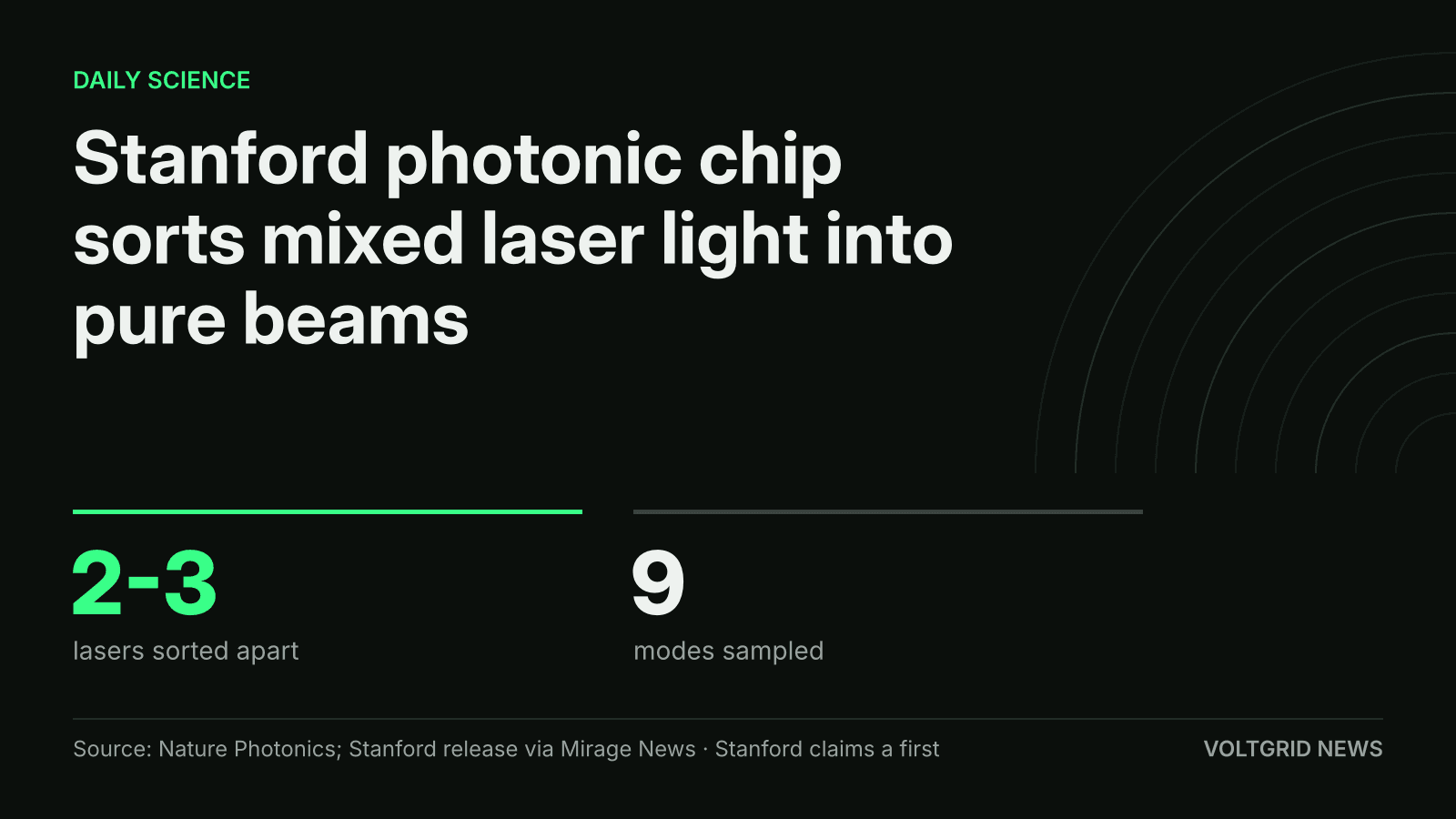
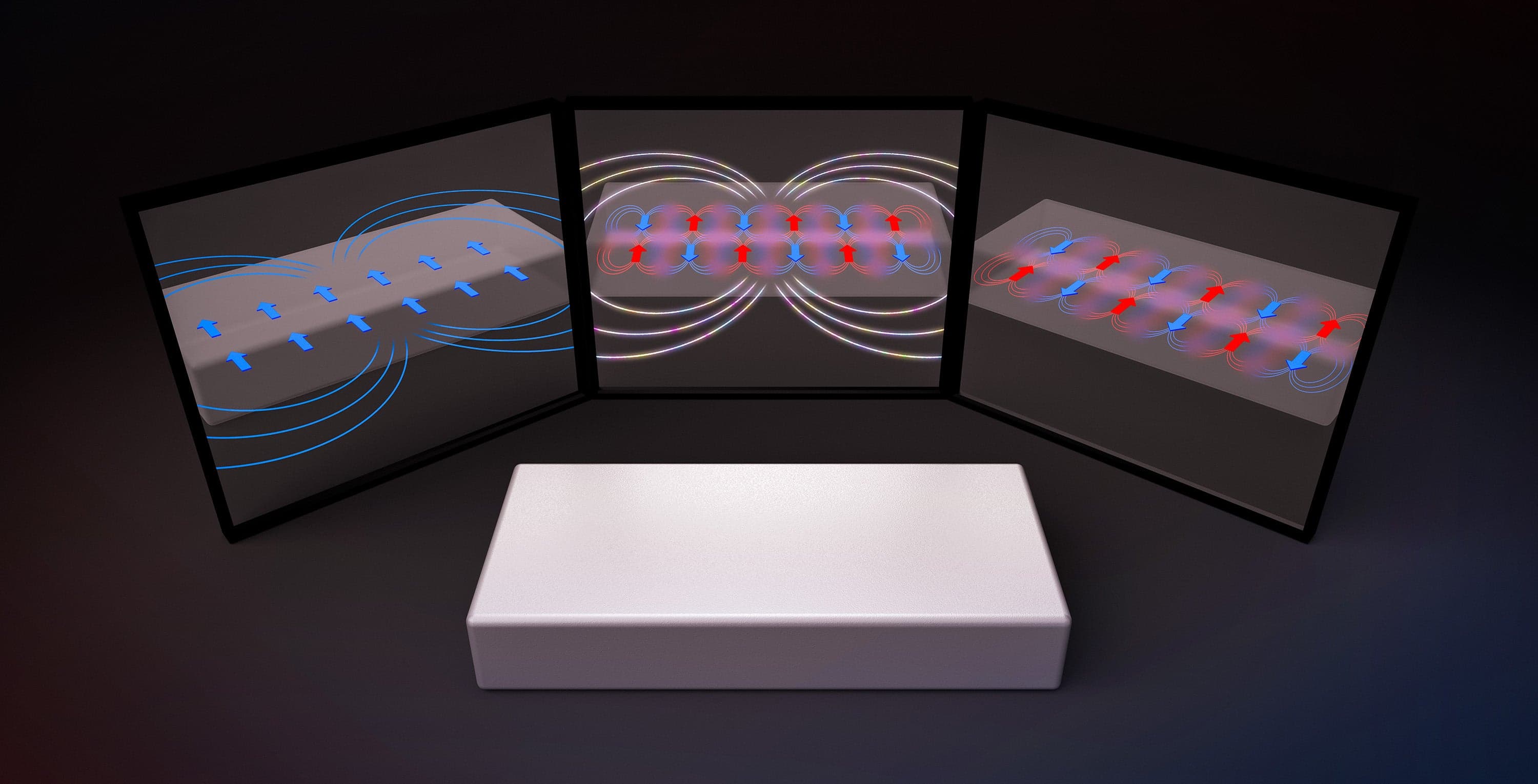
The Stanford team sorted mixed light from 2 lasers, and in a further test a 3rd, into separate beams.
Illustration (AI-generated)
Stanford engineers and collaborators built a fingernail-sized silicon photonic chip that takes mixed light from two lasers, and in a further test three, and sorts it into separate beams, according to a paper published Oct. 30 in Nature Photonics.
Stanford says it is the first time a device has taken in partially coherent light and split it into a clean set of mutually incoherent beams. Coherent light, such as a laser, has photons that oscillate in step. A light bulb's photons drift out of step. Partially coherent light sits between the two: the oscillations line up briefly, then fall out of phase.
How the chip separates the light
In the experiment, the team pointed two infrared lasers into the chip, mixing the sources. Inside, layers of tunable interferometers, which are components that split and recombine light, configure themselves automatically. The paper says this process finds the eigenvectors and eigenvalues of the coherency matrix, the maths that describes how the light's parts relate to each other. The chip measures the state of the light while leaving it intact and separated.
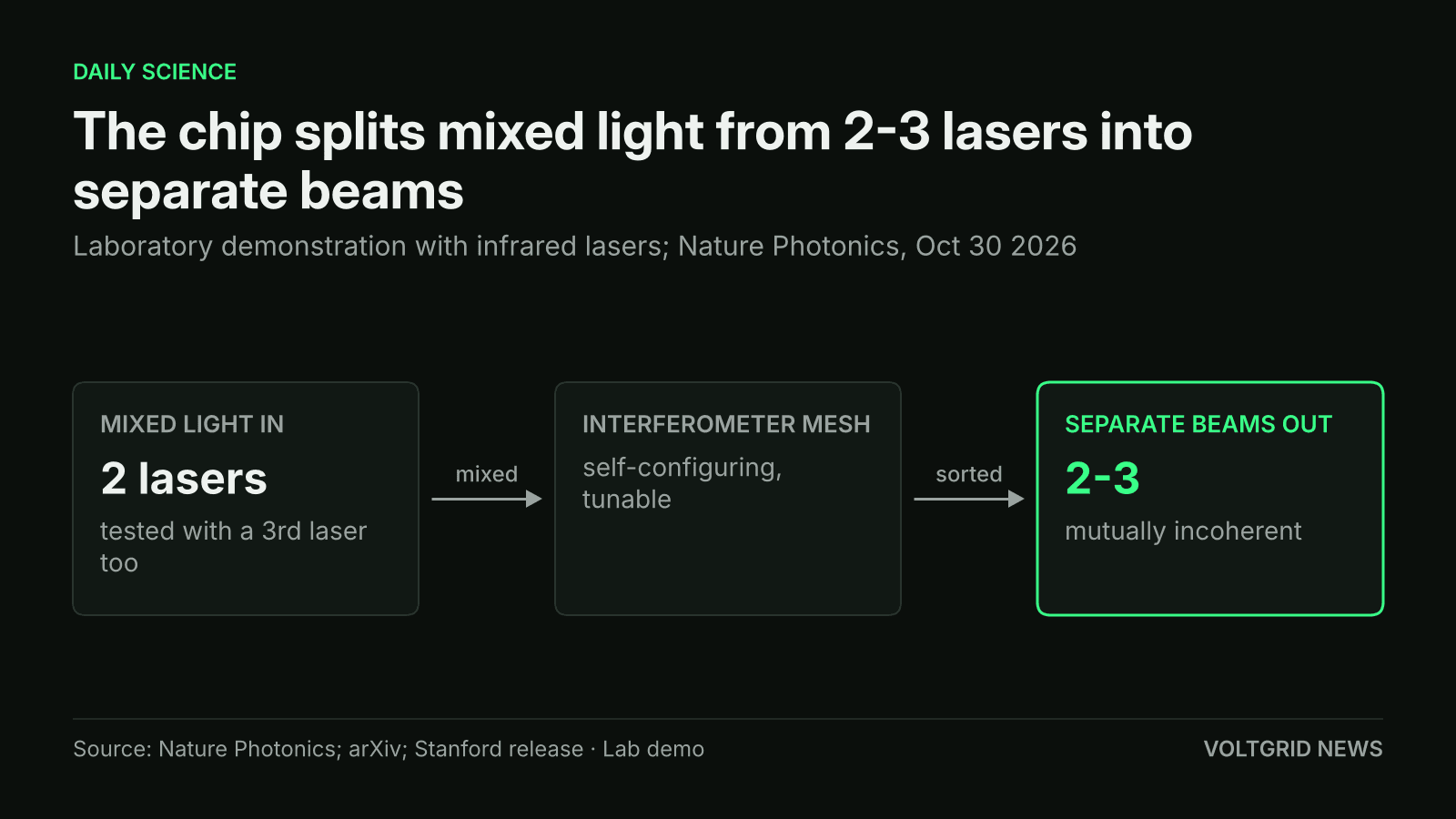
Stanford's chip sorts mixed laser light into separate, mutually incoherent beams in a laboratory demonstration, according to the Nature Photonics paper.
Illustration (AI-generated)
The researchers then mixed the output beams to check them. The two beams would not add together, which showed they were mutually incoherent. When the team added a third laser, the chip still sorted the mixture into pure beams, according to Stanford. The paper's arXiv version describes the test as finding and separating the two strongest coherence modes from a nine-mode sampling of fields from two independent lasers.
"Our chip learns the underlying coherence modes of an unknown light field and physically directs them into separate outputs," said co-author Shanhui Fan, a Stanford professor of electrical engineering.
What it could be used for
The stated targets are imaging and sensing, not computing hardware. A camera flattens overlapping light sources into one image and loses depth information, co-author David Miller, a Stanford professor emeritus, said. Separating the light could let a microscope tell apart two overlapping fluorescent particles, Stanford said. Miller, Olav Solgaard and PhD student Annie Kroo are working with NASA to test whether the approach can probe light from distant galaxies.
The paper also says the number of physical components scales linearly with the rank of the coherency matrix, which is the count of independent light modes being separated. That matters for building larger versions.
For readers who follow photonic hardware, this is an optical measurement and processing tool, so it sits near the work on moving data with light that Voltgrid has covered, such as a slow-light silicon modulator from Yokohama. The authors say the framework could serve communication and photonic information processing, but the paper reports no data-rate or power figures.
What is not confirmed yet
This is a laboratory demonstration with two and three lasers. The sources give no efficiency, loss or speed numbers for the chip, no date for a product and no energy-saving claim. Some outlets have framed fingernail-sized photonic chips as a fix for data-centre energy use, but that framing belongs to a different project, and neither the paper nor Stanford's release makes that claim for this chip. The NASA work is at the testing stage.