1-Minute Grid Frequency Ripple Traced to Battery and UPS Self-Tests
Jülich researchers in Nature Energy link a 60-second grid-frequency ripple on five continents to synchronized battery and UPS self-tests, and say randomizing the timing would fix it.
Science DeskEdited by Ege Erten
3 min readAI-assisted
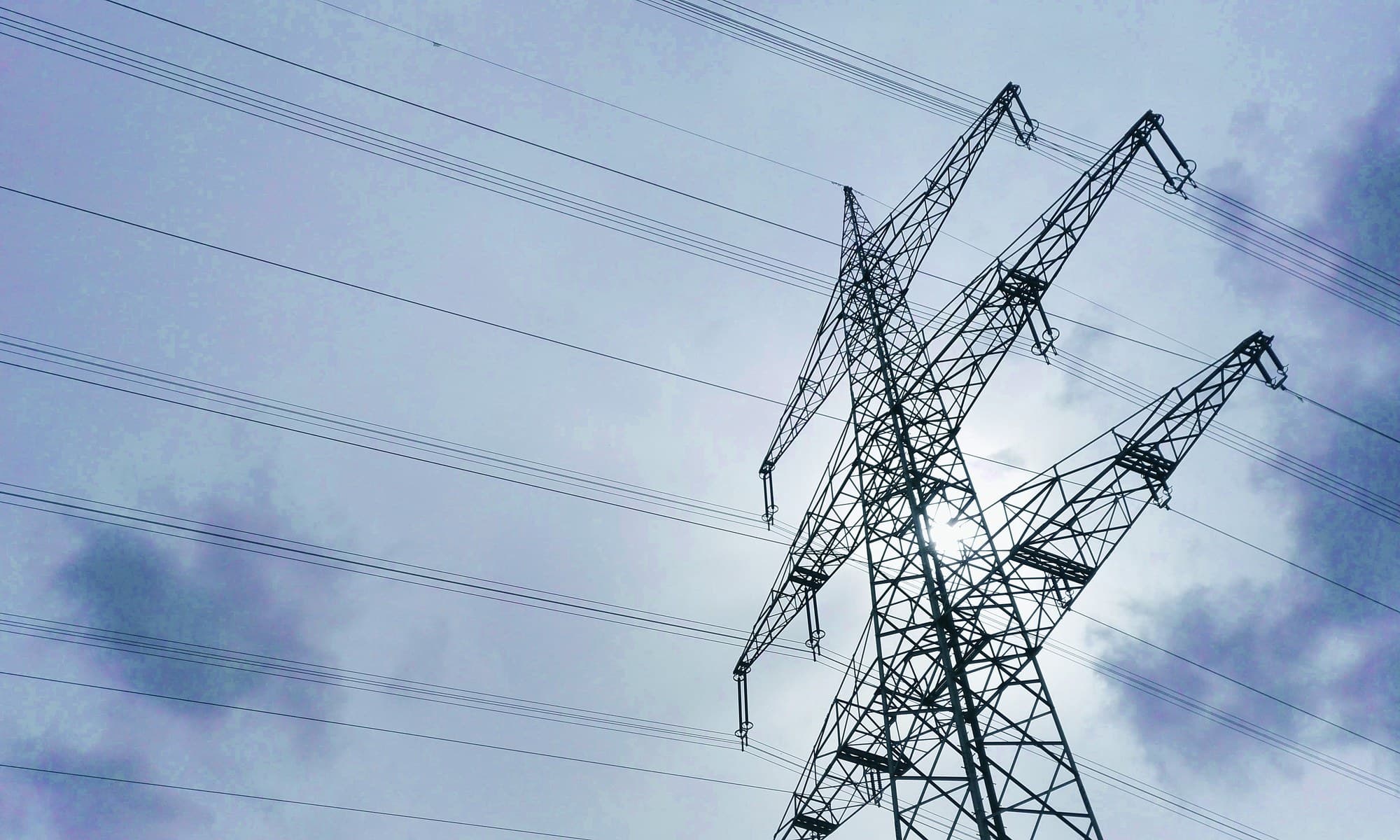
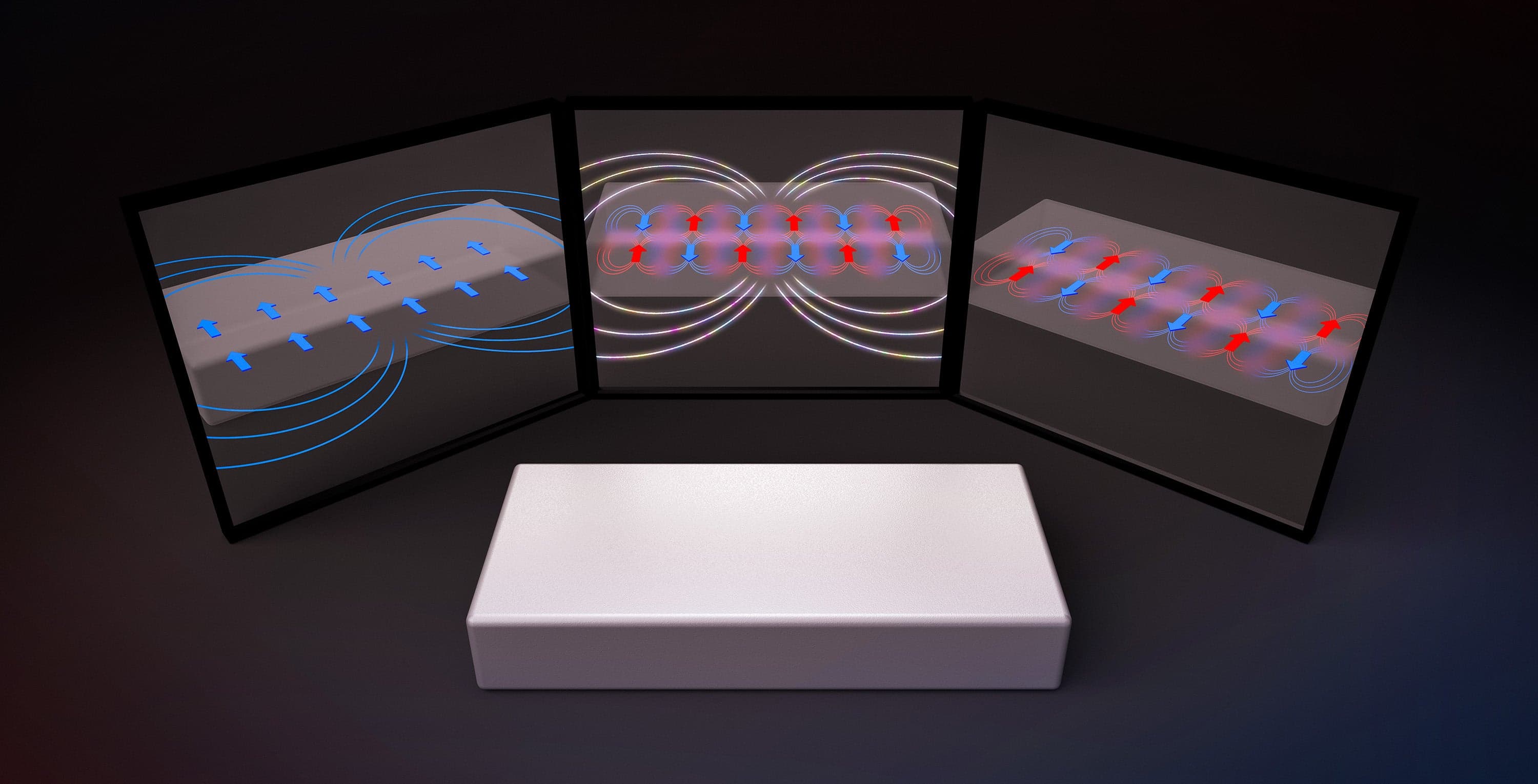
Illustrative image from the Juelich release on the 60-second grid-frequency ripple; it does not show the devices or sites studied.
Image: Forschungszentrum Juelich
Source · Press image from the Forschungszentrum Juelich newsroom, used for news reporting.
Researchers at Forschungszentrum Jülich traced a grid-frequency ripple that repeats every 60 seconds on five continents to clock-synchronized self-tests in battery storage and uninterruptible power supply (UPS) systems, they reported in Nature Energy on Oct. 30.
Tennet Germany, the country's largest transmission system operator, had seen the frequency of the European grid dip briefly once a minute for years. The dips were measurable and unusually regular, but not critical to grid security, according to the Jülich press release. A team led by Dirk Witthaut, with researchers from the University of Cologne and the Karlsruhe Institute of Technology, set out to find the cause.
The paper, by Carsten Hartmann, Edoardo De Din, Witthaut and colleagues, finds the same narrow 1-minute peak in every grid it investigated, from Continental Europe and North America to Iceland, Mallorca and South Africa. Nature Energy published it as open access.
How the ripple forms
Grid frequency (50 Hz in Europe, 60 Hz in North America) rises when generation exceeds demand and falls when demand outpaces supply. Witthaut said the team realized early that the precise 60-second cycle had to come from something controlled by a clock, and that it could only appear if many devices drew power at the same moment.
The clue came from measurement points at 80 locations on the Jülich campus. The same minute-by-minute pattern showed up where battery systems protect against outages, and one system drew a spike of power at the start of every minute while it ran its power check. Because no binding standard sets the interval, Witthaut suspects most manufacturers simply chose 60 seconds.
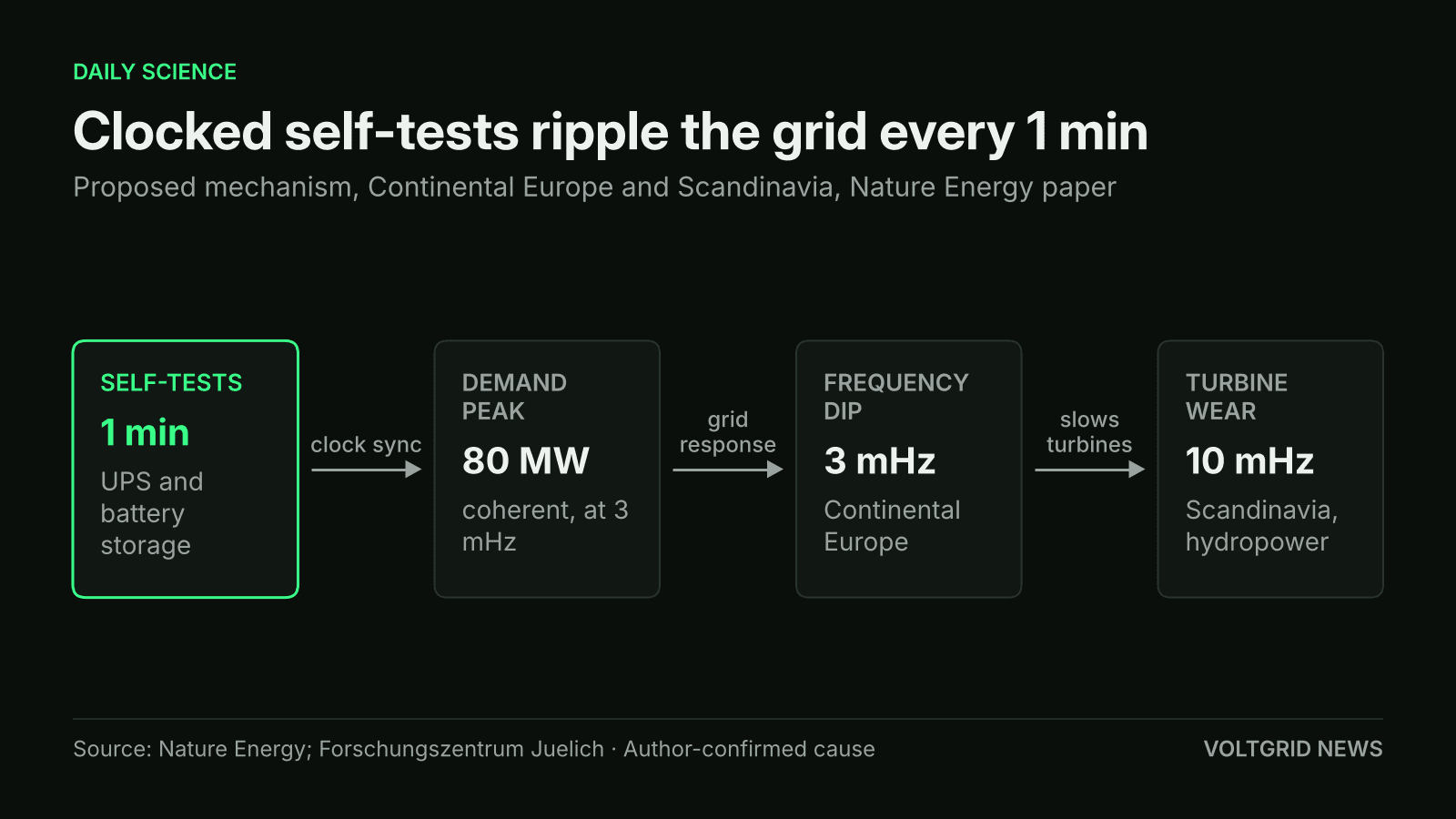
Clock-synchronized self-tests can give rise to the 1-minute ripple, according to the Nature Energy paper.
Illustration (AI-generated)
The paper puts a size on the effect. In the Continental European grid, a 3 mHz swing in frequency corresponds to a coherent power swing of about 80 MW.
Why grid operators care
The repeated dips make hydropower turbines slow briefly and then speed back up, which adds wear. In the Scandinavian grid, amplitudes regularly exceeded 10 mHz, and grid operators there revised their requirements for frequency containment reserves in 2023. The paper reports no amplitudes above 10 mHz in 2025.
Data centers sit in the middle of this. In Ireland, where data centers reached about 18% of national electricity demand in 2022, the paper reports the minute-scale frequency drop grew from about 3 mHz to 12 mHz between 2016 and 2021. The authors write that growth in battery storage, data centers and Internet-of-Things devices may amplify such oscillations further.
The proposed fix is simple. The authors recommend randomized scheduling, adaptive offsets or event-driven rather than strictly clock-driven routines, so devices do not all act at once. After the team contacted one manufacturer, a software update removed the strict periodicity of the current peaks in one battery block of the UPS system studied. Self-tests still occur at discrete times, so the root cause is only partly resolved.
What is not settled yet
The sources emphasize different devices. The press release points to large-scale battery storage, while the paper and a Nature Energy commentary by Florian Dörfler of ETH Zürich name battery-based UPS systems, including those in data centers, and say the mechanism is not specific to batteries. Witthaut said battery storage may be only part of the problem and that heat pumps, air conditioners and other digitally controlled appliances could show similar patterns.
The paper also notes that fixes will be harder for household-scale devices, where updates and control standards are less coordinated. It reports a second, weaker peak near 100 seconds whose origin remains uncertain. With co-located batteries now part of 16% of new US utility-scale solar in 2026, as Voltgrid reported from EIA data, the timing of battery self-tests is a design detail worth watching.
Sources
- 01Mystery of 60-second fluctuations in power grids solvedTech Xplore · news.google.com
- 02One-minute frequency disturbances from unintended synchronization in cyber-physical power systemsNature Energy · nature.com
- 03Mystery of 60-Second Fluctuations in Power Grids SolvedForschungszentrum Julich · fz-juelich.de