Cornell, C4V Cut Battery Formation Time by Up to 60% in Tests
Cornell researchers and battery maker C4V used live cell measurements to shorten lithium-ion formation, but the plant power and dollar savings are the team's own estimates.
2 min readAI-assisted
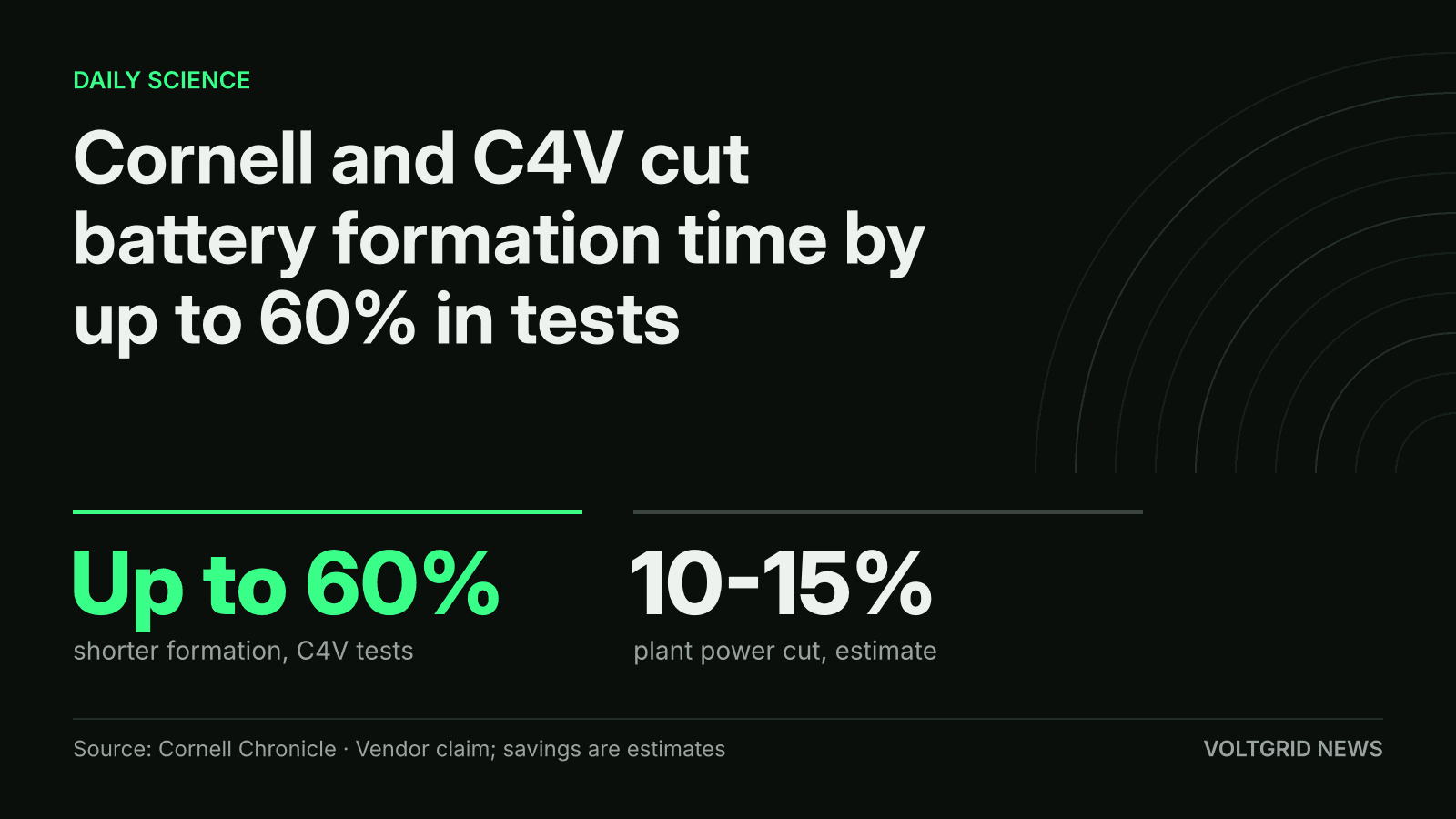
Formation time fell by up to 60% in tests at C4V's facility, Cornell reports; the plant power figure is an estimate.
Illustration (AI-generated)
Cornell University researchers and the upstate New York battery maker Charge CCCV (C4V) cut lithium-ion cell formation time by up to about 60% in tests at C4V's facility, according to a Cornell Chronicle report on research published Oct. 28 in the journal Energy Storage Materials.
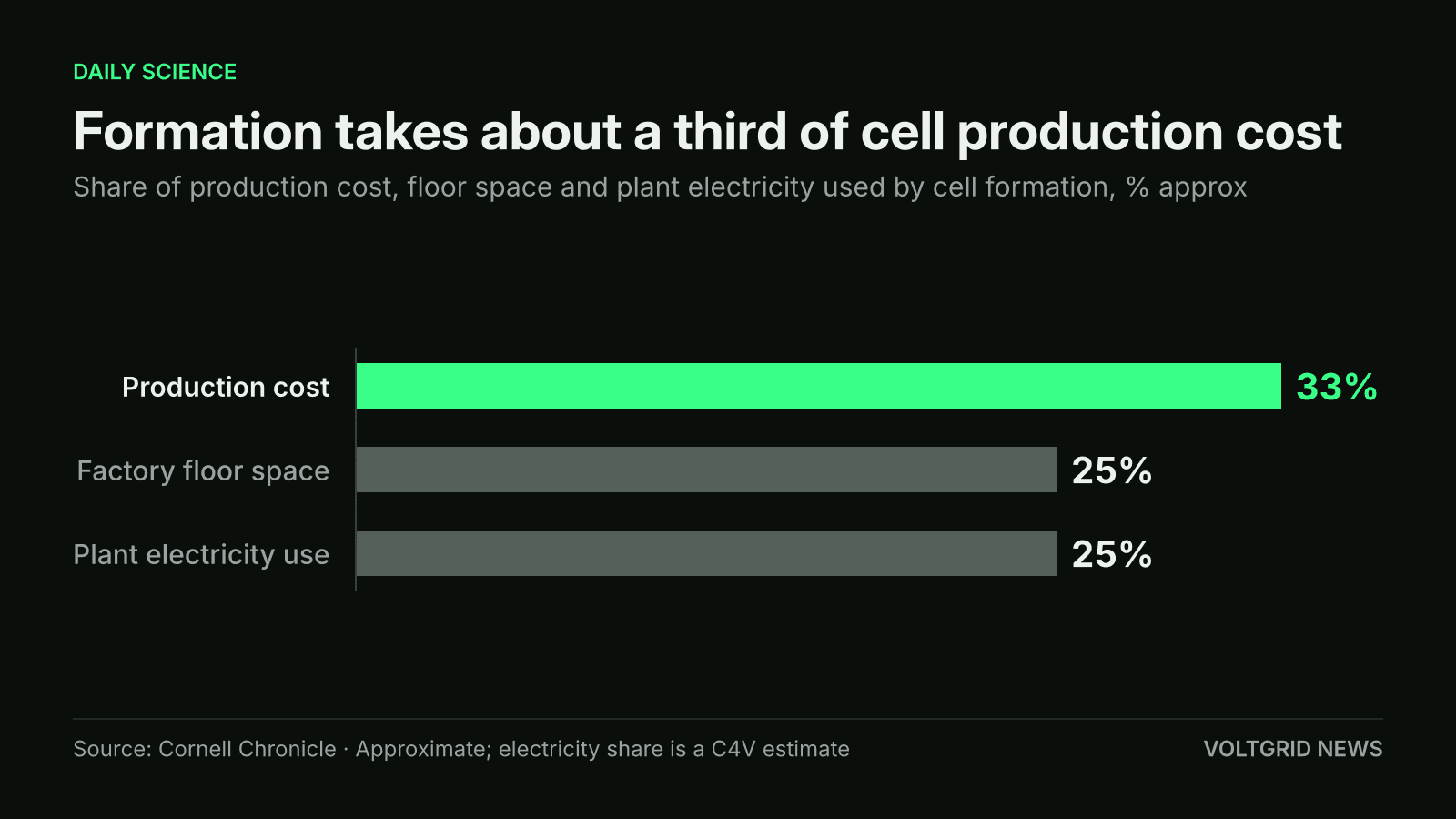
Formation is roughly one-third of production costs and a quarter of factory floor space, Cornell says; the electricity share is a C4V estimate.
Illustration (AI-generated)
Formation is the first set of charge and discharge cycles a new cell goes through. Those cycles build protective layers inside the cell and help set how well it performs over its life. Cornell says the step accounts for roughly one-third of production costs and a quarter of factory floor space.
The team, led by chemical engineer Vibha Kalra with lead author Jantakan Nedsaengtip, used two live measurements: operando Raman spectroscopy, which reads the chemistry of the protective layers, and operando electrochemical impedance spectroscopy, which tracks their electrical resistance. "Operando" means the cell is measured while it runs. Manufacturers usually lack that view, and Kalra said evaluating formation is typically trial and error that can take months to years.
What the measurements showed
The researchers found that a slower charging rate was key to a stable interface, with more uniform, inorganic-rich protective layers. They also found evidence that the discharging rate could be raised to speed the process, with key resistance readings settling after just 1.5 cycles.
They turned those observations into two accelerated protocols. Cornell says tests at C4V's facility showed both kept performance comparable to the company's conventional process while cutting formation time by up to about 60%. The page gives no cell chemistry, cell format or cycle-life figures, so how the cells compare beyond "comparable" is not public in that report.
Why it matters for cell plants
Formation ties up floor space and work-in-progress inventory, so a shorter step frees both. Shalabh Gupta, C4V's system engineering manager, estimated that formation is about a quarter of a battery plant's electricity use, and that halving it or better could cut overall plant power use by 10% to 15%. For a factory consuming more than 10 gigawatt-hours (GWh) a year, Cornell says that could mean up to $100 million in lower cell formation costs.
That matters as cell supply expands for storage and vehicles. Voltgrid News has covered cell-equipment shipments to Tata's Agratas and Samsung SDI's US LFP line conversion; new capacity like that is where a shorter formation step would count.
What is not confirmed yet
The 60% figure is a best case ("up to"), measured on C4V's materials and process. The power and dollar savings are estimates from Gupta and the research team, not measured plant results, and Cornell does not say when any manufacturer would adopt the protocols. Interesting Engineering also carries the 60% figure, citing the same work. The paper is at ScienceDirect.