HZDR Model Flags 2,531 Candidate 2D Materials in 24,000+ Crystals
A Dresden team's XCP model screened 24,000+ non-layered crystals for 2D materials. Every result is a calculation, and lab synthesis is still untested, the researchers say.
2 min readAI-assisted
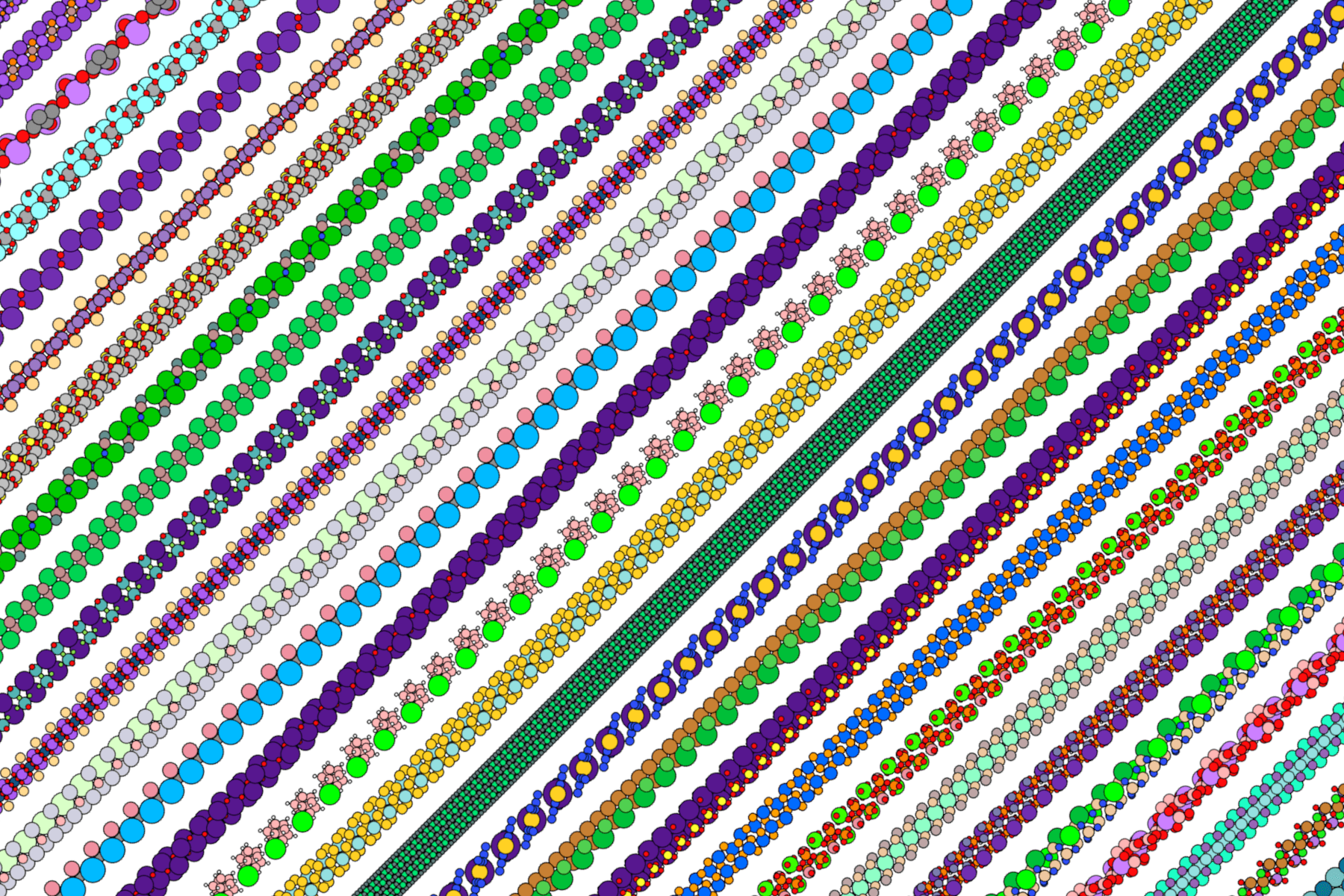
Calculated 2D structures from the HZDR and TU Dresden screening. The image is a computer illustration, not a lab photograph.
Image: Tom Barnowsky / HZDR
Source · Press image from the HZDR newsroom, used for news reporting.
Researchers at the Helmholtz-Zentrum Dresden-Rossendorf (HZDR) and TU Dresden said on October 27 that a new computational method flagged 2,531 promising candidates for two-dimensional materials among more than 24,000 known crystal structures that are not layered.
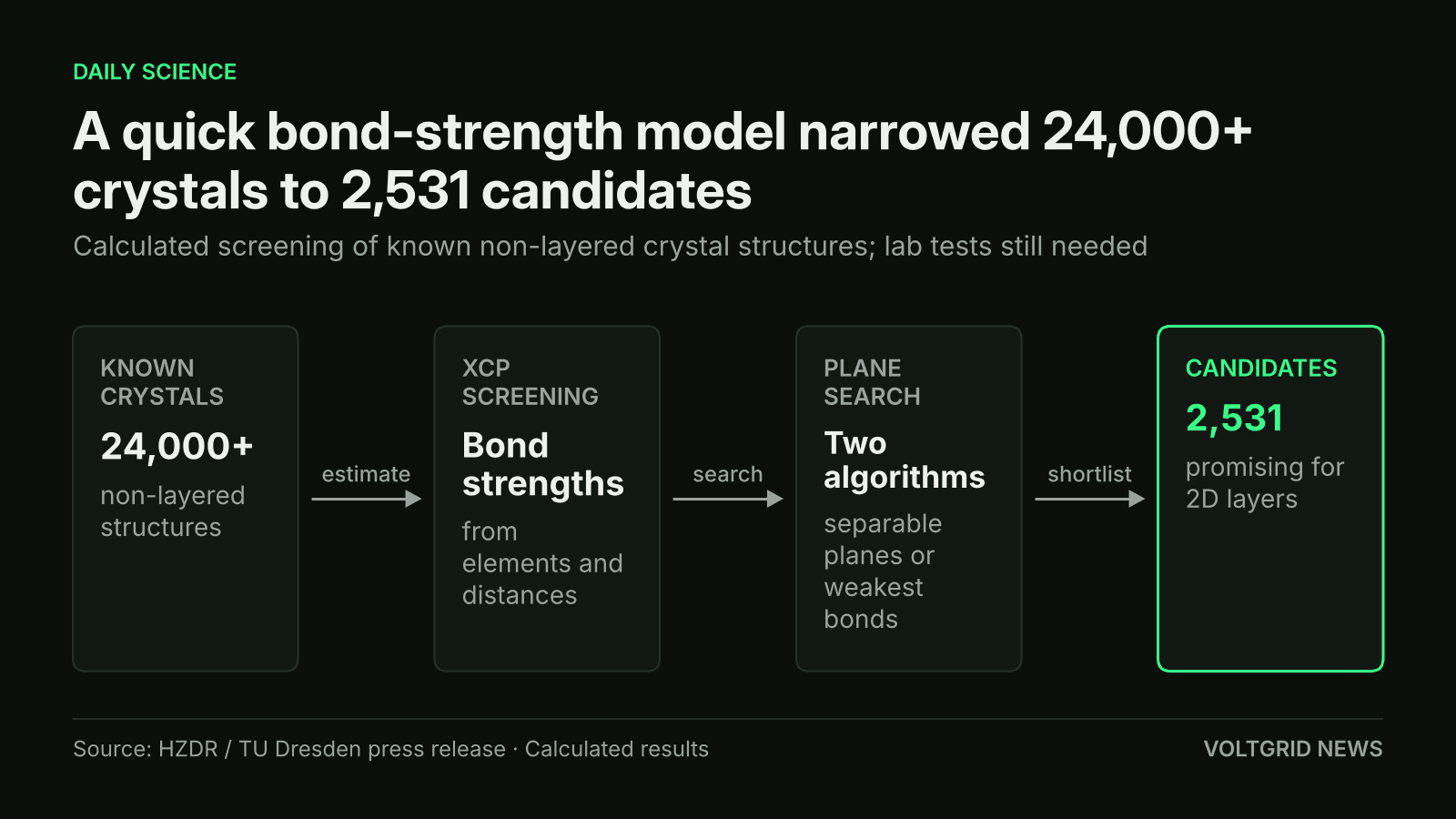
The method narrowed more than 24,000 known crystals to 2,531 candidates; the results are calculated and lab tests are still needed, HZDR says.
Illustration (AI-generated)
The work, published in Nature Communications, targets a gap in materials discovery. The best-known 2D materials, such as graphene, come from crystals built like a book, with layers held together by weak forces, so single layers peel off easily. Most solids are not like that: their atoms form a three-dimensional network of much stronger bonds, and until now it was hard to predict which of them could be split into stable layers.
How the model finds where a crystal can split
The method is called the eXfoliation and Cleavage Potential, or XCP. It uses the chemical elements involved and the distances between atoms to estimate how strong each bond is. Two further algorithms then either look for crystal planes that separate easily or remove the weakest bonds step by step until 2D pieces remain. Lead author Tom Barnowsky said that working out the electronic structure for every possible surface would take far too long, so the quick model screens whole databases and detailed calculations are reserved for the best hits.
The team checked XCP against 2D materials already made in laboratories, and it reliably found their preferred splitting planes, according to the release. The tool is free to use as a web tool.
What the candidates could be used for
For the 2,531 candidates, most showed comparatively low calculated exfoliation energies, and many proved both dynamically and thermodynamically stable, a basic precondition for technological use. The calculations also predict that some compounds that are semiconductors as 3D crystals turn metallic as a thin layer, and that others gain a direct band gap, which may matter for optoelectronic devices. Magnetic candidates might suit spintronics, which stores and processes data using electron spin.
For readers who follow chips and power electronics, this is a screening tool, not a component. Materials with new electronic properties are the raw input for future devices, as in Voltgrid's report on GaN power chips, but nothing here points to a product or a date.
What is not confirmed yet
Every result is a calculation. The researchers say experiments now have to show whether, and under what conditions, the candidates can actually be produced. Dr. Rico Friedrich of HZDR and TU Dresden said the method does not guarantee that every candidate can be made in the lab, but it shows which crystals are worth the experimental effort.