PNNL AI Agents Analyze Gallium Nitride Chip Radiation Damage in Hours
PNNL says its SciLink team of AI agents analyzed radiation damage in gallium nitride chips in hours, not days or weeks. The work is a conference presentation, not yet a peer-reviewed paper.
2 min readAI-assisted
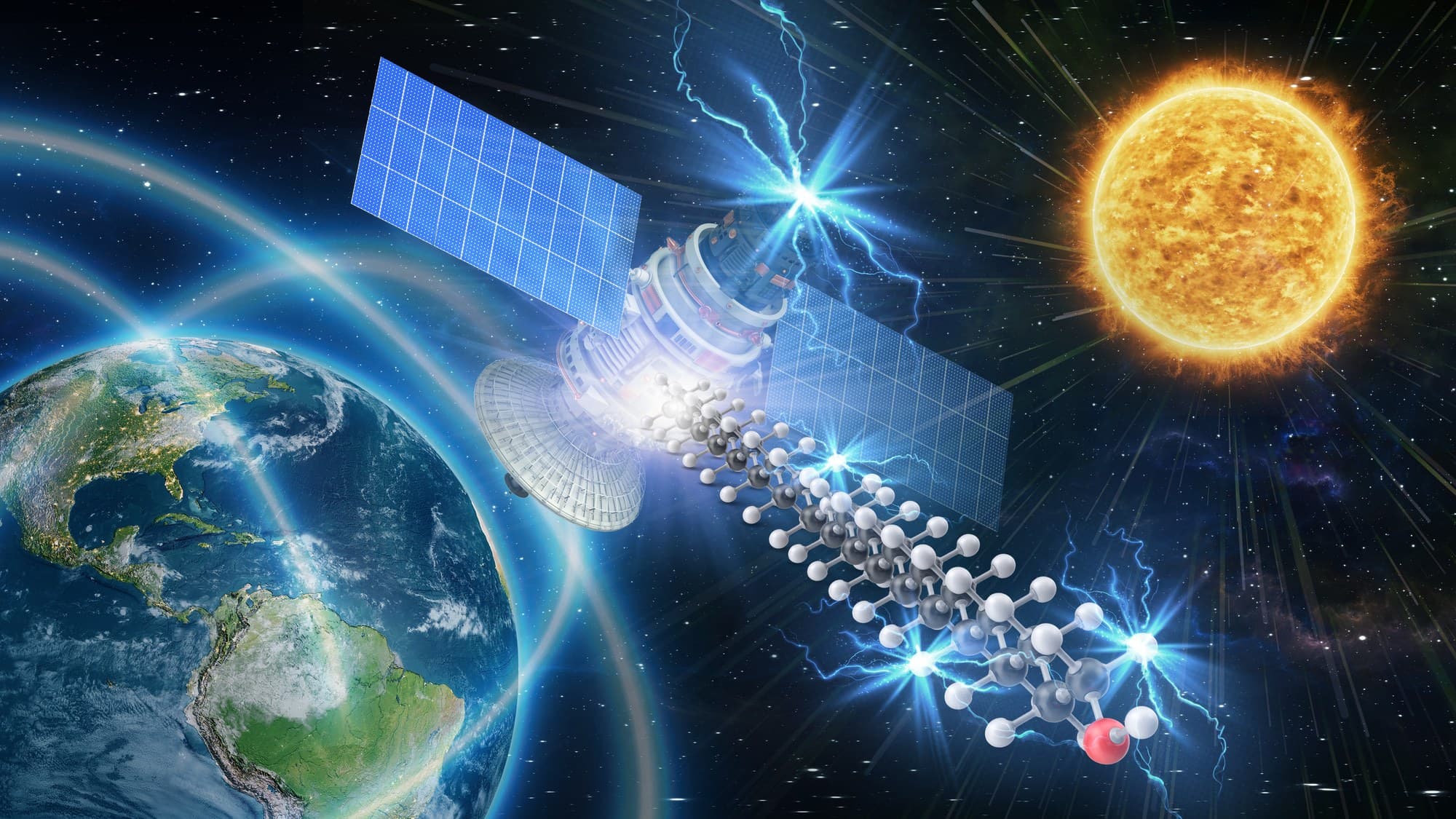
PNNL's illustration of the radiation that high-energy particles pose to electronics in space. It is not a photo of the gallium nitride chips studied.
Illustration: Jeff London | Pacific Northwest National Laboratory
Source · Press image from the Pacific Northwest National Laboratory newsroom, used for news reporting.
Pacific Northwest National Laboratory (PNNL) says a team of AI agents analyzed radiation damage in gallium nitride chips in hours, work that normally takes human teams days or weeks. The lab described the result in a release dated Oct. 26.
The chips are made of layers of aluminum gallium nitride and gallium nitride. According to PNNL, such chips handle critical jobs in satellites, communications, power systems and radar. The data came from experiments at the University of Tennessee, where an ion beam delivered energy into precise spots on the chips. PNNL says that mimicked, in a few hours, the damage ion strikes do to microchips over years in space.
How PNNL's SciLink AI Agents Analyze Chip Damage
PNNL researchers fed those results to SciLink, a system built by PNNL scientist Maxim Ziatdinov and colleagues. It sorts AI agents into a hierarchy: three lead agents, for experimental analysis, planning and computational simulation, hand work to more specialized agents. Those agents read results from instruments such as atom probe tomography and scanning transmission electron microscopy, which map the atoms inside a chip and produce large, separate piles of data.
The three leads then met in an interactive session and swapped questions and hypotheses, much as three human project leads might in a conference room. Most conclusions came with a confidence score. The system was 90% confident that heavy ions dominated the damage, and only 60% confident in its conclusions about proton damage, PNNL said.
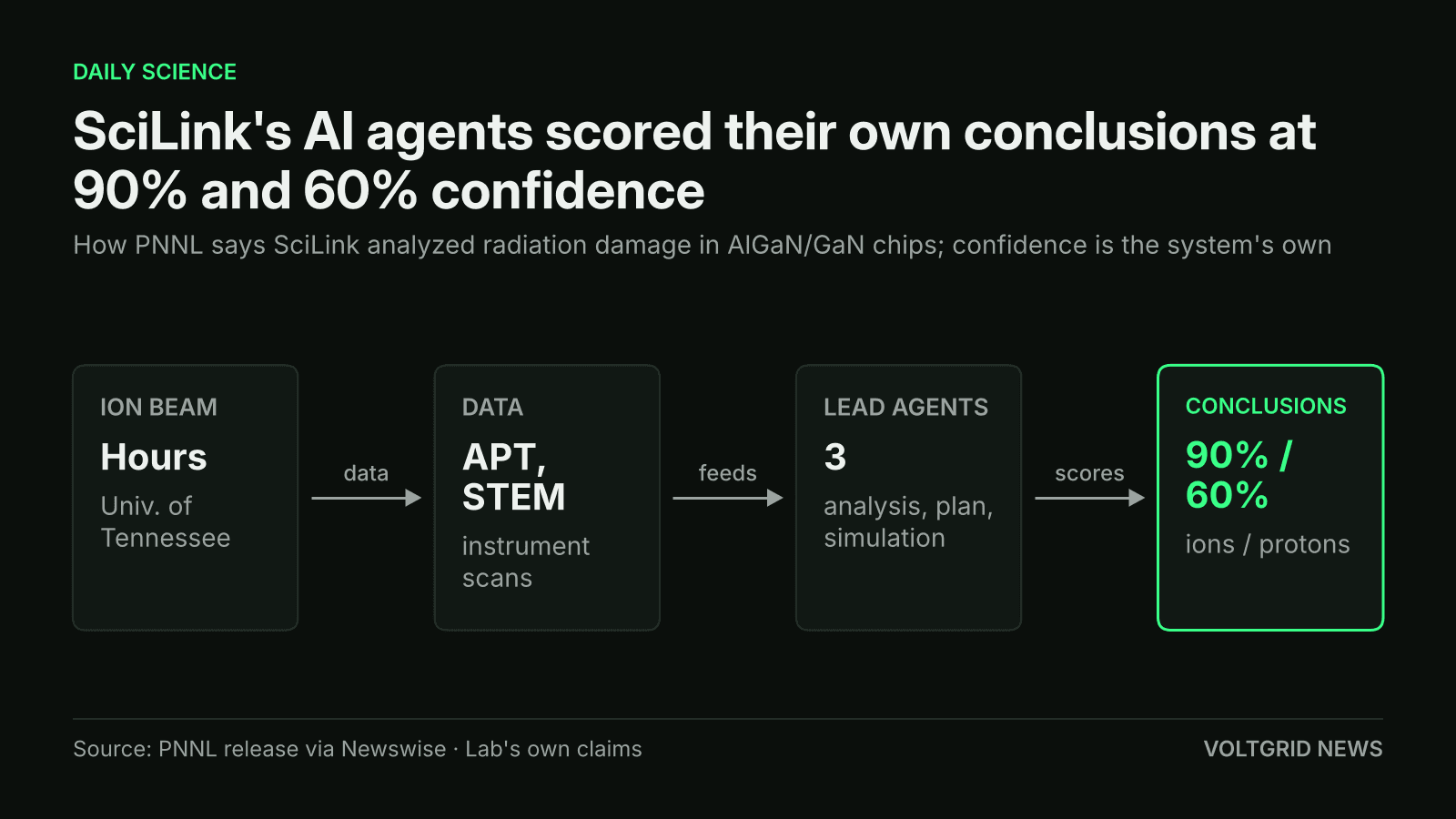
PNNL says SciLink was 90% confident ions dominated the damage and 60% confident about proton damage; the scores are the system's own.
Illustration (AI-generated)
Why Radiation-Hardened Chips Matter for Satellites and Reactors
Radiation hardening means building parts that survive radiation in space or inside nuclear plants. Ben Kowash, who leads PNNL's radiation-hardening work, said shielding adds weight and backup systems add cost and complexity, so making the electronics themselves tolerant is often more effective. Scientist Erin Barker said many of the best testing capabilities were designed for systems 25 years old or more and do not tell engineers what they need to know about newer chips.
For power and grid hardware, gallium nitride is also used in power electronics, so faster damage analysis could shorten the test cycle for parts that must run in harsh environments. PNNL did not give a timeline or a product. Voltgrid News reported earlier on Infineon's GaN line in Villach.
What Is Not Confirmed: No Peer-Reviewed Paper Yet
This is a research presentation, not a peer-reviewed paper. PNNL scientist Jenna Pope described the work at a regional American Chemical Society meeting in Boise, and the work was funded by PNNL. The 90% and 60% figures are the AI system's own confidence scores, not independent measurements. People checked the results for hallucinations and ran calculations to confirm they made sense, the lab said. Barker put it plainly: "you can't just turn your brain off." No speed-up beyond "hours instead of days or weeks" has been quantified.