Oxford Nature Study: Bismuth Sulfide Cuts Charge-Loss Rate About 75%
An Oxford-led Nature study finds bismuth sulfide absorbs light strongly yet cuts its charge-loss rate by about 75%, a mechanism for better solar cells that has not yet been built into a device.
2 min readAI-assisted
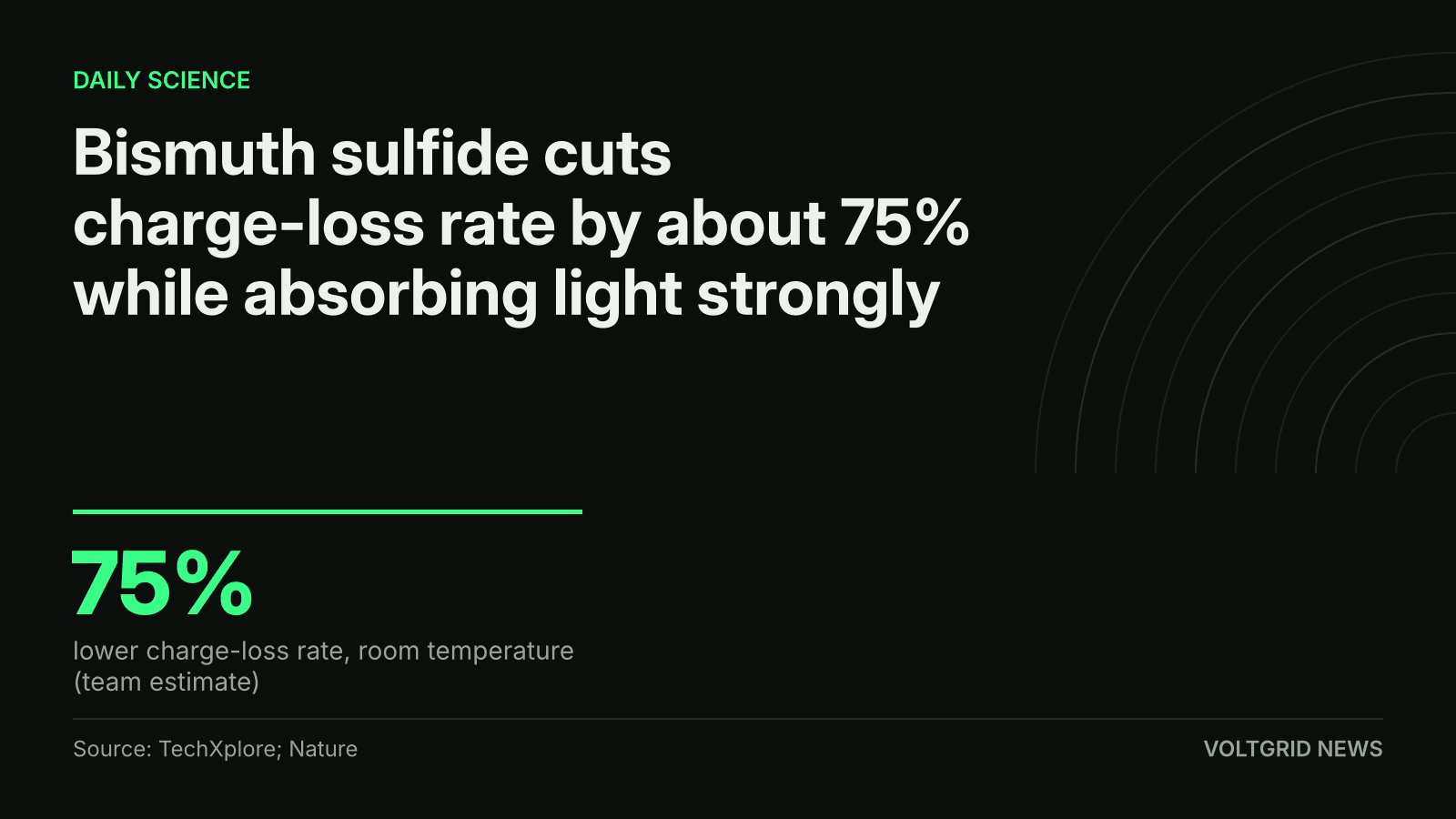
The researchers' room-temperature estimate compares bismuth sulfide with conventional materials that absorb light as strongly.
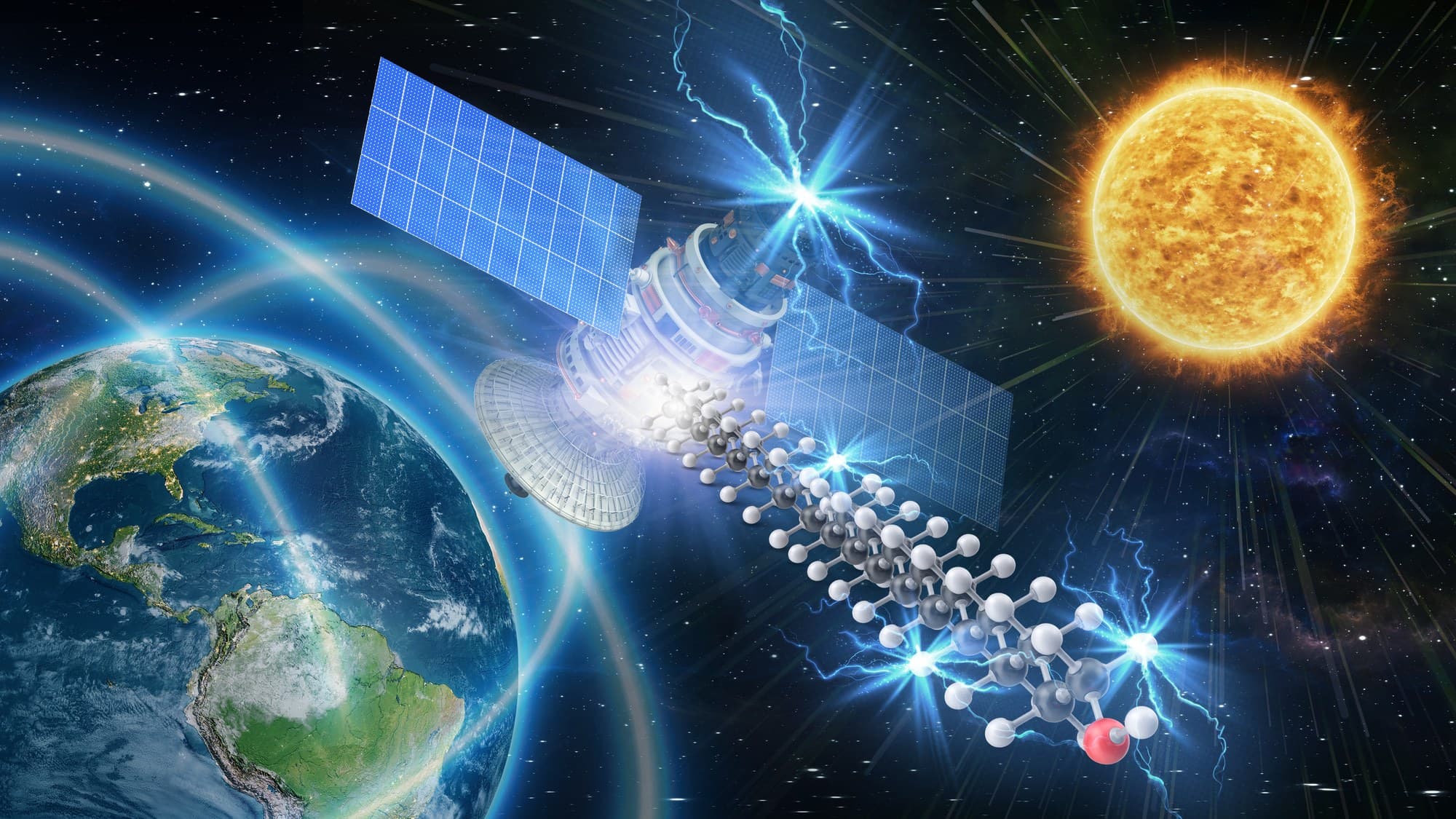
Illustration (AI-generated)
Researchers led by the University of Oxford report that bismuth sulfide, a semiconductor, absorbs sunlight strongly while cutting the rate at which it loses its electrical charges by about 75%, compared with conventional materials that absorb light as strongly, according to a study published on Oct. 28 in Nature and reported by TechXplore.
The 75% figure is the team's estimate for room temperature. It describes the rate at which charges are lost, and the researchers stress that the work demonstrates a physical mechanism, not a finished solar cell.
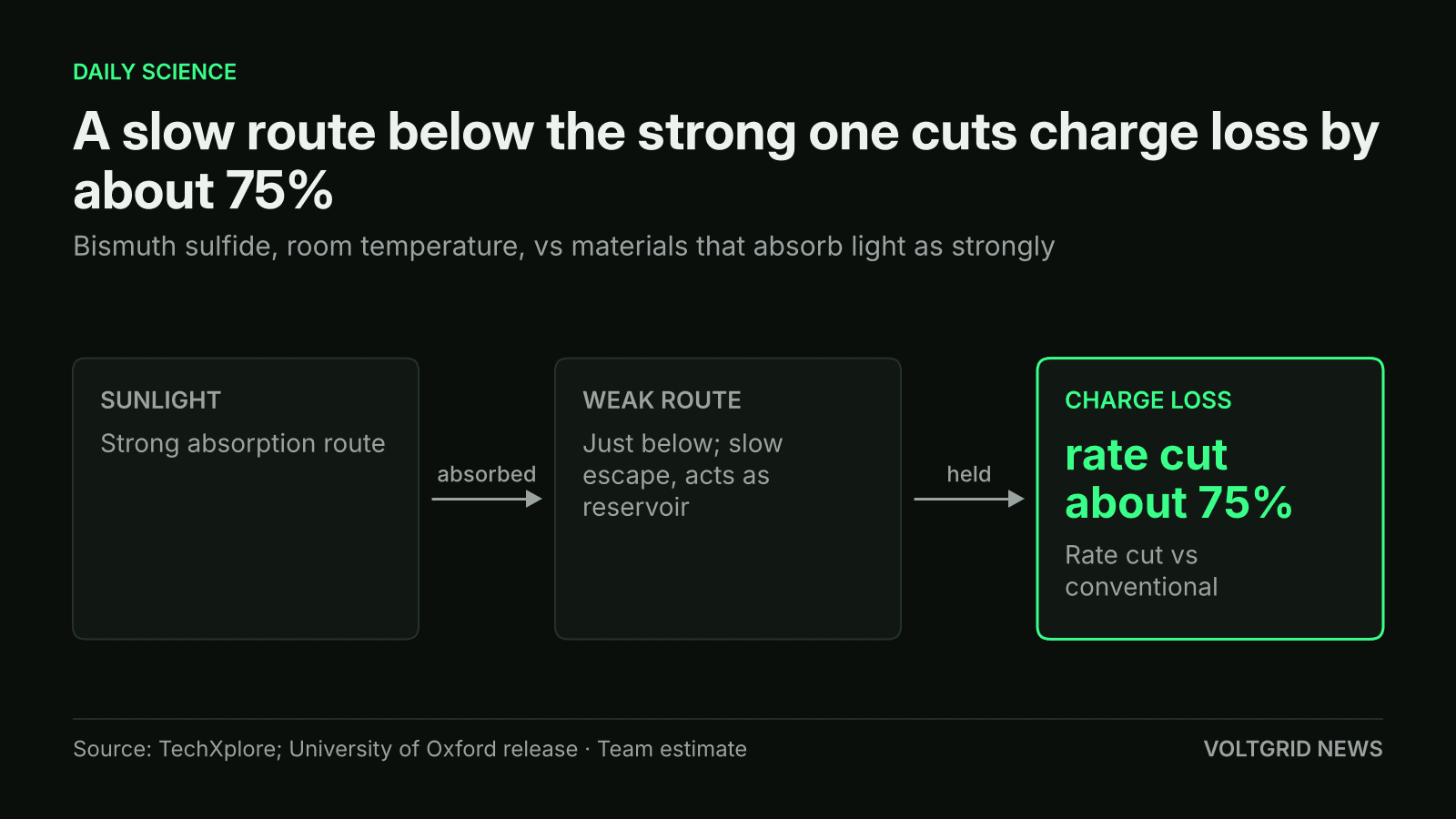
Bismuth sulfide's weak lower route slows charge loss, a team estimate of about 75% at room temperature, according to TechXplore.
Illustration (AI-generated)
The trade-off in solar cells
A solar cell relies on a semiconductor to absorb light and free electrons, which carry a negative charge and leave behind positively charged gaps called holes. To produce electricity, those charges must be collected before an electron and a hole meet and cancel each other out, which wastes the energy they carry.
The difficulty, the researchers said, is that materials which absorb light more strongly also tend to lose their charges more quickly. That link limits how efficiently solar cells can turn sunlight into electricity.
How bismuth sulfide sidesteps it
According to TechXplore's report on the study, the material has an unusual arrangement of energy levels. It absorbs light mainly through one strong route between energy levels. Just below it, a second and much weaker route lets charges escape only slowly.
The two routes sit so close in energy that charges spend much of their time in the lower states. Those states act as a temporary reservoir, a holding area that slows the loss. Physicists call a material with this arrangement a pseudo-direct semiconductor. The paper is titled "Delayed electron–hole recombination in a pseudo-direct semiconductor."
The team excited thin films of bismuth sulfide with extremely short laser pulses. They then tracked how fast the charges disappeared with a technique called ultrafast terahertz spectroscopy, at temperatures from room temperature to just above absolute zero. Calculations by Professor Marina Filip's group in Oxford's Department of Physics explained what makes the material unusual.
In most semiconductors, charges disappear faster as the material cools. In bismuth sulfide they disappeared more slowly, because more charges settled into the reservoir. That matched the model.
What it could mean for solar panels
Charges that last longer have more chance of being collected. The researchers said this could reduce one of the fundamental energy losses in solar cells without giving up strong light absorption. Longer-lived charges could also give more time for the chemical reactions needed to turn sunlight into fuels.
For readers following new absorber designs, such as the perovskite work Voltgrid reported earlier, this is a different kind of result: a design principle for choosing materials, not a record cell.
What is not confirmed yet
No solar cell has been built from the material in this study. "Further work is now needed to translate these findings into improved solar cell technologies," the report said, and it gave no timeline or efficiency figure for a device.
Corresponding author Professor Laura Herz said understanding the mechanism gives the team "a roadmap for discovering and potentially engineering other materials." She also said: "Our work shows that this trade-off is not inevitable." The team's calculations suggest such materials could be found by screening materials databases, or engineered.
The work was a collaboration between Oxford and Wuhan University in China.