Graphene Electrons Filmed Jumping a Gap With Up to 100% Probability
Regensburg, Marburg and Jülich researchers recorded electrons crossing an energy gap in graphene within one light cycle, a basic-physics result in Nature on Oct. 28, not a device.
3 min readAI-assisted
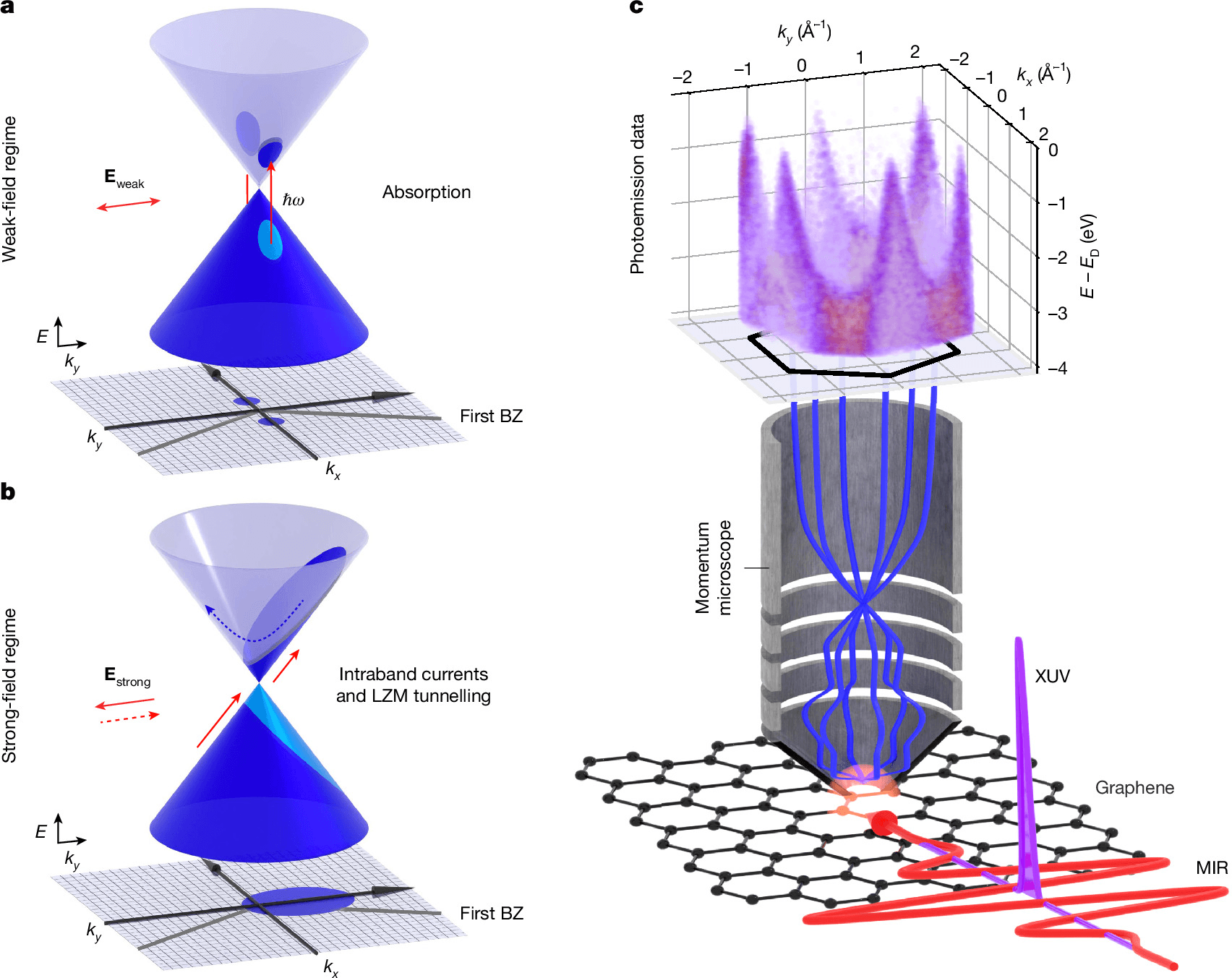
Figure 1 of the Nature paper: electrons in graphene's band structure under weak and strong light fields, and the momentum microscope used to image them.
Figure: Eggers et al., Nature (CC BY 4.0)
Source · Open-access figure from the Nature paper, licensed CC BY 4.0. · License
Researchers in Germany have filmed graphene electrons jumping across an energy gap within a single oscillation of a light wave, reporting a tunnelling probability of up to 100%. The study appeared in Nature on Oct. 28, 2026.
The teams come from the University of Regensburg, Philipps-Universität Marburg and Forschungszentrum Jülich. First author Vincent Eggers and colleagues, including Rupert Huber and Ulrich Höfer, call the technique subcycle band-structure videography. It records how electrons move through the full range of momenta in the crystal, not just a narrow slice of it.
How Graphene Electrons Jump an Energy Gap
The effect has a long name: Landau–Zener–Majorana tunnelling. The Jülich release compares it to an elevator that carries an electron from one floor to a distant one without stopping at the floors between. In graphene, a strong, fast-oscillating light field pushes electrons along their energy band. As they pass the point where the upper and lower bands come closest, some of them jump to the upper band instead of following the lower one.
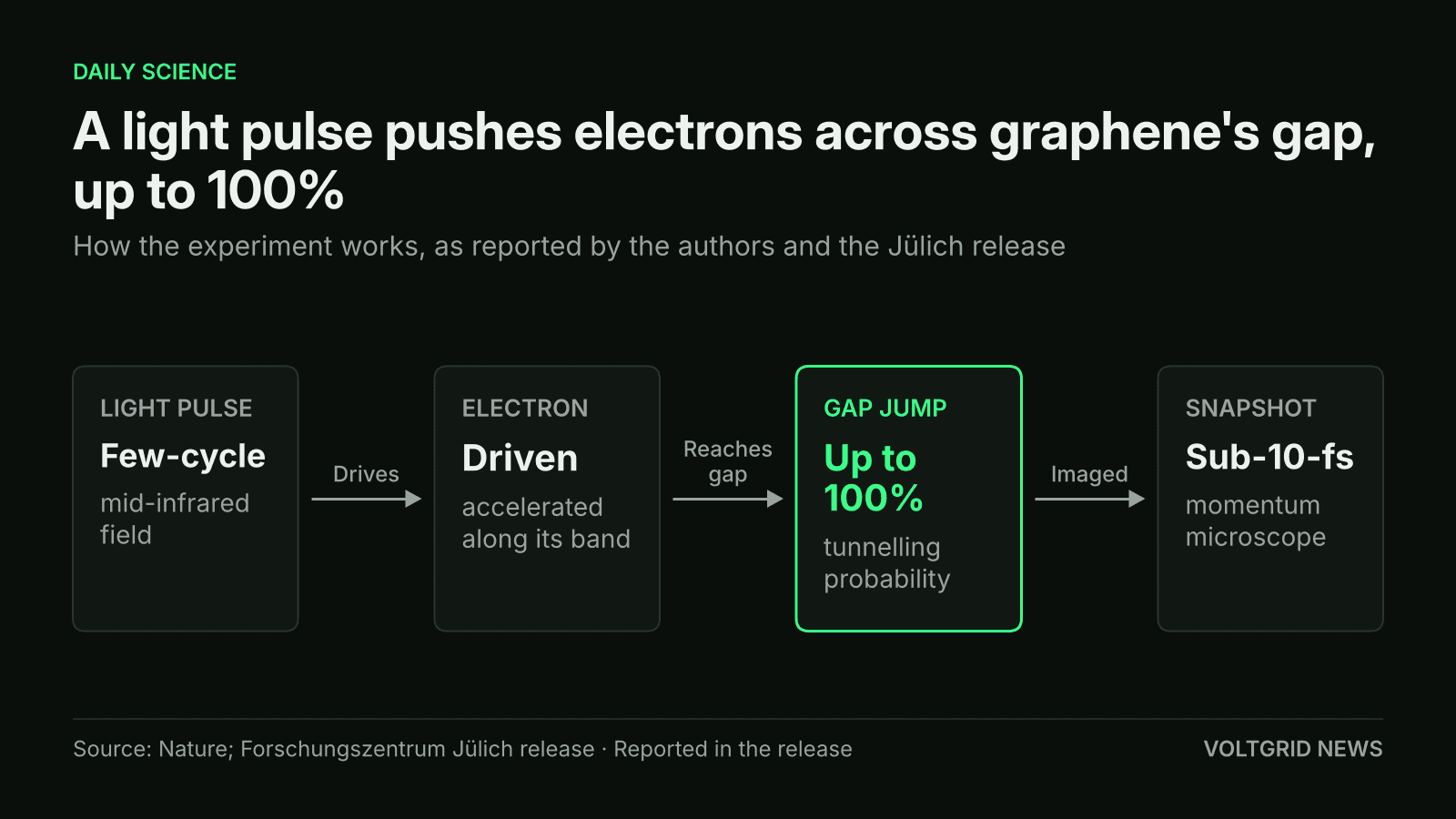
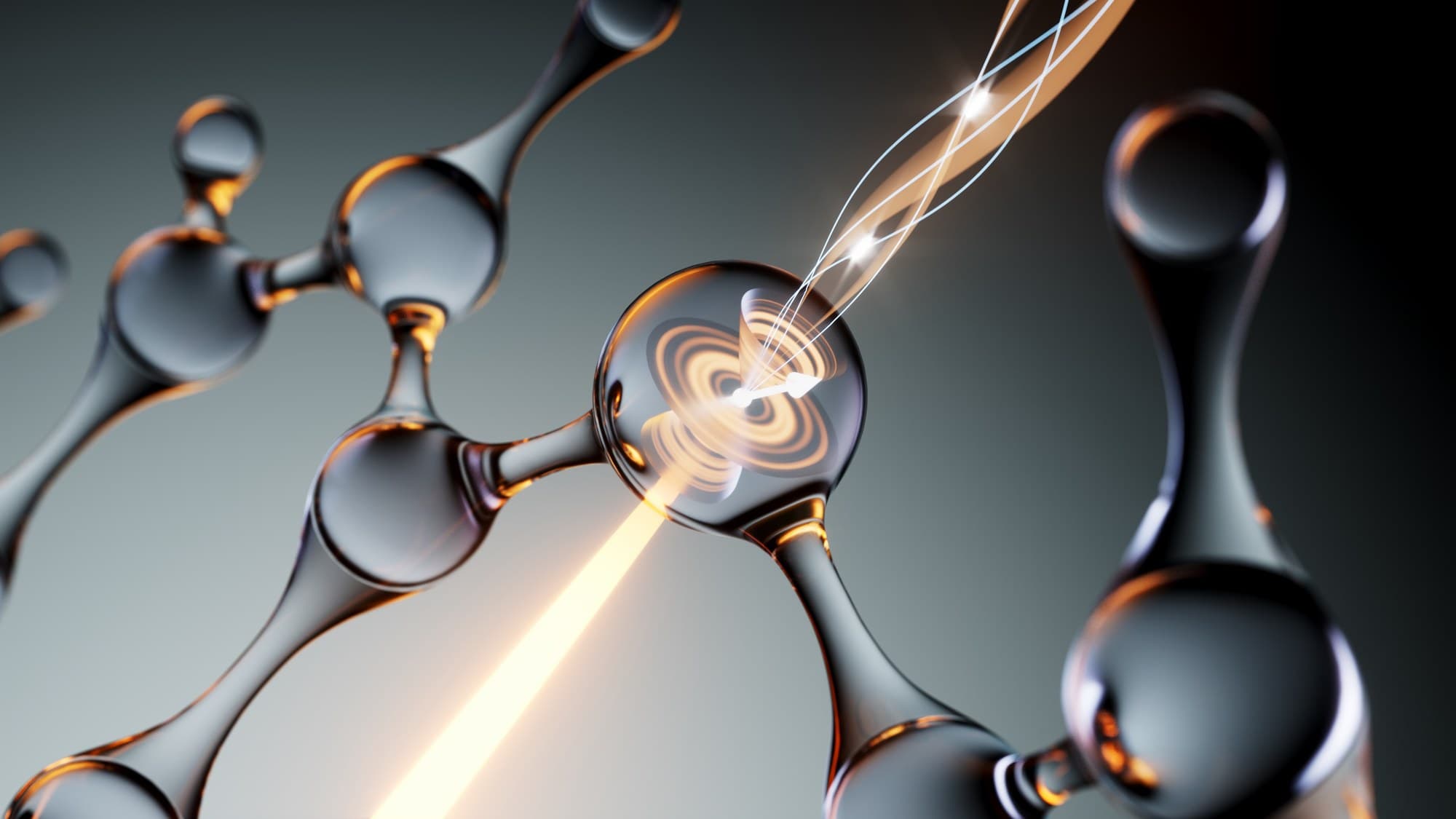
A strong light pulse drives electrons across graphene's gap with a tunnelling probability of up to 100%, the Jülich release reports.
Illustration (AI-generated)
According to the release, the jump is governed by how quickly electrons approach the gap. That separates it from ordinary tunnelling through a physical barrier. The authors report that under strong fields the electrons cross with a probability of up to 100%, even between clearly separated energy states.
How the Momentum Microscope Measures It
The team used a photoemission momentum microscope. It does not magnify an image. It records the energy and direction of motion of electrons knocked out of the sample and builds a map of their distribution. The group combined it with few-cycle mid-infrared light pulses and a time resolution below 10 femtoseconds (10 quadrillionths of a second).
In the paper, the authors say this raises the range of momenta they can follow at subcycle speed by more than two orders of magnitude and the usable field strength by one order of magnitude, compared with earlier approaches. The samples were atomically thin, high-purity carbon layers made at Jülich, including rotated graphene, which Stefan Tautz of Jülich said makes the dynamics clearer.
The electron cloud is displaced and distorted at the edge of the Brillouin zone, the repeating unit of momentum space in a crystal. The extreme, non-thermal distributions also let the researchers separate the effect of different scattering processes. Interactions with the crystal lattice disturb the orderly motion, which the authors say matters for control.
Why Lightwave Electronics Is Interested
Lightwave electronics aims to steer electrons with the oscillations of light instead of with voltages, which could in principle allow much faster switching than today's transistors. The Nature paper notes that graphene has already been used for the first lightwave electronic logic gates in earlier work, and frames the new view as a basis for quantum control, sensing and computation.
Voltgrid News reported earlier on INRS's light-pulse study of the pseudogap. Lightwave electronics is a research direction, not a product, and the new study is a measurement of a basic process in one material, made in a laboratory with specialised laser equipment. The release describes the link to high-speed semiconductor electronics as a long-held suspicion, and the authors propose, but do not show, that the method can be applied to other quantum materials.
What Is Not Confirmed Yet
No device, speed figure or timeline for chips comes with the study. Whether other materials show the same behaviour, and how well the control survives scattering at practical conditions, remain open. The paper is peer-reviewed and open access, and the raw data are public in the Jülich DATA repository.