SLAC X-Ray Study in Science Finds Chiral Signal in Altermagnet MnTe
SLAC reports chiral X-ray evidence in manganese telluride, backing a third class of magnetism. Spintronic memory uses are still prospective, and the result covers one material.
Science DeskEdited by Ege Erten
2 min readAI-assisted
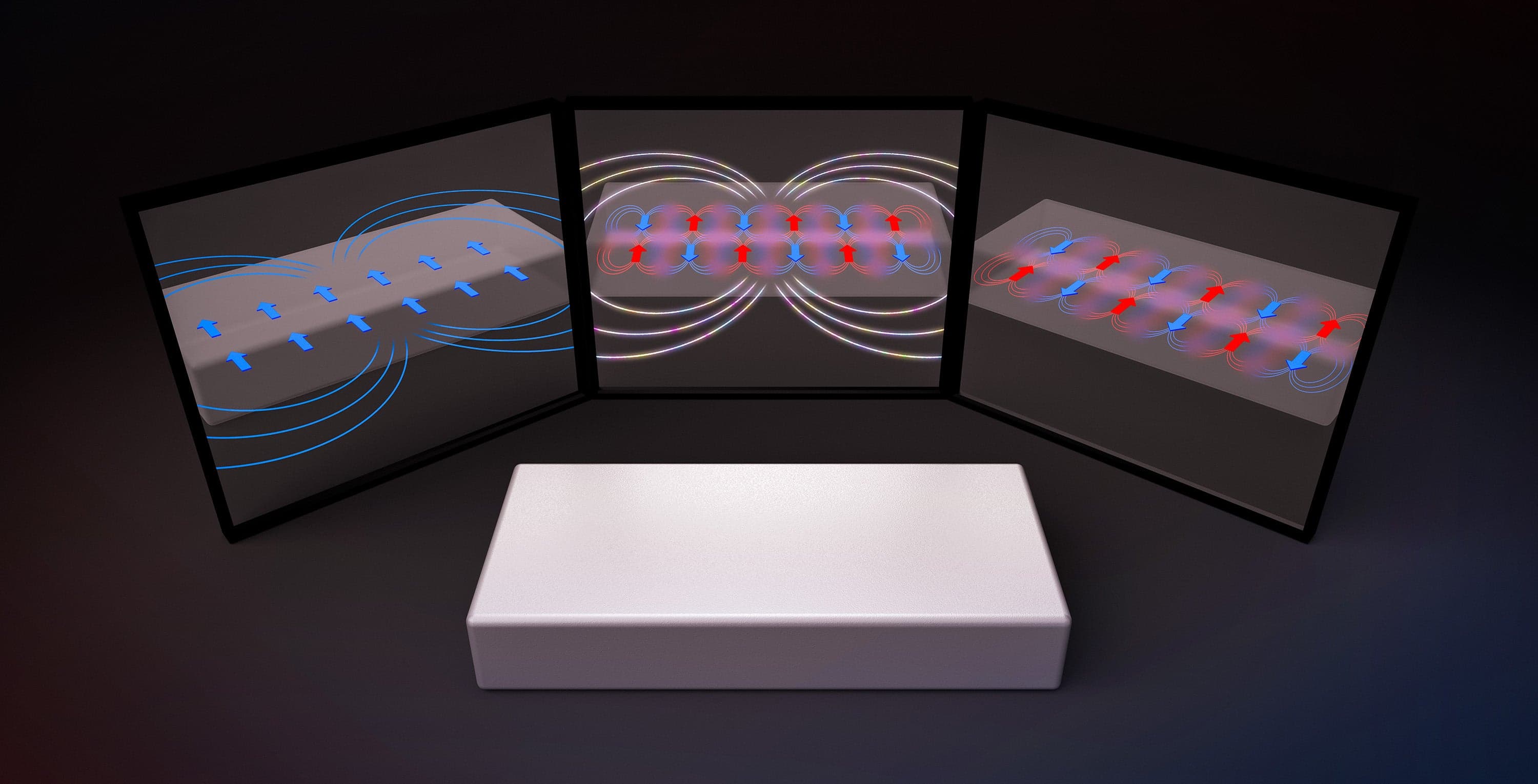
SLAC graphic of three proposed forms of magnetism: ferromagnetism (left), altermagnetism (center) and antiferromagnetism (right). It is an illustration, not a photo of the MnTe sample.
Image: Greg Stewart/SLAC National Accelerator Laboratory
Source · Press image from the SLAC National Accelerator Laboratory newsroom, used for news reporting.
Researchers at SLAC National Accelerator Laboratory report experimental evidence that manganese telluride (MnTe) is an altermagnet, a magnetic class proposed in 2022, in a paper published in Science on Oct. 29, 2026.
The lead author is Daniel Jost, an associate scientist at SLAC and the Stanford Institute for Materials and Energy Sciences. The team says the result gives robust confirmation of the third class of magnetism. That is the authors' own characterization, and the SLAC release gives no signal sizes or error bars.
What altermagnets are
For about 90 years, magnets were sorted into two groups. In ferromagnets the electron spins line up and produce a magnetic field. In antiferromagnets the spins alternate and cancel, so there is no net field.
Altermagnets, proposed in 2022, sit in between. The spins still alternate, but the crystal lattice around the "up" spins is rotated relative to the lattice around the "down" spins. That broken symmetry lets them carry spin-polarized currents while showing zero net magnetization.
How the team tested it
MnTe was long treated as an antiferromagnet and was suspected to be an altermagnet only a few years ago. To tell the two apart, the team looked for chirality, a handedness that a material cannot share with its mirror image. A conventional antiferromagnet should lack it. An altermagnet should show it.
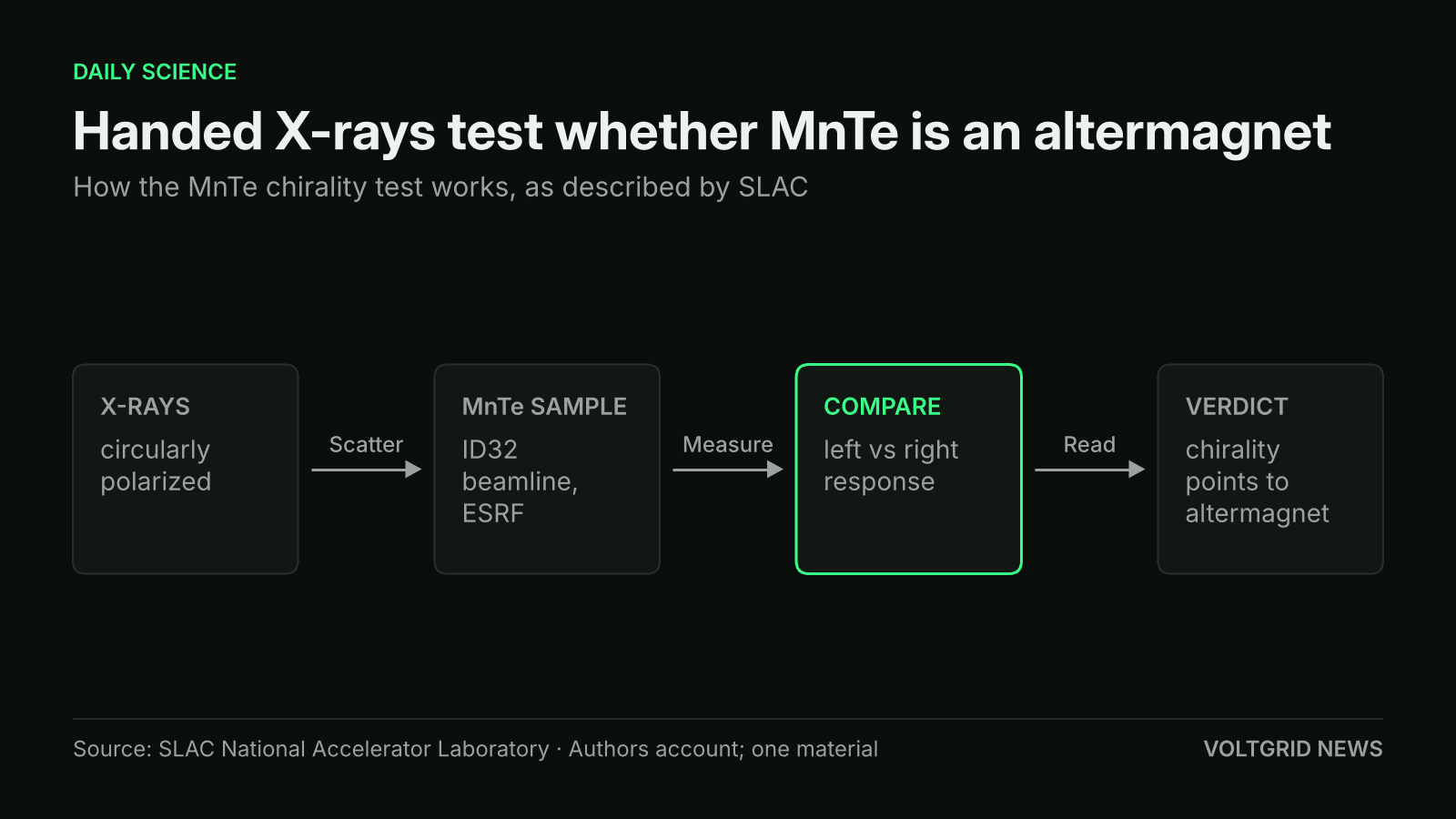
The test, as SLAC describes it: if left- and right-handed X-rays get different responses, MnTe has chirality, which points to altermagnetism.
Illustration (AI-generated)
They scattered circularly polarized X-rays off the sample and compared the response to left-handed and right-handed beams. A material without chirality would respond the same way to both. The measurement ran on the ID32 beamline at the European Synchrotron Radiation Facility (ESRF) in France, with postdoctoral scientist Rachel Nickel helping design and run the experiment. SLAC says a first experiment in 2024 was repeated in early 2025 and confirmed the earlier results.
Why computing engineers are watching
Spintronics uses the spin of electrons as well as their charge to store and read data. SLAC says altermagnets could suit memory devices, quantum technologies and data centers, because zero net magnetization makes bits harder to flip by accident from outside magnetic fields, while the spin-polarized current still lets the data be read.
These uses are prospective. The release does not give a device, a power figure or a date, and the result covers one material. Other recent Voltgrid coverage of spin physics includes the Bristol work tying cuprate superconductivity to electron spin and the Warwick X-ray study of cuprates.
What is not settled yet
The release describes MnTe as a candidate in places, and independent replication has not been reported. The team plans to study how altermagnetic states can be controlled with light and electricity. The work was supported in part by the U.S. Department of Energy Office of Science.