Cuprate Superconductors Are a Patchwork, Warwick X-Ray Study Finds
A Physical Review Letters study maps two coexisting crystal structures in a 214 cuprate, with boundaries far wider than expected. The team says they may hold back superconductivity.
2 min readAI-assisted
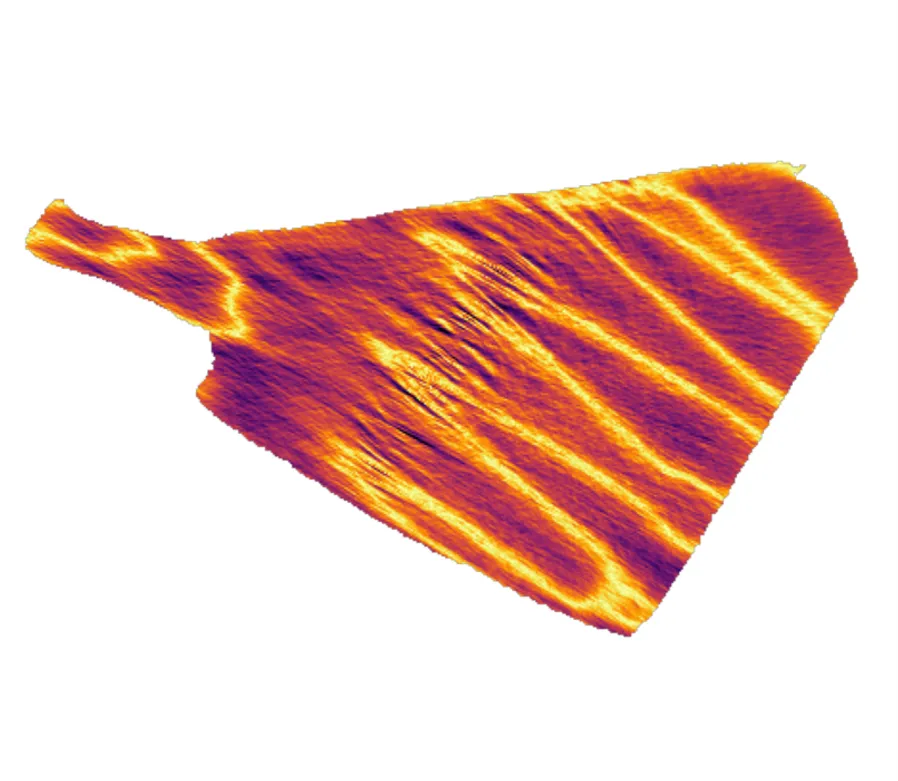
Map of the crystal from the University of Warwick release. The bright stripes mark the boundaries between the two coexisting structures; the release gives no further scale.
Image: University of Warwick
Source · Press image from the University of Warwick newsroom, used for news reporting.
University of Warwick and European Synchrotron Radiation Facility (ESRF) researchers have found that a widely studied cuprate (copper-oxide) superconductor is not uniform inside: it is a patchwork of two slightly different atomic arrangements, with boundaries "hundreds of times wider than expected", according to a Warwick release carried by ScienceDaily.
The work, led by Professor Mark Senn of Warwick's Department of Chemistry, appeared in Physical Review Letters (volume 137, issue 12) under the title "Giant Domain Walls and Intrinsic Heterogeneity in 214 Cuprate Superconductors". The authors are Evie Ladbrook, Jon P. Wright and Senn. The study covers the 214 family of cuprates, the copper-oxide ceramics that have been studied since the 1980s.
Senn said: "For forty years, the working assumption has been that these materials are the same all the way through." The new maps suggest otherwise.
How the team looked inside the crystal
The researchers used scanning 3D X-ray diffraction at the ESRF in France. The release compares the method to a CT scan, but for the positions of atoms rather than tissue. It maps how atoms are arranged deep inside a single crystal instead of averaging over the whole sample.
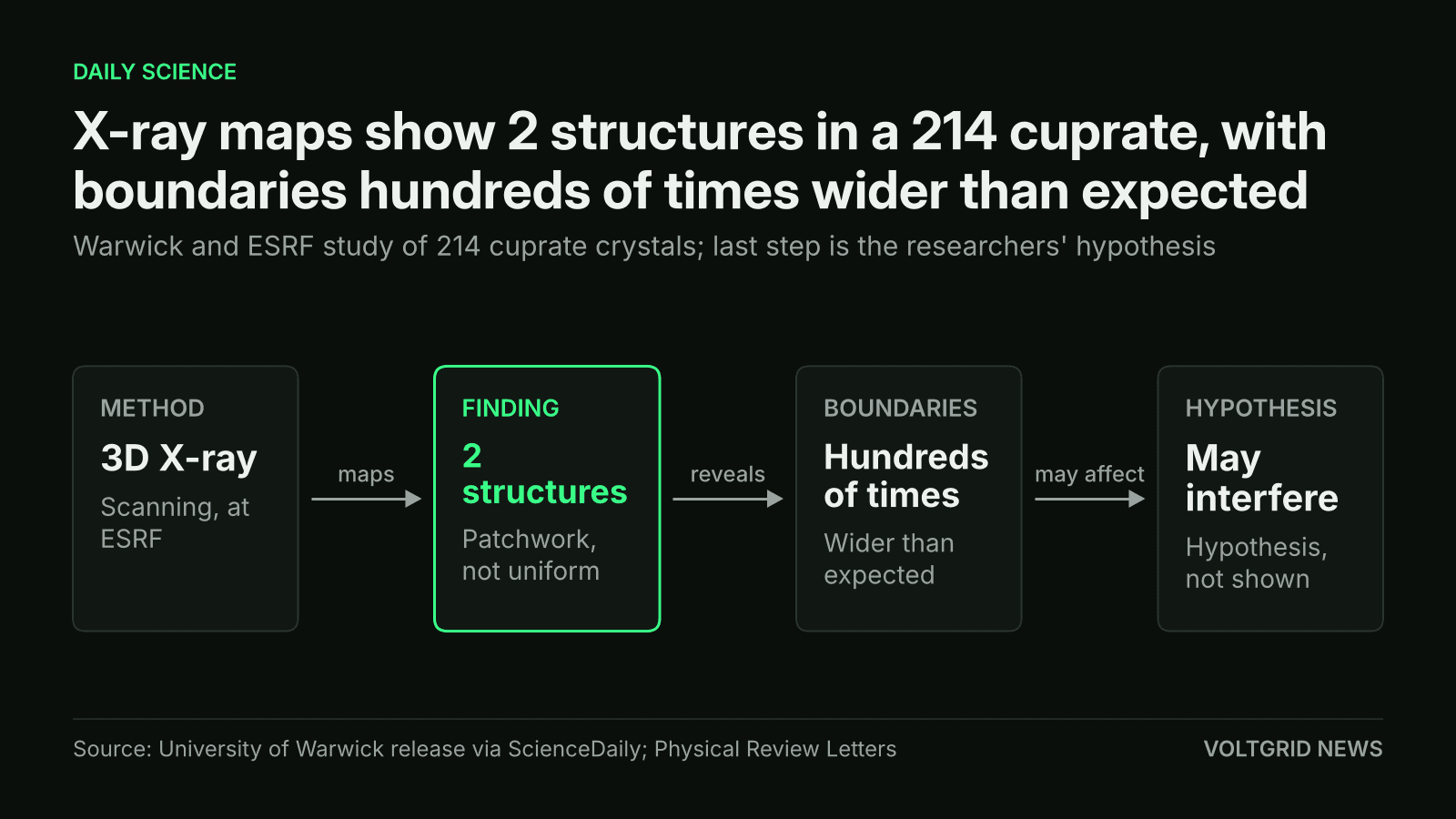
The team's hypothesis that the wide boundaries may interfere with superconductivity has not been shown, according to the Warwick release.
Illustration (AI-generated)
That is how the two coexisting structures showed up. The boundaries between them, called domain walls, turned out to be wide enough to behave almost like a third structure of their own. That could change how electric current moves through the material.
Why it matters for superconductor research
Cuprates are the best-known high-temperature superconductors, and they are a long-running testbed for ideas about how superconductivity works. If real crystals are this uneven, some earlier bulk measurements, which average over a whole sample, may need to be reinterpreted, the researchers say. Future theories will also have to account for structural complexity in real crystals.
The team suggests the hidden structure may help explain why some superconductors perform better than others. For Voltgrid readers watching superconducting cable, magnet and quantum-hardware supply chains, this is basic science with no product attached, but it targets the material quality question that those technologies depend on. Voltgrid has covered other cuprate work this week, including a Bristol result tying superconductivity to electron spin and an INRS light-pulse study on the pseudogap. This study is a separate finding: it concerns crystal structure, not electron behaviour.
What is not confirmed yet
The claim that the wide boundaries work against superconductivity is a hypothesis. The release says they "likely" do and "may" interfere with it. The researchers also only suspect that similar patterns are common in other cuprates and in materials that become superconducting under extreme pressure; that has not been shown.
The release does not give transition temperatures or sample details, and it does not report any change in a measured superconducting property. Next steps named by the team are reinterpreting earlier bulk data, building models that include the structural complexity, and applying the imaging technique to other materials.