Andreev Qubit Readout Without Ancillas Reaches 99.85% in Simulation
A Physical Review B theory paper simulates reading an Andreev qubit from its own supercurrent at up to 99.85% accuracy, with no ancilla qubits. No device has been built.
2 min readAI-assisted
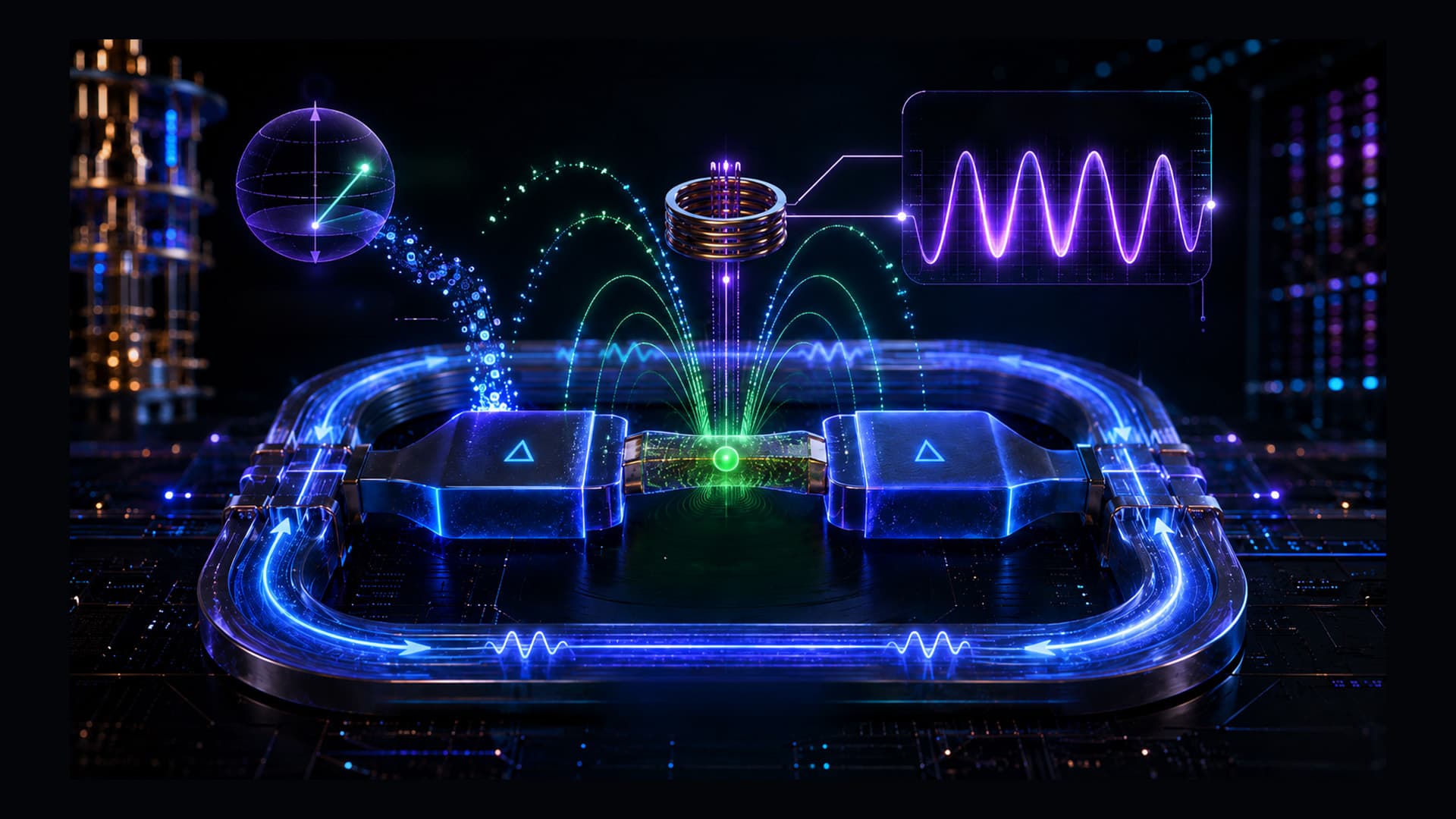
Conceptual illustration from the FAPESP release, not a photo of a built device. The readout is a simulated proposal; no device has been fabricated.
Image: Agência FAPESP
Source · Image from the Agência FAPESP release, published under Creative Commons CC-BY-NC-ND and used for news reporting. · License
Physicists at the University of São Paulo and the Beijing Institute of Technology report a theoretical Andreev qubit readout that reads a superconducting qubit through the current it carries, with simulated accuracies of 99.52%, 99.81% and 99.85%, according to a release from the Brazilian research agency FAPESP republished by Phys.org.
The work is theoretical. No one has yet built the measurement setup, and the numbers come from simulations, not a lab run.
A qubit is the basic unit of a quantum computer. Looking at it normally forces it into a single answer and erases the delicate state it held. The usual workaround is to copy the information onto a helper qubit, called an ancilla, and measure that instead. The authors say this is slow and costly, because the helpers must be prepared, linked to the main qubit and measured, then reset for the next round.
How Andreev Qubit Readout Works
The qubit in the study is an Andreev qubit: a quantum dot in an indium arsenide (InAs) nanowire sitting between two superconductors. A supercurrent is electricity that flows through a superconductor with no resistance. In this design the supercurrent oscillates on its own with no voltage applied, and a SQUID, a very sensitive magnetic-field detector, picks up the field it creates. The qubit's state shapes that oscillation, so reading the field tells the researchers the state, with little disturbance, and no helper qubit is needed.
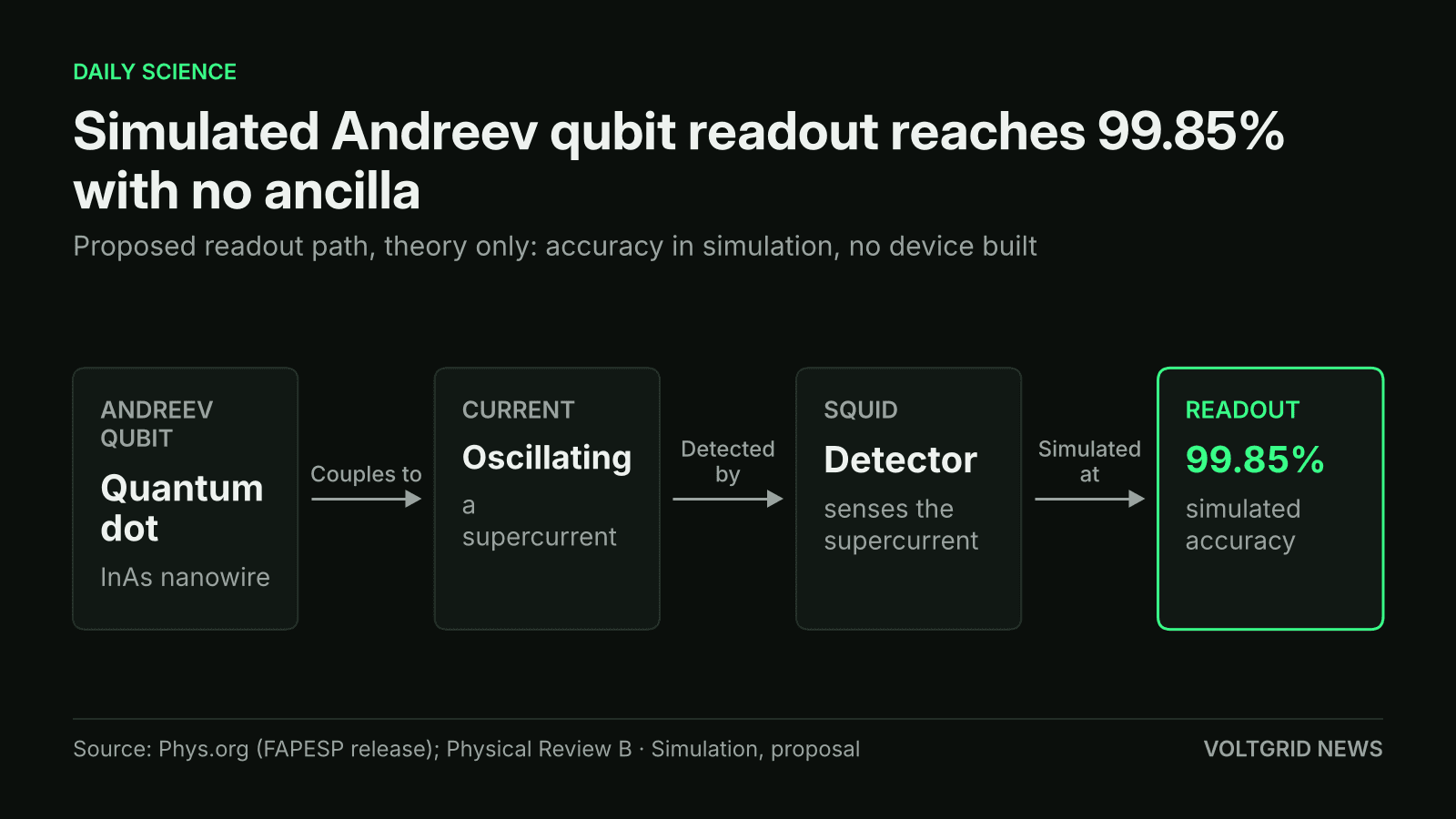
In simulation the supercurrent readout reaches 99.85% accuracy without ancilla qubits, according to the Physical Review B theory paper; no device has been built.
Illustration (AI-generated)
The paper, titled Andreev qubit readout from dynamic interference supercurrent, appeared in Physical Review B in 2026 (DOI 10.1103/6gkt-hghj). The release names José Carlos Egues of the São Carlos Institute of Physics at the University of São Paulo and Yugui Yao of the Beijing Institute of Technology as leaders of the work. The authors place the simulated accuracies within the thresholds that standard quantum error correction needs.
What Skipping Ancillas Could Change
Error correction depends on measuring many qubits again and again without wrecking them. A readout that skips ancillas could mean fewer qubits and simpler wiring in a future superconducting quantum chip. That matters for the size and cooling load of quantum hardware, though the source gives no timeline. Voltgrid News reported earlier on superconductor research from Warwick.
What Is Not Confirmed Yet
Experiments must still confirm the predicted voltage-free oscillating supercurrent, and someone must fabricate the proposed geometry. The measurement still disturbs the qubit slightly, although the simulations suggest the effect can be made negligible. Egues said the parameters come from existing systems and that no new technology is required, but that is the authors' view, not a demonstrated result.