Hanbat Disordered Lithium-Rich Cathode Keeps 90% Capacity After 50 Cycles
South Korea's Hanbat National University reports a deliberately disordered, cobalt-free lithium-rich cathode kept about 90% of capacity; the release gives no mAh/g or full-cell data.
2 min readAI-assisted
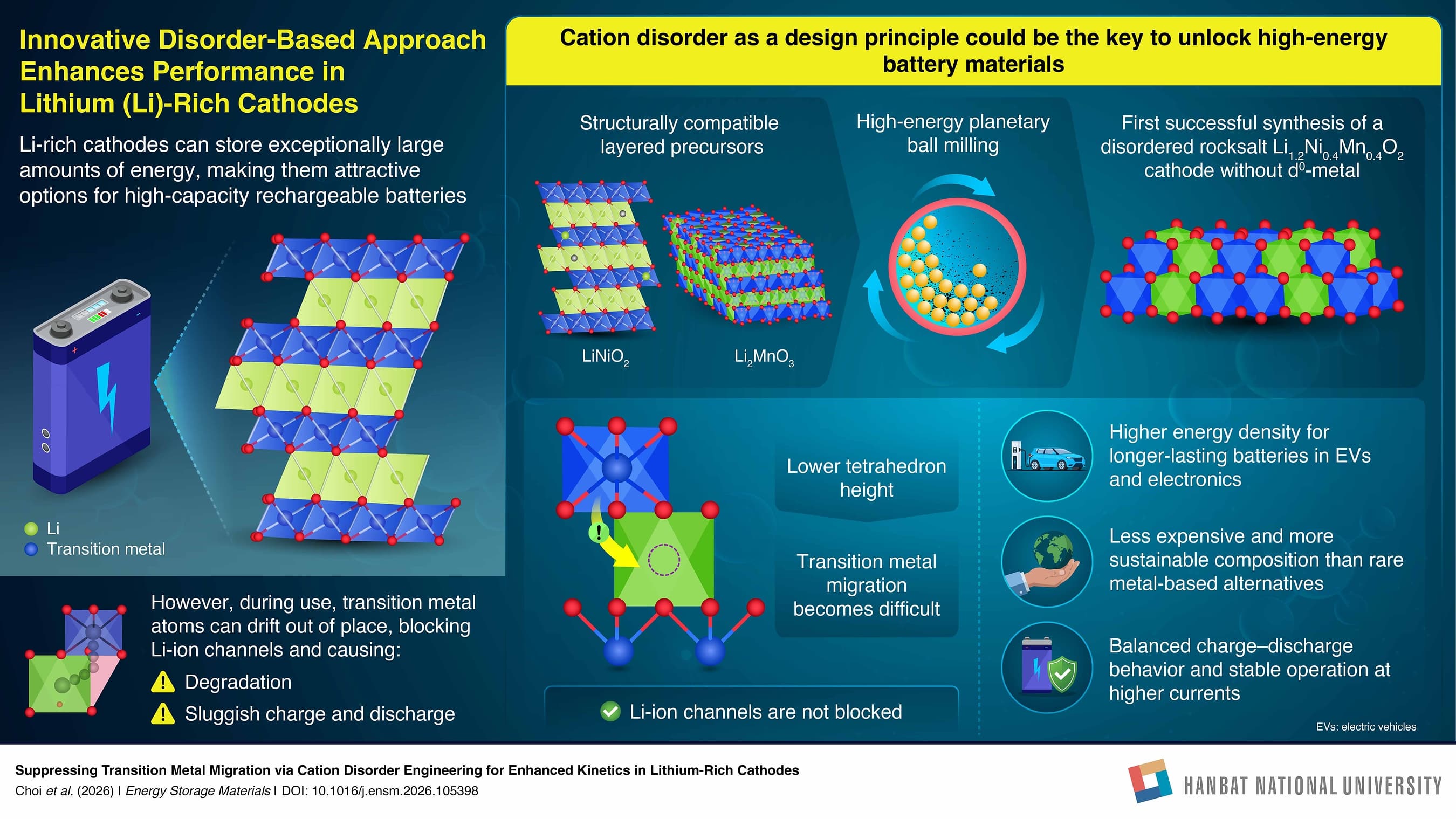
Hanbat National University's own graphic summarizing the study: layered precursors are ball-milled into a disordered rocksalt cathode. It is an illustration from the release, not a photo of the cells.
Image: Hanbat National University
Source · Press image from the Hanbat National University release, used for news reporting.
Researchers at Hanbat National University in South Korea made a lithium-rich cathode that kept about 90% of its initial capacity after 50 charge-discharge cycles with no drop in voltage, the university said in a release on Oct. 23. The trick was to disorder the material on purpose.
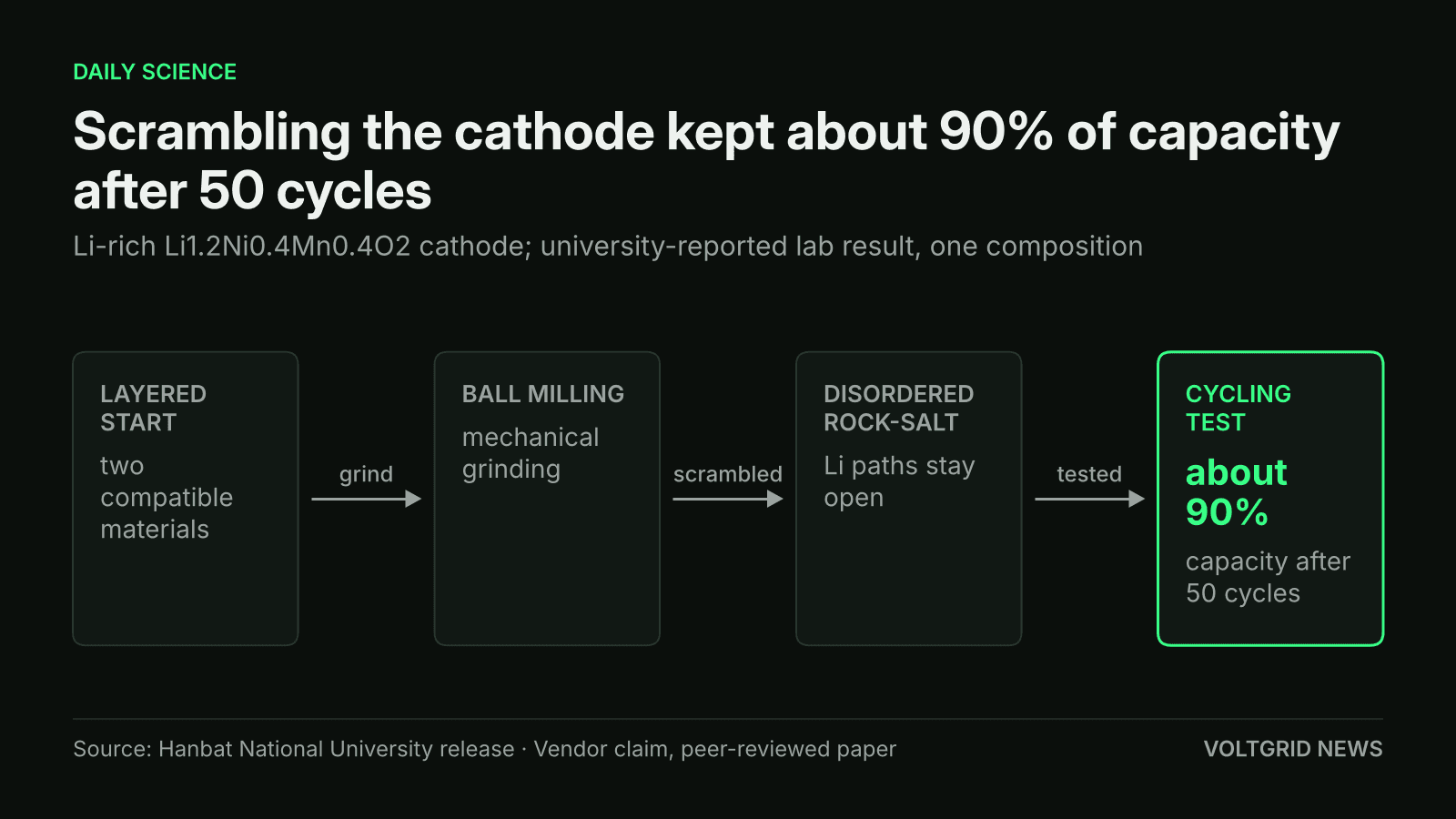
The university reports about 90% of capacity retained after 50 cycles for the disordered cathode, a laboratory result on one composition.
Illustration (AI-generated)
The work, led by Professor Kyojin Ku, was published on Aug. 1, 2026 in volume 90 of the journal Energy Storage Materials, after appearing online on July 18. The team studied Li1.2Ni0.4Mn0.4O2, a nickel-manganese composition that avoids cobalt. Lithium-rich cathodes are attractive because they promise higher energy density than conventional designs, which matters for electric vehicles and stationary storage. Voltgrid News also reported on Surrey's sodium-ion cathode tests.
Why Ordered Lithium-Rich Cathodes Fade
In a normal layered cathode, lithium ions sit in one set of planes and transition metals, here nickel and manganese, sit in others. During operation, the transition-metal ions can drift out of place and block the paths lithium needs to move through. That loss of access is a known cause of performance decline in this family of materials. Scientists have traditionally tried to keep the crystal as orderly as possible to prevent it.
How Disordered Cation Structure Keeps Lithium Moving
The Hanbat team went the other way. According to the release, they used high-energy ball milling, a mechanical grinding process, on two structurally compatible layered starting materials. The grinding scrambled the positions of the cations, the positively charged ions, so lithium and transition metals ended up more randomly distributed in a rock-salt arrangement.
Ku said in the release that this decoupled lithium movement from the harmful movement of transition metals. Lithium still flows through a connected network of open pathways, while the transition metals are effectively locked in place. The researchers compared the result with an ordered version of the same material and report more symmetric charge-discharge behavior, higher capacity and better performance at high currents. The release gives no capacity figures in milliamp-hours per gram.
What Is Not Confirmed Yet
This is a laboratory result on one composition, and the release reports 50 cycles, far fewer than an EV battery must survive. It does not describe full cells, cost or manufacturing at scale. Ku said that if the principle is developed further it could help move lithium-rich cathodes closer to commercial use, which is a possibility, not a schedule. For cell makers weighing high-energy, cobalt-free chemistries, the finding is a design lead worth watching, not a product. Voltgrid News also covered Fraunhofer ISE's silicon-anode cells.