Yokohama Slow-Light Silicon Modulator Hits 200 Gb/s at 320 µm
Yokohama National University researchers report a slow-light silicon modulator that reaches 200 Gb/s with PAM-4 signalling in a 320 µm device. It is a lab result with no commercialization timeline.
3 min readAI-assisted
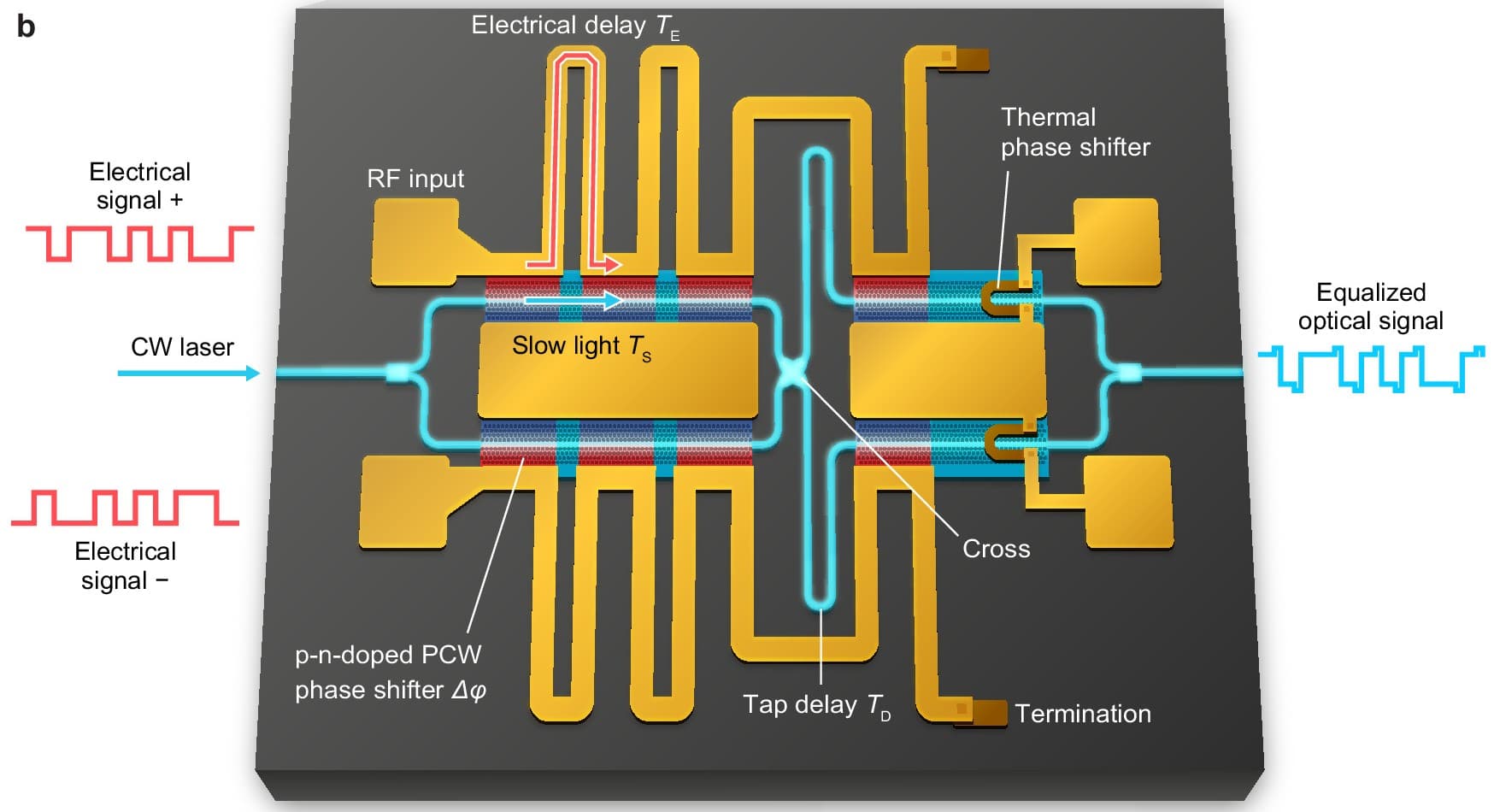
Schematic of the 320 µm slow-light modulator with its built-in electro-optic equalizer, cropped from Fig. 1b of the open-access paper. It is an illustration, not a photo of the device.
Image: Kawahara et al., Nature Communications (CC BY 4.0), cropped
Source · CC BY 4.0, open-access figure from Kawahara et al., Nature Communications 2026; cropped from the original. · License
A team led from Yokohama National University has built a slow-light silicon modulator about 320 µm long that reaches 200 Gb/s with PAM-4 signalling and a low-complexity 11-tap receiver equalizer, according to a paper published in Nature Communications on Oct. 22. Without any digital signal processing it reached 180 Gb/s, the paper says.
The open-access paper is titled "Reduced-DSP 200G/λ low-voltage slow-light silicon modulator enabled by built-in EO equalizer". Keisuke Kawahara, of the Institute of Science Tokyo and Yokohama National University, is first author, and Toshihiko Baba, a professor in Yokohama National University's Faculty of Engineering, is senior author. The National Institute of Advanced Industrial Science and Technology (AIST) and the Photonics Electronics Technology Research Association (PETRA) also took part. Tech Xplore reported on the work the same day.
What the device does
A modulator turns electrical data into light on a fibre link. AI data centers need such links because copper only works over very short distances; beyond about 1 m, fibre optics are needed, Tech Xplore reports. The common design, the Mach-Zehnder modulator, is nearing its physical limits.
The new device uses a silicon photonic crystal waveguide, a nanostructure patterned with tiny holes, to produce "slow light". Slowing the light increases how strongly it interacts with the silicon, which improves modulation efficiency. The catch is that earlier slow-light modulators lost bandwidth because of high electrical resistance. The team added a built-in electro-optic equalizer to compensate.
The 3-dB bandwidth reached 80 GHz on one variant of the device; the variant used for the 200 Gb/s test measured 55 GHz, the paper says. It puts conventional long silicon modulators below 50 GHz. The device ran at 140 Gb/s with simple on-off keying at 26 fJ per bit. With PAM-4, a format that packs two bits into each signal level, it reached 180 Gb/s without digital signal processing and 200 Gb/s with an 11-tap digital equalizer.

The 200 Gb/s result needs a low-complexity 11-tap receiver equalizer; without any digital signal processing the device reached 180 Gb/s, the paper says.
Illustration (AI-generated)
According to Tech Xplore, the team compares this with conventional Mach-Zehnder modulators, which it says are typically 2 to 4 mm long and use several thousand fJ per bit at the same speed; the paper itself says such modulators typically extend several millimetres. The team claims about one order of magnitude smaller footprint and two orders of magnitude better modulation efficiency, a comparison relayed by Tech Xplore that the paper does not state as ratios.
The drive voltage, 0.6 V for 140 Gb/s on-off keying and 1.5 V peak-to-peak for 200 Gb/s PAM-4, is compatible with FinFET CMOS drivers, the paper says, and the devices were fabricated at AIST using ArF immersion lithography on silicon. Tech Xplore contrasts that with thin-film lithium niobate, which often needs specialised bonding steps.
Why it matters for AI data centers
A shorter, lower-energy modulator would let more optical channels fit on one chip and cut the energy spent per bit, two limits on optical links between AI accelerators. The authors write that the architecture "offers promise as a building block for future co-packaged optics", where optical engines sit next to the processor.
Why Slow Light Shrinks an Optical Modulator
A modulator writes data onto light by changing how the light travels through a silicon waveguide. Slowing the light inside a photonic crystal waveguide, which is silicon patterned with tiny holes, lets a short stretch of silicon do the work of a long one. The paper reports a total device length of 320 µm, against several millimetres for conventional silicon Mach-Zehnder modulators.
The catch is speed: short slow-light devices lose bandwidth to electrical resistance. The team's built-in electro-optic equalizer boosted the 3-dB bandwidth of one variant from 35 to 80 GHz. Insertion loss of 11.7 to 15.5 dB still has to fall before co-packaged optics can use it, the paper says.
What is not confirmed yet
This is a laboratory result, not a product, and neither the paper nor the report gives a commercialisation plan or timeline. The device's optical insertion loss of 11.7 to 15.5 dB was compensated by an erbium-doped fibre amplifier in the test setup, and the paper says it must be reduced for co-packaged optics. The 200 Gb/s figure also depends on PAM-4 and a digital equalizer.