IQM Emerald Entangles All 54 Qubits at 0.516 Fidelity, Above 0.5 Bar
IQM says its cloud-accessible Emerald chip entangled all 54 qubits on Oct. 29, up from about 30 before, but offers no paper and a thin margin over the 0.500 threshold.
Science DeskEdited by Ege Erten
2 min readAI-assisted

IQM's press illustration for its 54-qubit entanglement announcement. It is a conceptual image, not a picture of the Emerald chip.
Image: IQM
Source · Press image from the IQM newsroom, used for news reporting.
IQM Quantum Computers (Nasdaq: IQMX) said on Oct. 29, 2026 that its cloud-accessible IQM Emerald system has entangled all 54 qubits on the chip at the same time, with a measured fidelity of 0.516 against a threshold of 0.500 for genuine entanglement.
The company made the claim in its own press release from Espoo, Finland. IQM says the practical limit on Emerald for such a test had been on the order of 30 qubits, and that large-chip studies typically use 10 to 20.
How the entanglement test works
IQM prepared a Greenberger-Horne-Zeilinger (GHZ) state, a standard entanglement benchmark in which every qubit is tied to every other. If any one qubit or link between qubits misbehaves, the score drops. Fidelity is that score: how closely the state the chip produced matches the ideal one. The release calls 0.500 the classical threshold for genuine entanglement.
Craig Ciesla, IQM's chief technology officer, said that entangling the entire chip means every qubit and every connection between them has to work correctly in the same circuit.
What the numbers show
The release gives two results. A 40-qubit state reached a fidelity of 0.515 without readout error mitigation (REM), a correction applied to the measured results. The full 54-qubit state reached 0.516 with REM. The margin over the 0.500 line is therefore small, and the two figures are not measured the same way.
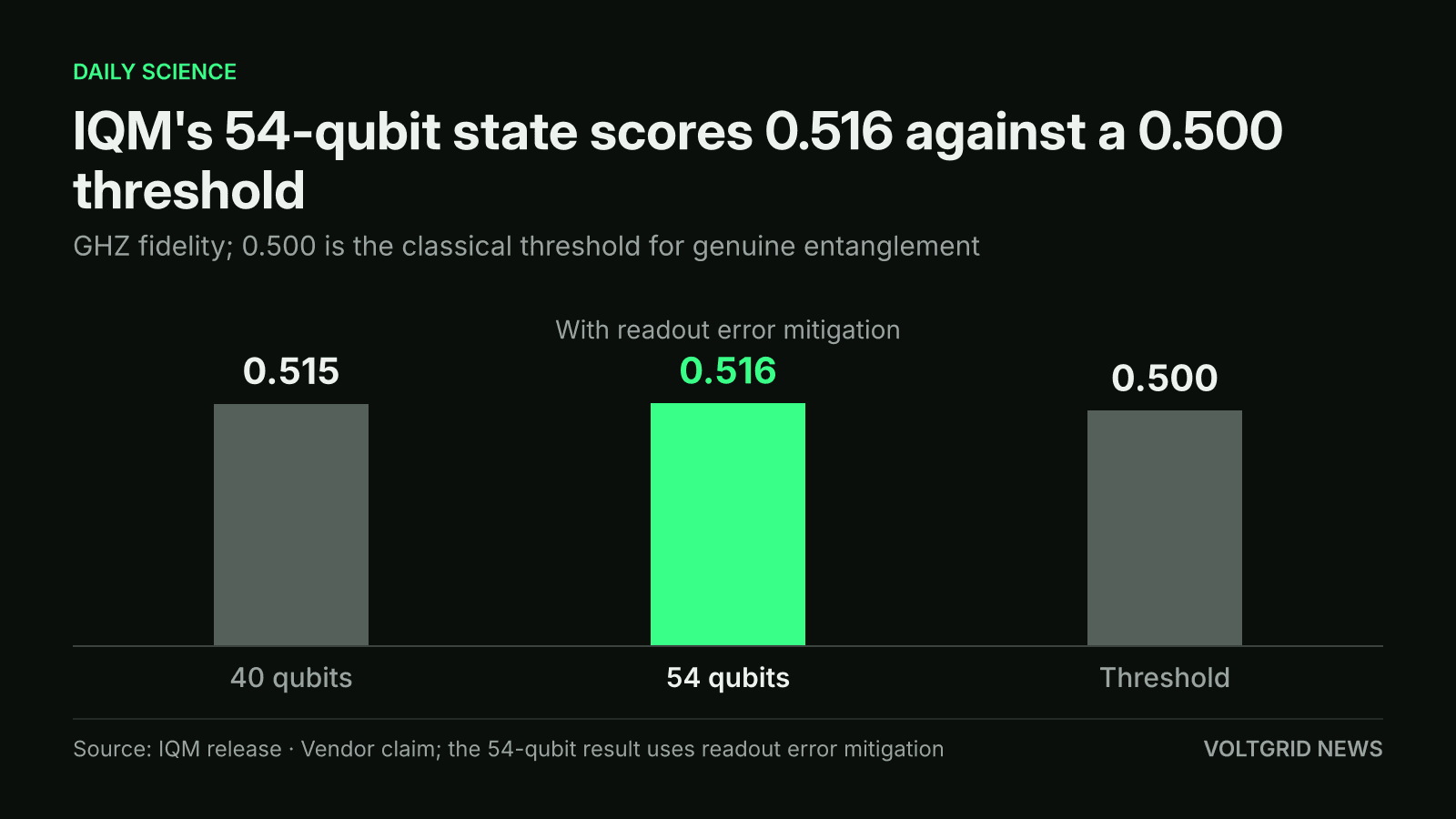
IQM reports 0.516 fidelity for the 54-qubit state with readout error mitigation; the 40-qubit 0.515 is without it. Vendor figures.
Illustration (AI-generated)
IQM credits roughly a year of hardware and calibration work. It lists an automated routine that picks which qubits and two-qubit gates to use, balancing gate fidelity against the time qubits sit idle, plus an updated calibration method, an improved gate set and error-reduction tools such as dynamical decoupling. The company says these tools cut error rates of quantum operations by up to 50%.
Why it matters beyond one chip
Voltgrid News has tracked quantum hardware scaling in other designs, such as IBM's link between two 120-qubit chips and a single-molecule qubit aimed at photonic chips. IQM's result is a different kind of progress: not more qubits, but proof that the existing ones work together in one circuit. For cloud users, Ciesla said current and prospective customers now have the chance to use the same tools and system performance that made the result possible.
What is not confirmed yet
The release links to no paper, and no arXiv preprint or peer-reviewed study was found, so the figures are IQM's own and have not been independently checked. The release gives no date for when the full-chip tools reach cloud customers, and it does not say how many users will run 54-qubit circuits or what the result means for useful algorithms. A GHZ state is a benchmark of quality, not a calculation of practical value.