IBM Links Two 120-Qubit Quantum Chips With Four Cables at 99% Fidelity
IBM researchers joined two 120-qubit processors with four 80 cm superconducting cables and moved quantum states between them at 99.00% average fidelity. It is a preprint, and the chip-to-chip gates are still weaker.
2 min readAI-assisted
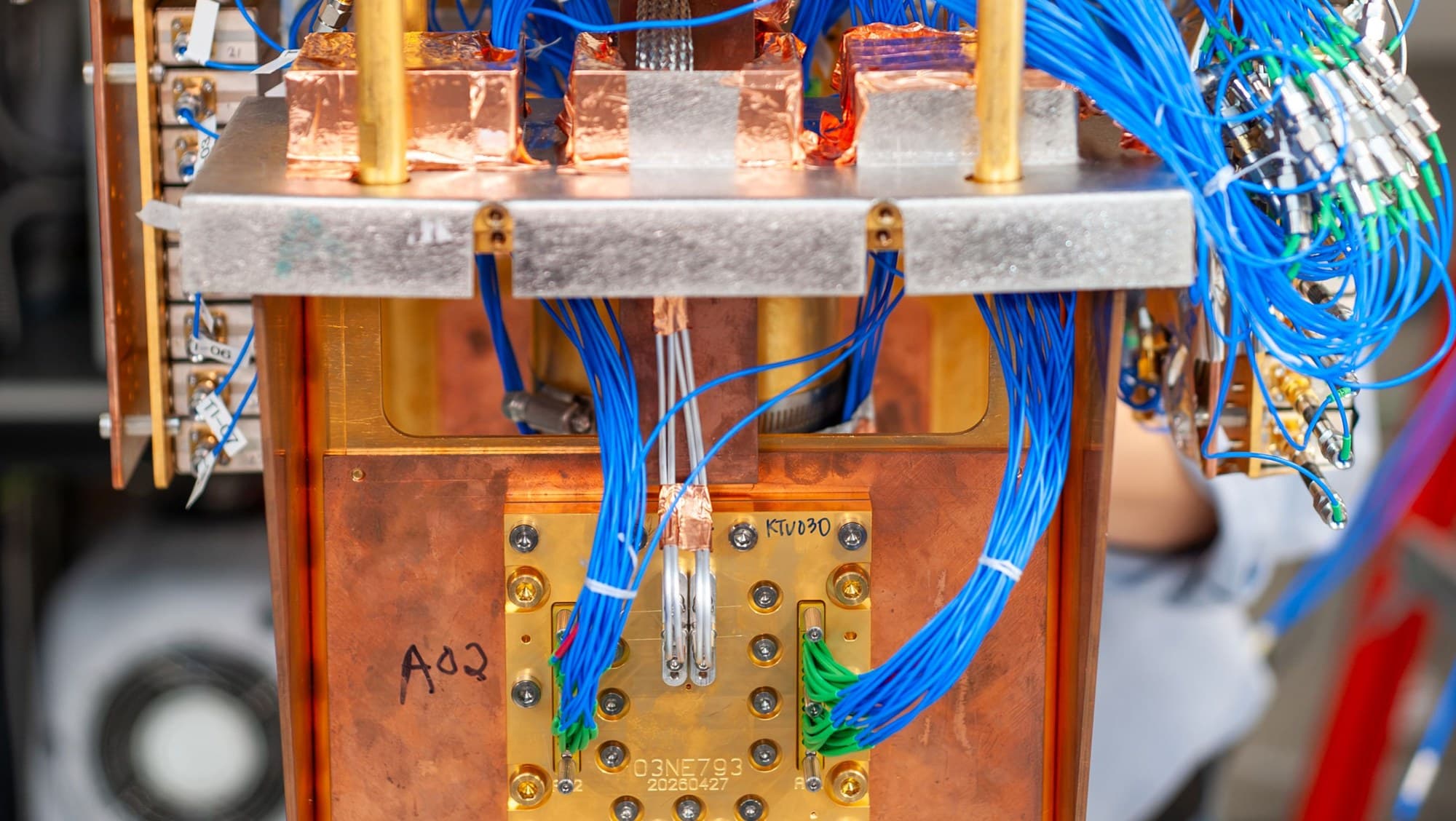
Test hardware for IBM's L-coupler experiment, from IBM's quantum blog; the image is cropped and does not show the two-chip link itself.
Image: IBM
Source · Press image from the IBM Quantum blog, used for news reporting.
IBM researchers have linked two 120-qubit Nighthawk quantum chips with four superconducting cables, each 80 cm (31.5 inches) long, and moved quantum states across them at an average fidelity of 99.00%, according to Quantum Computing Report. The best single link reached 99.29%.
The work appeared as an arXiv preprint, so it has not been peer-reviewed. Network World and ScienceAlert both reported it on Oct. 27, and the authors say that, to their knowledge, it is the first multi-channel quantum link between large superconducting processors.
Why link chips at all
Building ever bigger single chips is hard, so IBM plans to build large quantum computers from several modules joined together. The cables, which the team calls L-couplers (long-distance couplers), carry the fragile quantum state of a qubit from one chip to another. Fidelity is the share of that state that arrives intact, so 99.00% means the typical transfer loses about one part in a hundred. Voltgrid News also covered qubit readout without ancillas in a separate qubit study.
The cables are aluminum coaxial lines that become superconducting when cold. According to Quantum Computing Report, they are pressed onto the chips with indium joints after both chips are already mounted in the cryostat, the supercooled chamber that keeps the qubits cold. The cables kept working through three warm-up and cool-down cycles, and they also carried entanglement, the link between qubits that quantum algorithms depend on.
What still falls short
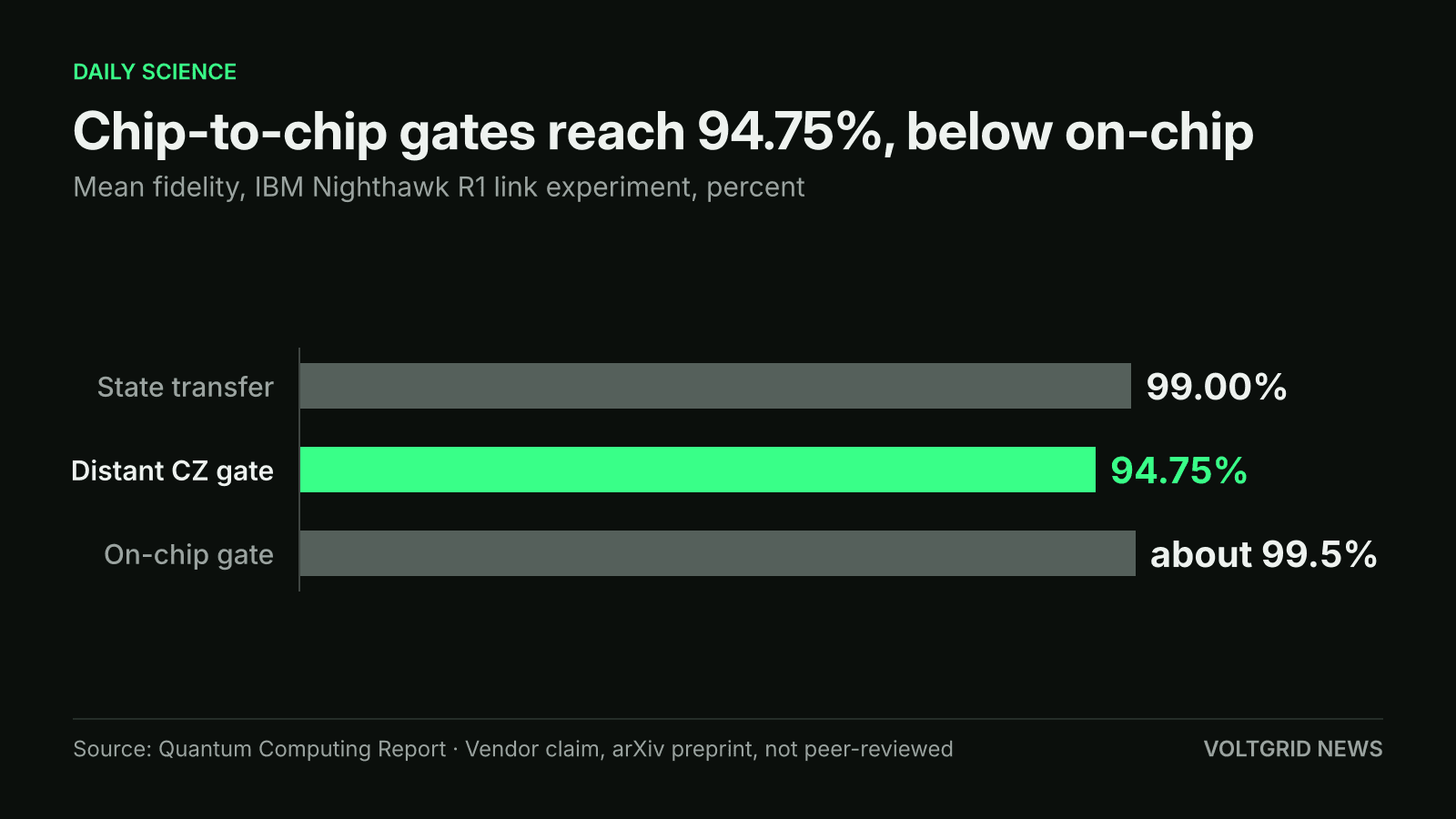
Distant gates averaged 94.75%, below state transfer at 99.00% and on-chip gates, per Quantum Computing Report; vendor claim, preprint.
Illustration (AI-generated)
Transferring a state is not the same as running a calculation across chips. Quantum Computing Report says the distant two-qubit gates built on these links averaged 94.75% fidelity, below the roughly 99.5% typical of gates on a single chip. Each distant gate needs two state transfers plus three local gates, and those steps account for most of the error.
The team also found a loss mechanism it had not documented before: stray magnetic fields get trapped in the aluminum as it turns superconducting and degrade the cable. Shielding braids around the cables restored most of the quality, per the same report. IBM says better qubits at the cable ends could push transfer errors below one in a thousand and distant gate fidelity above 99%. That is a projection, not a measurement.
What it means for IBM's roadmap
Network World reports that the approach is compatible with IBM's Nighthawk processor and with IBM Quantum Starling, the fault-tolerant machine IBM plans for 2029. For data-center operators, the practical point is footprint: a modular machine means more cryogenic modules and cabling inside shared refrigerators, not one ever larger chip. IBM has not published power or floor-space figures for such a system.
No independent group has reproduced the result, and the preprint may change in review. The 2029 target is IBM's own plan, and nothing in the reports says when linked chips like these will run customer workloads.