Waterloo Hybrid Cooling Drops Chip Hotspot 17°C in 15 Seconds
University of Waterloo engineers cooled a simulated chip hotspot by about 17 °C in 15 seconds with one boiling coolant drop in water, a lab result with no data-center test yet.
Science DeskEdited by Ege Erten
2 min readAI-assisted
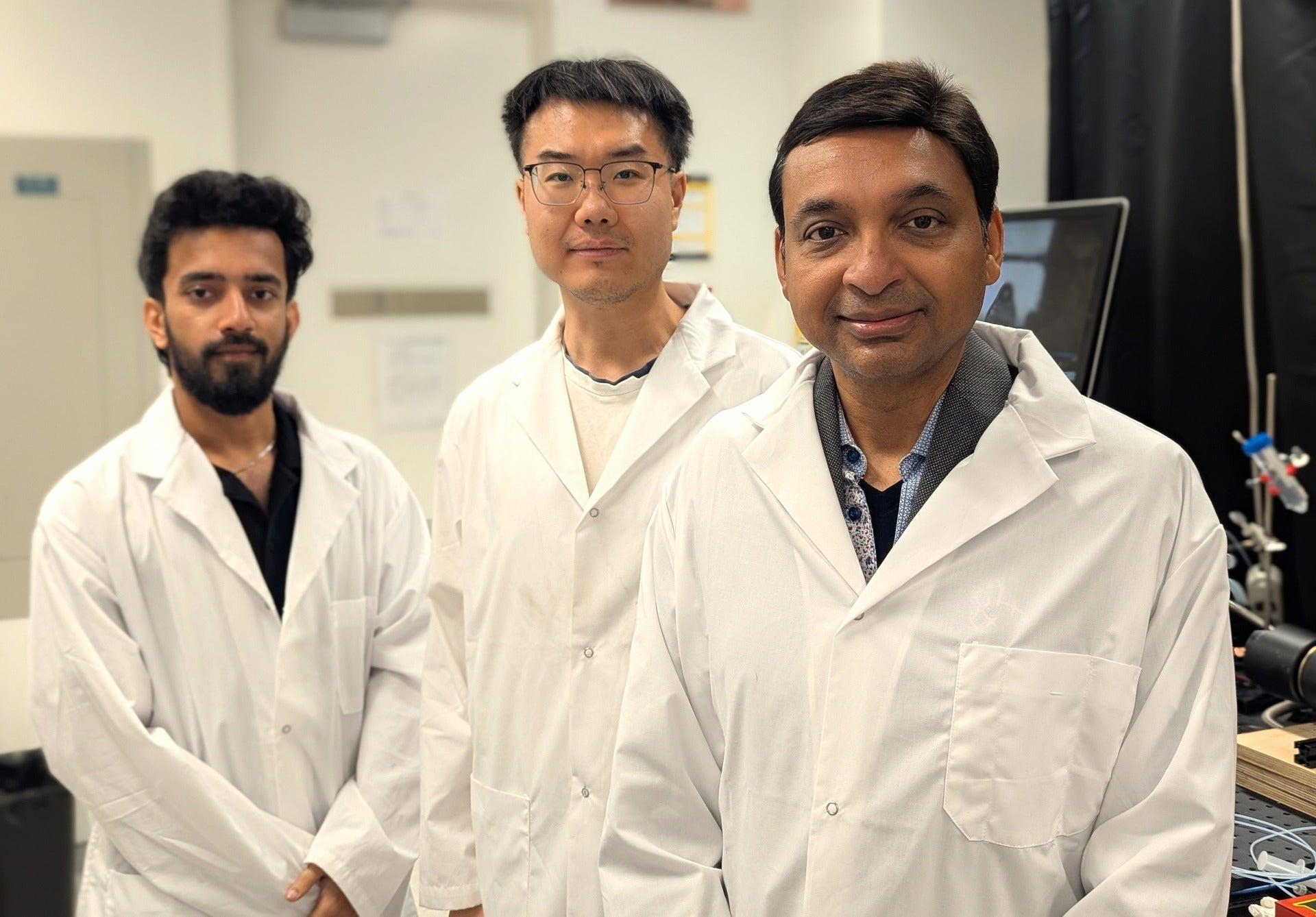
The Waterloo team behind the hybrid cooling work, from left: PhD student Arnav Banerjee, postdoctoral researcher Tian-Yu Zhang and Prof. Sushanta Mitra.
Image: University of Waterloo
Source · Press image from the University of Waterloo newsroom, used for news reporting.
University of Waterloo engineers have shown in laboratory tests that a single boiling drop of coolant can cut the temperature of a simulated chip hotspot by about 17 °C within 15 seconds, in a water bath, an approach the authors say cuts the amount of costly coolant needed.
Dr. Sushanta Mitra, postdoctoral researcher Dr. Tian-Yu Zhang and PhD student Arnav Banerjee published the work in the Journal of Colloid and Interface Science, according to the paper and the university's release. The 17 °C drop was measured at a heat flux of 14.4 W/cm², and the paper says it was several times faster than the benchmark cooling methods the authors tested.
Why hotspots matter for AI chips
Small areas of a processor can heat up much faster than the rest of the chip, the university said. That makes them slow down, age faster and lose reliability, and coolant that merely flows past is too slow to react. For data centers packing more GPU power into each rack, those short spikes are a cooling problem on top of the average heat load. Voltgrid News reported earlier on Chemours' Faizeon two-phase fluids, another approach to cooling AI chips with boiling fluids.
How a single drop does the work
Mitra calls the design a division of labour: deionized water, which is cheap, handles steady heat, and a drop of costly coolant handles the sudden spikes. The paper uses Novec-7100, an engineered fluid that boils at about 61 °C, is heavier than water and barely dissolves in it, so a drop stays on the hotspot.
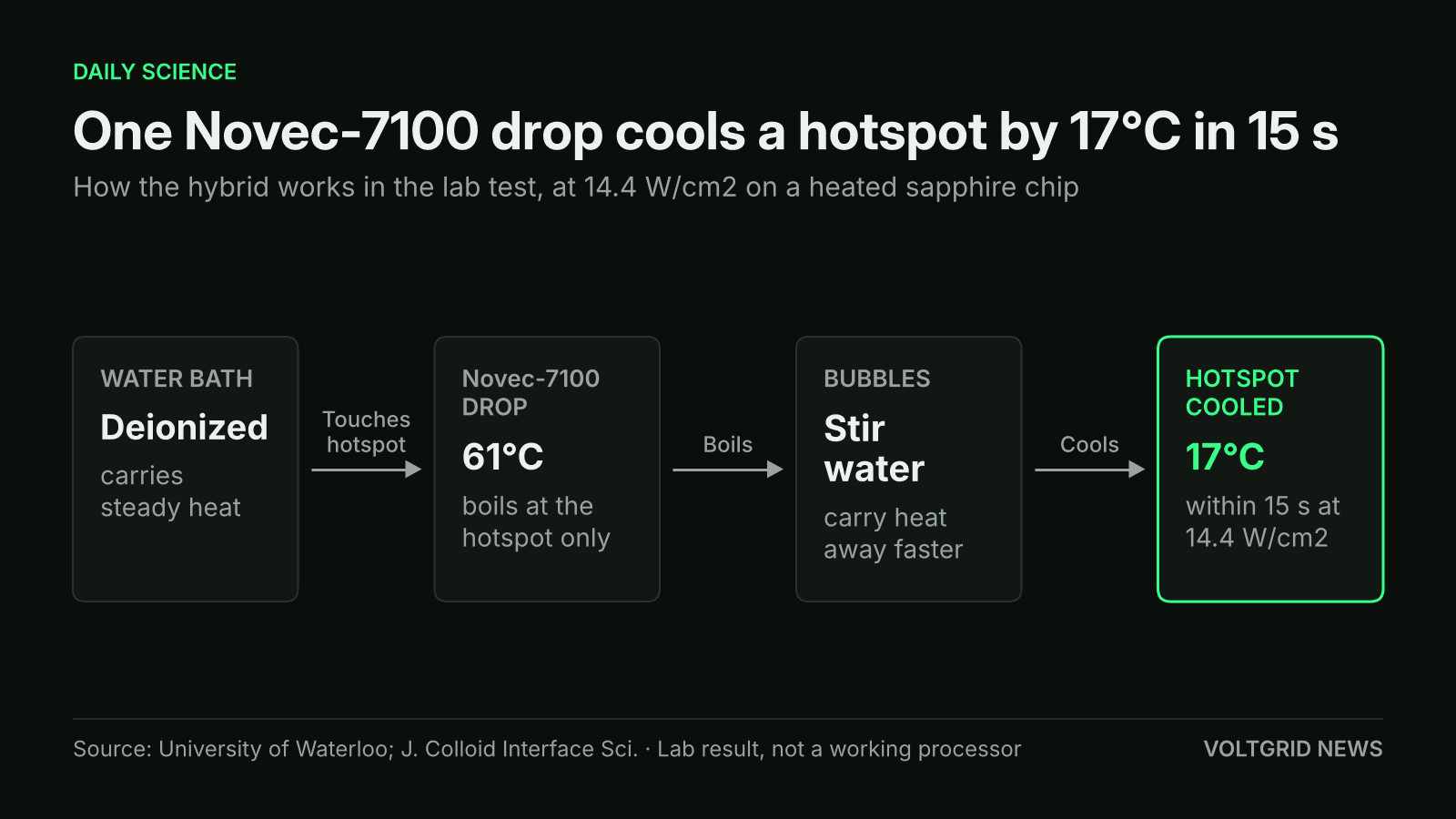
In the lab test, a single boiling drop cooled the simulated hotspot by about 17°C within 15 s, according to the University of Waterloo and the paper.
Illustration (AI-generated)
When the hot surface reaches the boiling point of the drop, it boils at that spot only. Boiling soaks up a lot of heat, and the rising bubbles stir the surrounding water so it carries heat away faster, Mitra said. The rest of the bath stays single-phase, meaning it never boils.
The researchers also wrapped each drop in a thin shell of silicone oil. The paper reports that a plain shell raised the temperature needed to start boiling and produced explosive boiling, while a shell loaded with aluminum nitride ceramic particles encouraged smoother bubble formation and reduced temperature overshoot.
What is not confirmed yet
This is a laboratory result. The test used a heated sapphire chip with an infrared camera, not a working processor in a server, and the system is still under development, according to the university. The researchers describe two possible designs, drops that circulate in the water and activate on contact with a hotspot, or drops placed on hotspots that sensors detect. Neither has been built at data-center scale, and the sources give no timeline, cost figure or partner for a product.
The university says the hybrid approach could also apply to electric vehicles, batteries, high-powered lasers and LED lighting; the paper names high-performance processors, power electronics and batteries.
Sources
- 01A hybrid immersion cooling assisted by liquid-liquid encapsulation: A game changer for thermal management of transient hotspotsJournal of Colloid and Interface Science · doi.org
- 02Waterloo innovation could make cooling AI data centres cheaper and more efficientUniversity of Waterloo · uwaterloo.ca
- 03A hybrid immersion cooling assisted by liquid-liquid encapsulation for thermal management of transient hotspotsJournal of Colloid and Interface Science (ScienceDirect) · sciencedirect.com
- 04Targeted drops of boiling coolant could help cool AI data centresUniversity of Waterloo Engineering · uwaterloo.ca