Cuprate Superconductors: Electron Pairing Matches 70 meV Pseudogap
Physicists at Utrecht, Leiden and LMU Munich report in Science that electrons in a cuprate superconductor pair up at the pseudogap energy, up to 70 meV. It is lab physics, not a product.
Science DeskEdited by Ege Erten
2 min readAI-assisted
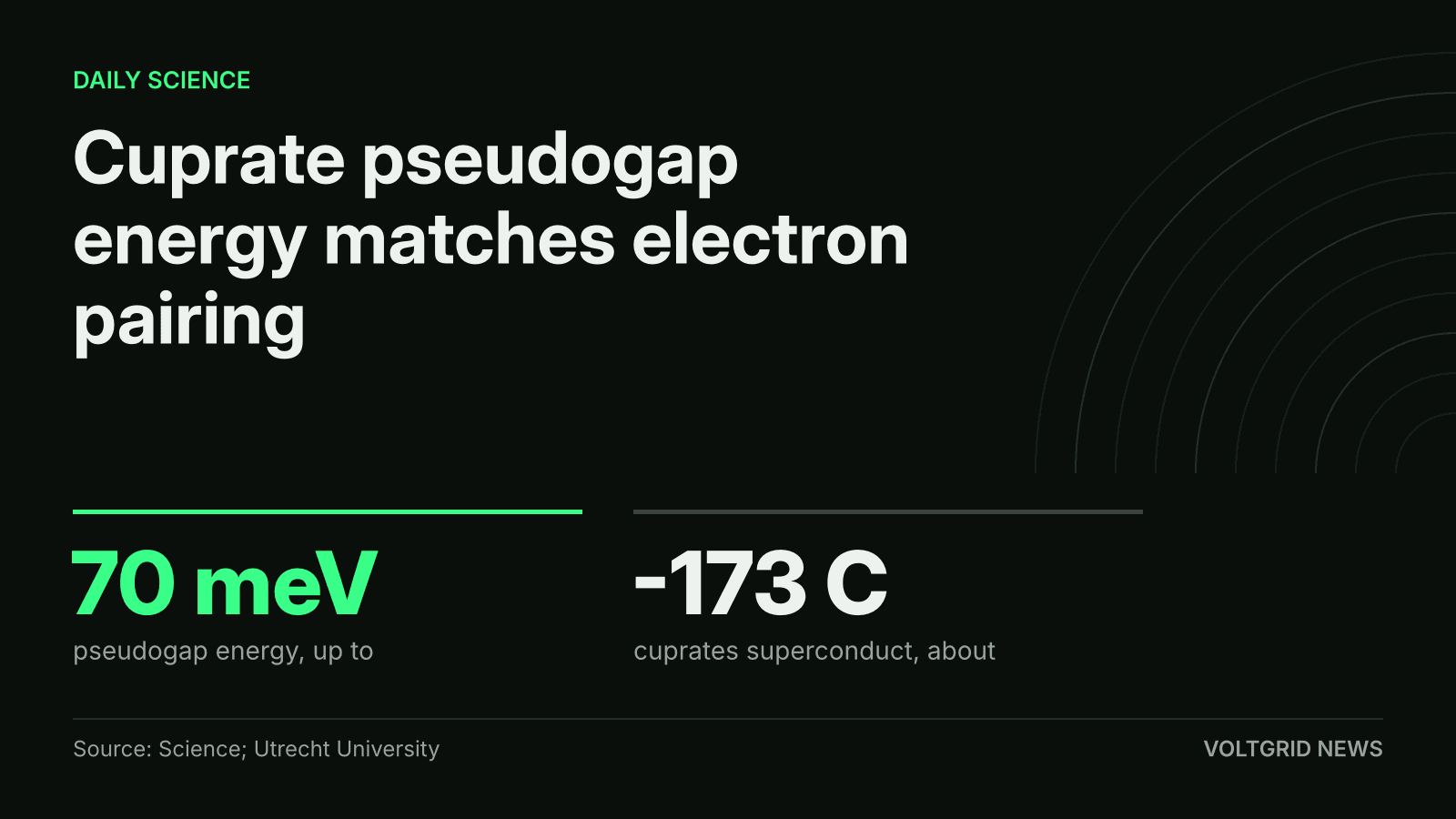
Utrecht, Leiden and LMU Munich physicists report the pseudogap energy matches electron pairing in a cuprate, in Science.
Illustration (AI-generated)
Physicists led from Utrecht University and LMU Munich report in Science that electrons in a copper-oxide (cuprate) high-temperature superconductor form pairs at the same energy as the material's pseudogap, which reaches up to 70 milli-electron volts (meV) in places.
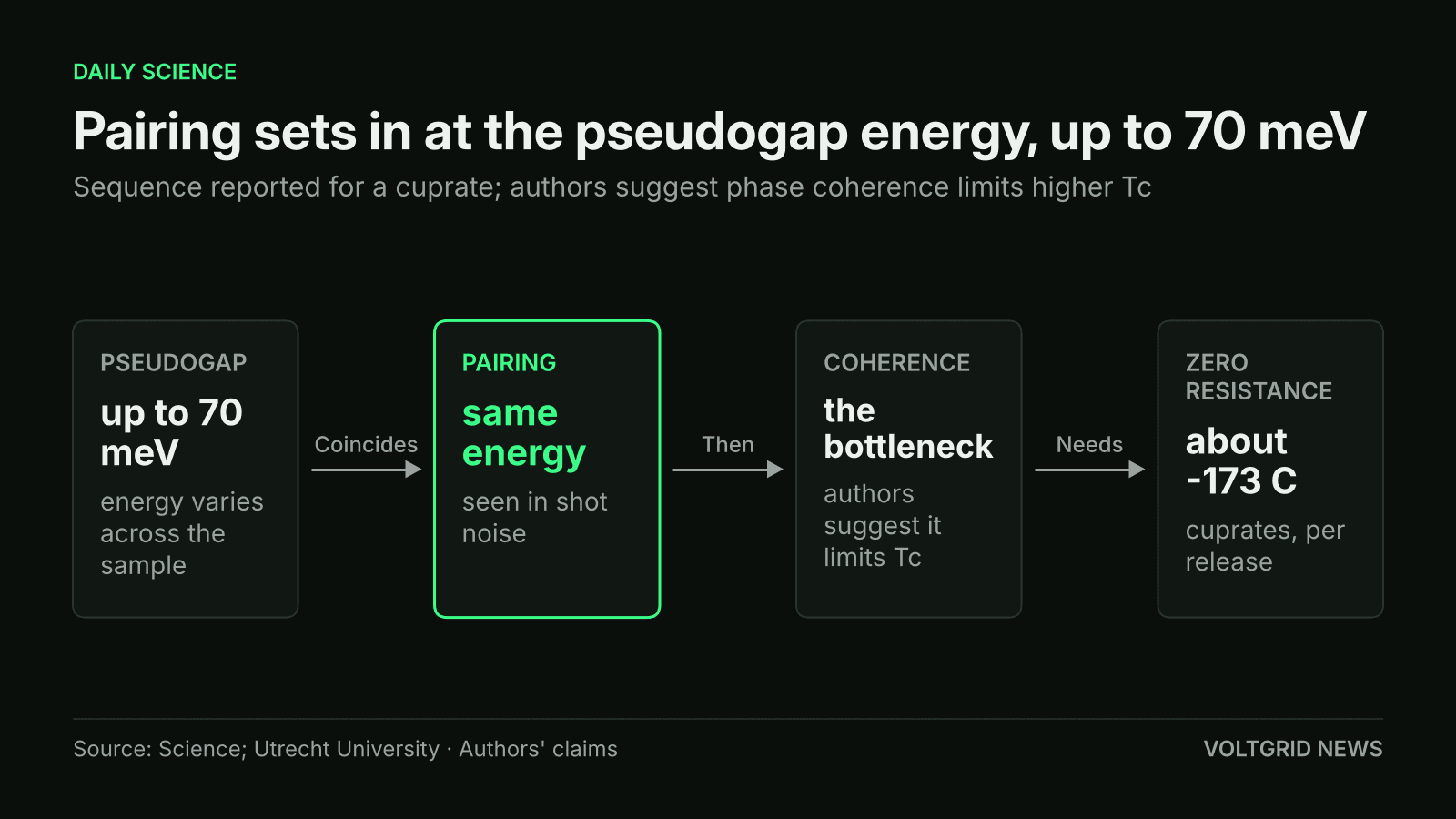
Pairing sets in at the pseudogap energy, up to 70 meV; the authors suggest phase coherence limits higher Tc, per Science and Utrecht University.
Illustration (AI-generated)
The paper, "Equivalence of pseudogap and pairing energy in a cuprate high-temperature superconductor," appeared in Science on Nov. 5, 2026 (volume 394, issue 6824, doi 10.1126/science.adt3444). First authors Maialen Ortego Larrazabal and Jiasen Niu and a team including Ingmar Swart and Milan Allan measured the compound Bi2Sr2CaCu2O8+δ. Utrecht University's release credits the work to scientists from Utrecht, Leiden and Munich.
What the pseudogap is
In conventional low-temperature superconductors, electron pairing (Cooper pairs) and the pairs moving in step occur together, according to Utrecht's release. Cuprates, found in the mid-1980s, superconduct at higher temperatures, still around -173°C, but the release says the theory behind them is not understood. The pseudogap stands out in the cuprate phase diagram, and its origin has been debated: preformed electron pairs, or a local order such as charge density waves.
How noise reveals the pairs
The team used local shot-noise spectroscopy. Shot noise is a fluctuation in an electric current whose size depends on the charge carried. Utrecht's release says the team built its own equipment to tell current carried by single electrons from current carried by pairs. According to the paper's abstract, the pseudogap energy coincides with the onset of pairing and varies from place to place on the sample.
The authors conclude that the result excludes a pure local-order origin of the pseudogap and links it to Cooper pair formation. They also suggest that the limiting factor for a higher critical temperature in cuprates is phase coherence, the pairs moving in step.
Why it matters for hardware
Utrecht's release frames the stakes in terms of lossless power transmission and storage: it names levitating trains, ultra-efficient energy storage and quantum computers as possible uses, and notes that most superconductors need cooling to about -260°C with liquid helium. "We show that one of the two key conditions for superconductivity can be met at room temperature," Swart said in the release, adding: "If we understand phase coherence, it may point to a path toward superconductivity at higher temperatures."
What is not settled
This is a measurement on one cuprate compound in a lab, not a new superconductor and not a cable or magnet. Neither source gives a timeline for applications, and no room-temperature superconductor has been shown. Swart plans follow-up research on phase coherence. An earlier version of the work was posted as an arXiv preprint (arXiv:2409.15928) in September 2024; the Science version is the peer-reviewed one.