Chemours Launches 5 Faizeon Two-Phase Fluids; Claims GPU 19°C Cooler
Chemours says its new Faizeon fluids kept a GPU up to 19°C cooler than single-phase water cooling; the test behind it was an Accelsius system at 50°C facility water, not a Chemours-run trial.
Energy & Cooling DeskEdited by Ege Erten
2 min readAI-assisted
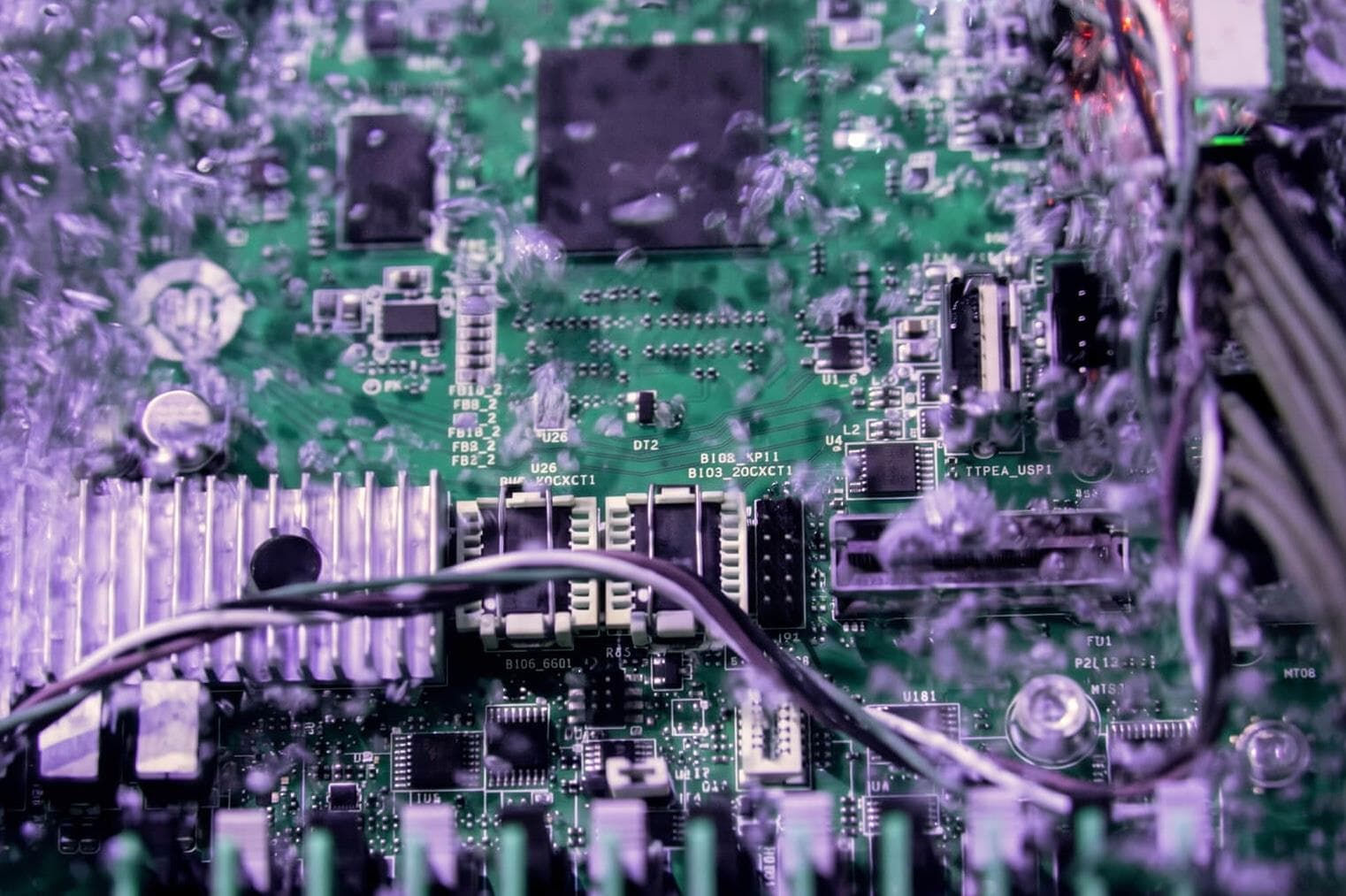
Two-phase fluid boiling on a server board, an image from Chemours's Faizeon site; it is not a photo of a specific product test.
Image: Chemours / Faizeon
Source · Press image from the Chemours Faizeon site, used for news reporting.
The Chemours Company (NYSE: CC) launched Faizeon two-phase liquid cooling fluids on Nov. 2, 2026, a five-fluid line for AI and high-density data centers, and cited a GPU held up to 19°C cooler than with single-phase water-based cooling.
Chemours said in its release that the portfolio covers four two-phase direct-to-chip fluids (Faizeon 100, 110, 200 and 220) and one immersion fluid, Faizeon 500, which was formerly sold as Opteon 2P50. Faizeon 110 is described as a low-pressure fluid with an intermediate boiling point and zero ozone depletion potential. Faizeon 200 is called the industry standard for medium-pressure systems, and 220 is the highest-performance direct-to-chip option.
The company says the fluids absorb heat by turning from liquid to vapor, which can cut cooling energy and "nearly eliminate" cooling-related water use, depending on system design and operating conditions. These are vendor claims, and the release gives no PUE, WUE or percentage figure for them.
What the 19°C test measured
The release links its "independent third-party" result to a whitepaper from Accelsius, a two-phase cooling vendor. That document describes a test by an unnamed systems integrator on a Dell PowerEdge XE9680L server with eight NVIDIA B200 GPUs and a total thermal design power of about 10 kW, run on 50°C facility water without a chiller.
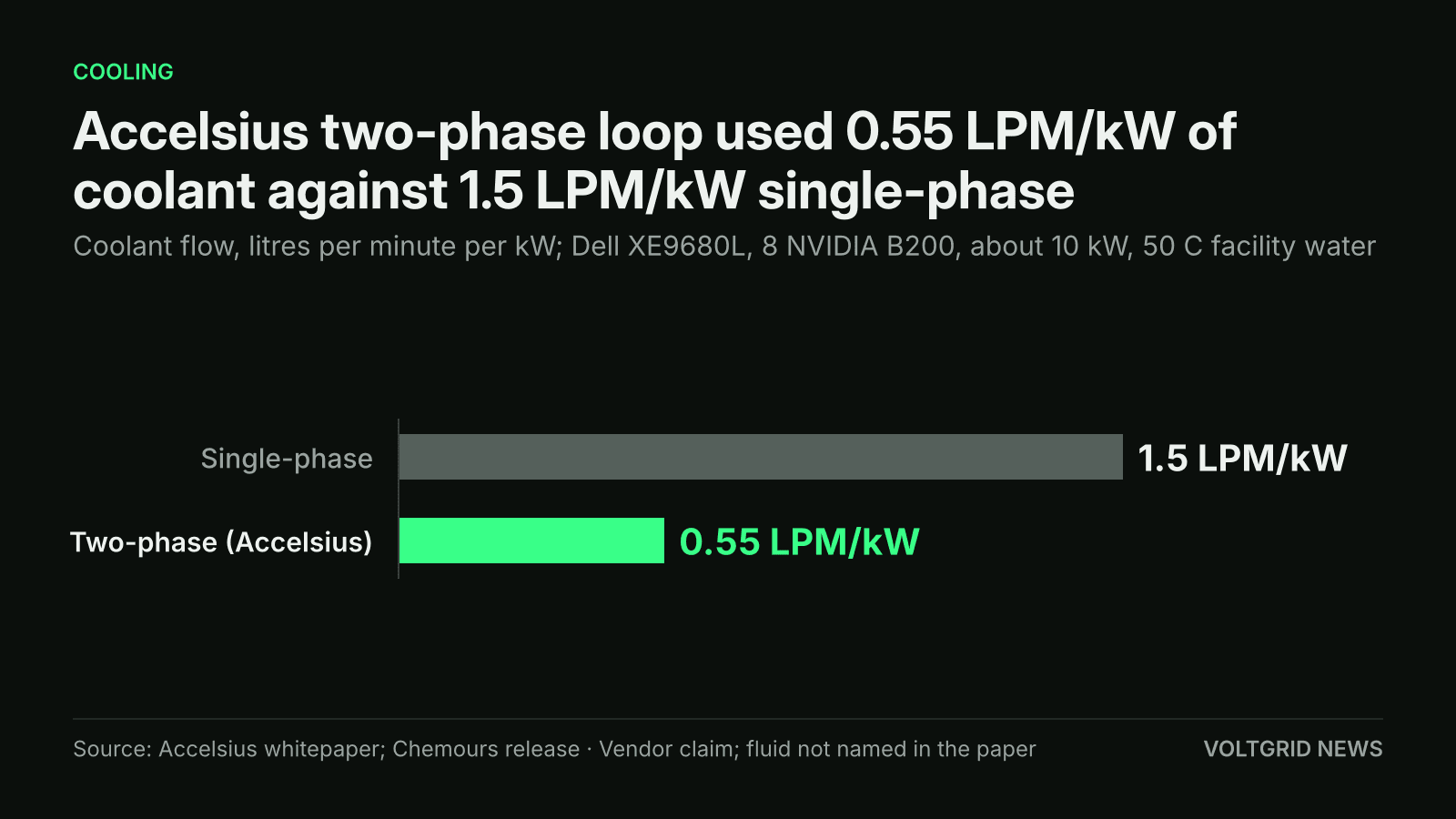
In Accelsius's own test, the two-phase loop needed 0.55 LPM/kW against 1.5 LPM/kW for single-phase (vendor claim).
Illustration (AI-generated)
In the Accelsius paper, the 19°C gap is the downstream GPU cold plate, the hottest position in the series loop, on Accelsius's NeuCool system against a stock single-phase setup. At full-system level the advantage is 9°C to 14°C. The two-phase loop used 0.55 litres per minute per kW against 1.5 L/min/kW for single-phase, roughly one-third of the coolant flow. The paper does not name the two-phase fluid, so the link to Faizeon 200 rests on Chemours's release.
Why it matters for the hall
Warm-water operation is where the numbers count. If a two-phase loop holds GPU temperatures with 50°C facility water, operators can drop chillers and spend less of the facility's power on cooling, and hot-climate sites gain room. Lower coolant flow also shrinks pumping power and pipe sizes. The caveat is that this is one system, one server and one vendor's own paper.
Fluid supply is the other constraint. Chemours is a fluid maker, so Faizeon sells through system builders. The release names engagements with Oak Ridge National Laboratory, NTT DATA, 2CRSi, DataVolt, Munters, Accelsius and ZutaCore, but gives no deployment sizes or customers.
Context and what is not confirmed
Two-phase systems add a fluid-handling layer that single-phase cold plates do not need, and loops like these still depend on accurate flow measurement, as in Sensata's 400 L/min liquid cooling flow sensors, which Voltgrid reported on Oct. 22. For the immersion route, see Voltgrid's report on LG, GS E&C and GRC standard immersion designs.
The release does not give pricing, availability dates, production capacity, rack power ratings, global warming potential or the fluids' PFAS (per- and polyfluoroalkyl substances) status, and it does not say how much of the 19°C result is the fluid and how much is Accelsius's cold plate design. No independent test of Faizeon in a production hall has been published with the launch.