NRC Advanced Reactor Oversight Process: Draft Paper Due in March
NRC staff outlined an Advanced Reactor Oversight Process at an Oct. 28 workshop, with a Commission paper due in May and an ADVANCE Act microreactor deadline next summer.
Chips & Power DeskEdited by Ege Erten
2 min readAI-assisted
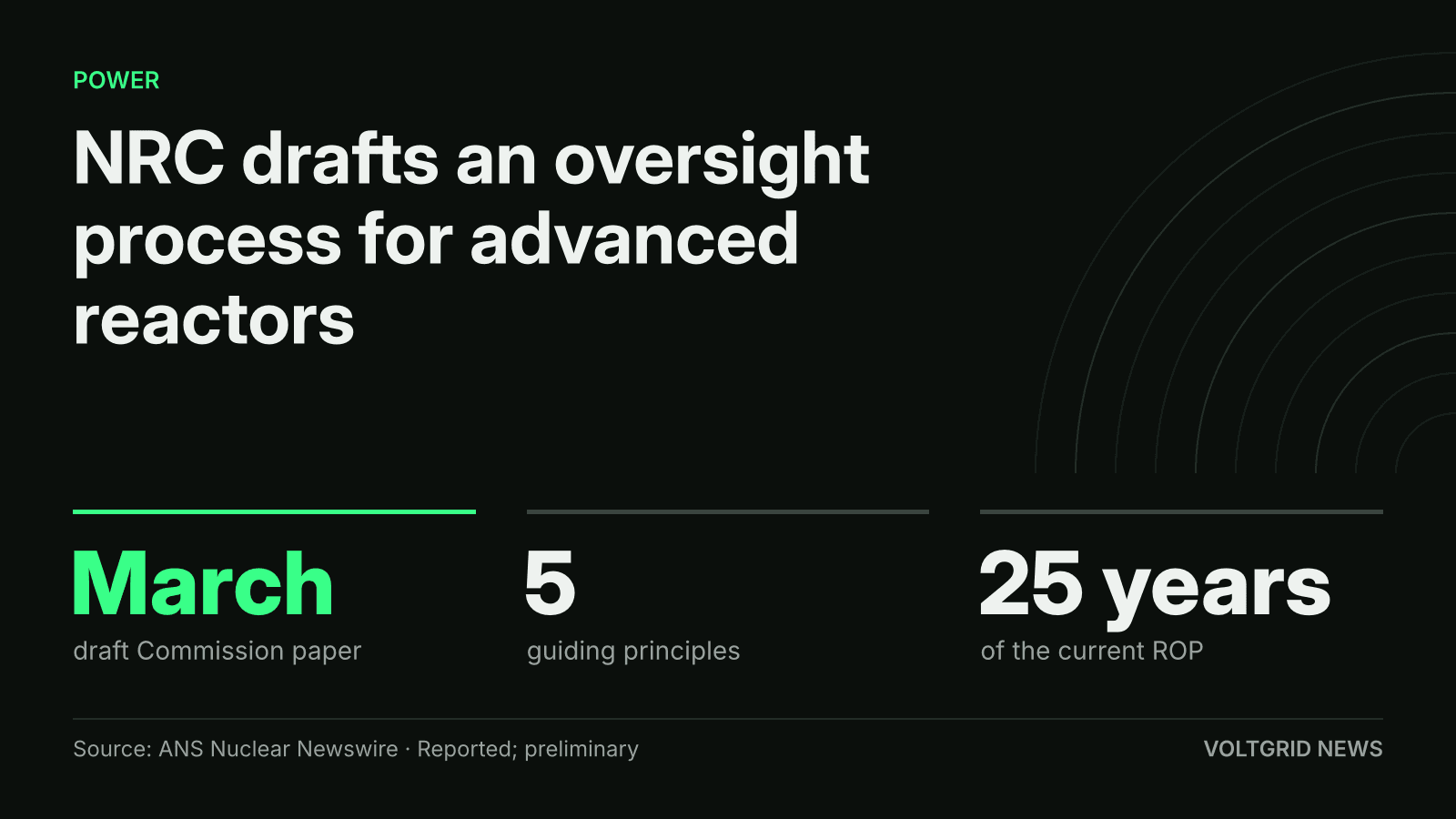
Staff reported a March draft Commission paper for the Advanced Reactor Oversight Process; discussions are preliminary.
Illustration (AI-generated)
The US Nuclear Regulatory Commission (NRC) is drafting an Advanced Reactor Oversight Process (AROP) to inspect new reactor designs, and staff told a public workshop on Oct. 28 that a draft Commission paper is due in March, according to ANS Nuclear Newswire.
The NRC has used the Reactor Oversight Process (ROP) for about 25 years to inspect and rate the operating fleet. The AROP would sit beside it for designs unlike today's plants, and would build on the Advanced Reactor Construction Oversight Process, which the agency already applies while new facilities are being built. Discussions are preliminary and no final decisions have been made, ANS reported.
Why the deadline matters for new reactors
Phil McKenna, deputy director of the NRC's Office of the Chief Nuclear Reactor Inspector, said staff are working on the AROP now because the ADVANCE Act requires the agency to complete its processes for microreactors by next summer. He said it is more efficient to cover all advanced reactors rather than microreactors alone.
For developers that the NRC is already reviewing, such as Dow's Long Mott Xe-100 plant, the oversight regime that applies after a licence is issued is a cost and schedule variable the permit itself does not settle. The proposal would be the rulebook for how often inspectors visit and what triggers a closer look.
What the draft framework looks like
Staff described five principles: risk-informed, performance-based, technology-inclusive, scalable and licensing-neutral. Industry feedback gathered over the past couple of years asked for oversight that borrows from research and test reactor practice, accounts for prefabrication, simple designs and remote operation, and uses targeted inspections when performance indicators cross a threshold. Routine on-site inspections would become less frequent if indicators keep showing good performance.
Odunayo Ayegbusi, a senior reactor operations engineer in the same office, said the AROP could reuse the ROP's structure of three performance areas and seven cornerstones, replace it with something new, or mix the two. The concepts presented use a matrix in which cornerstone-specific thresholds set a facility's oversight tier, and inspections increase as the tier rises. The seven cornerstones are initiating events, mitigating systems, barrier integrity, emergency preparedness, public radiation, occupational radiation and security.
The scope is broad: non-light-water reactors, small modular reactors (SMRs) and microreactors. Asked whether the AP1000 units at Vogtle and any future AP1000s would fall under the AROP, Ayegbusi said existing AP1000 designs are under the ROP and staff will consider where they belong later.
Timeline and what is not settled
Staff gave an early schedule. High-level strategies and guidance are to be finalized by January. A draft SECY, the staff paper that goes to the Commission, is due in March. It goes to the Office of the Executive Director for Operations in April and to the commissioners in May. More workshops are planned. As Voltgrid reported, the agency has also just finalized a rule on how applicants can cite DOE and Department of War test data, so oversight is the next piece of the advanced-reactor rulebook to take shape.
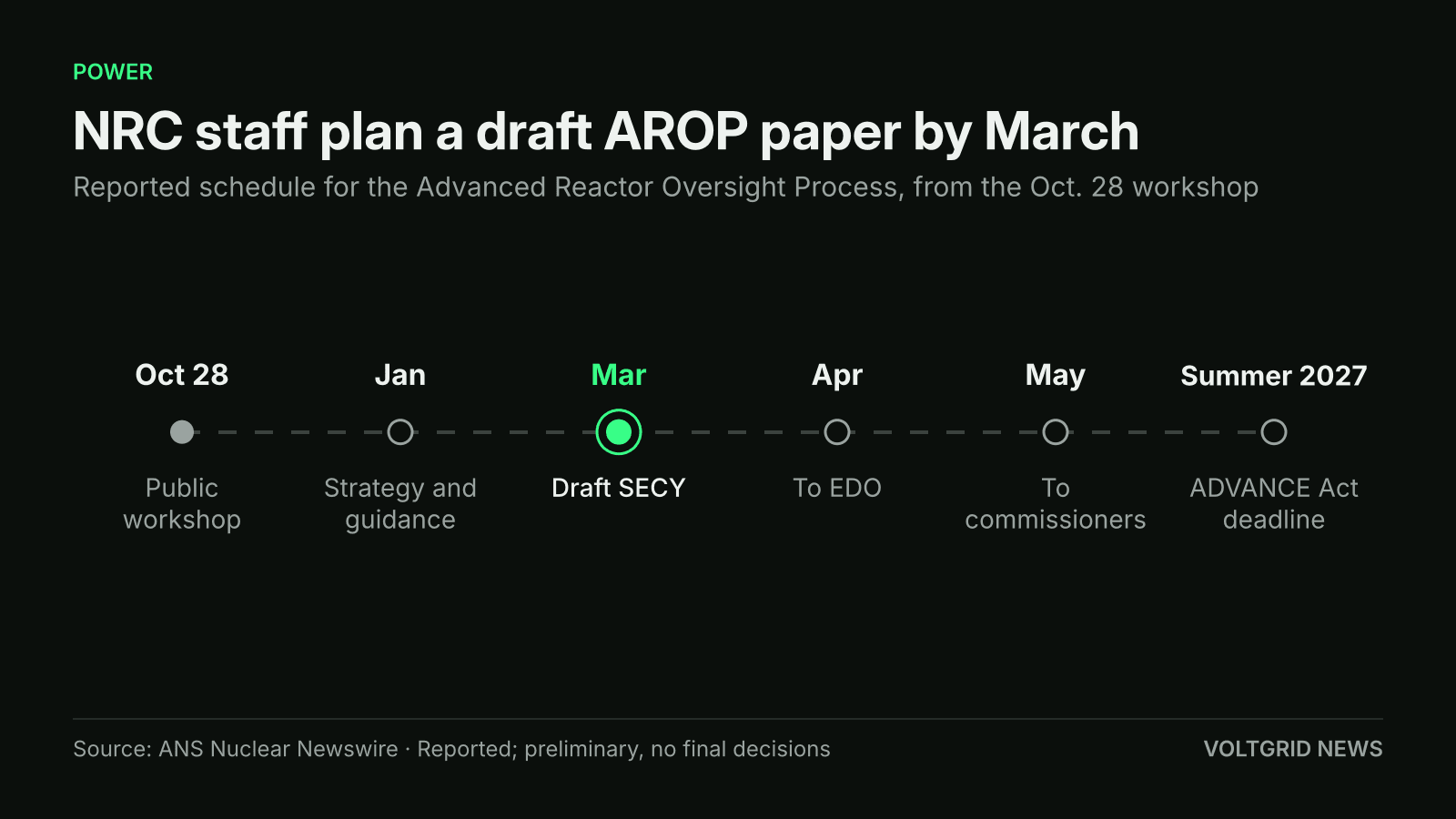
NRC staff reported a draft SECY in March and a Commission paper in May; the schedule is preliminary.
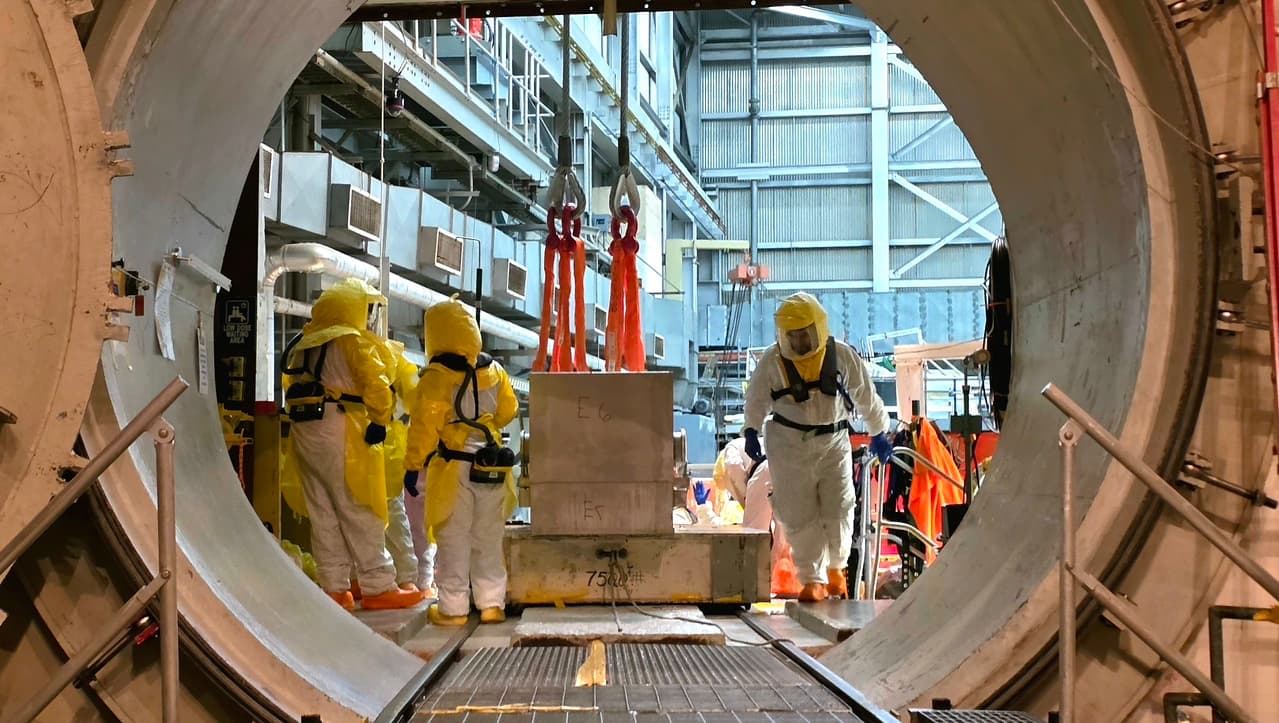
Illustration (AI-generated)
Still open: whether the AROP replaces or extends the ROP's cornerstones, which inspection thresholds apply to each tier, and where the AP1000 fleet lands. The ANS report does not say how many inspections each tier would bring, and none of this is binding until the Commission acts.