Radiant's Kaleidos Microreactor: DOE-Approved 1 MWe Unit Heads to INL Test
DOE approved the safety analysis for Radiant's 1 MWe Kaleidos test reactor on Oct. 29. A Readiness Review, fuel load and a 60 full-power-day INL test come next; Radiant targets its first units in 2028.
5 min read
Follows Radiant Kaleidos Microreactor Wins DOE Full-Power Safety Approval
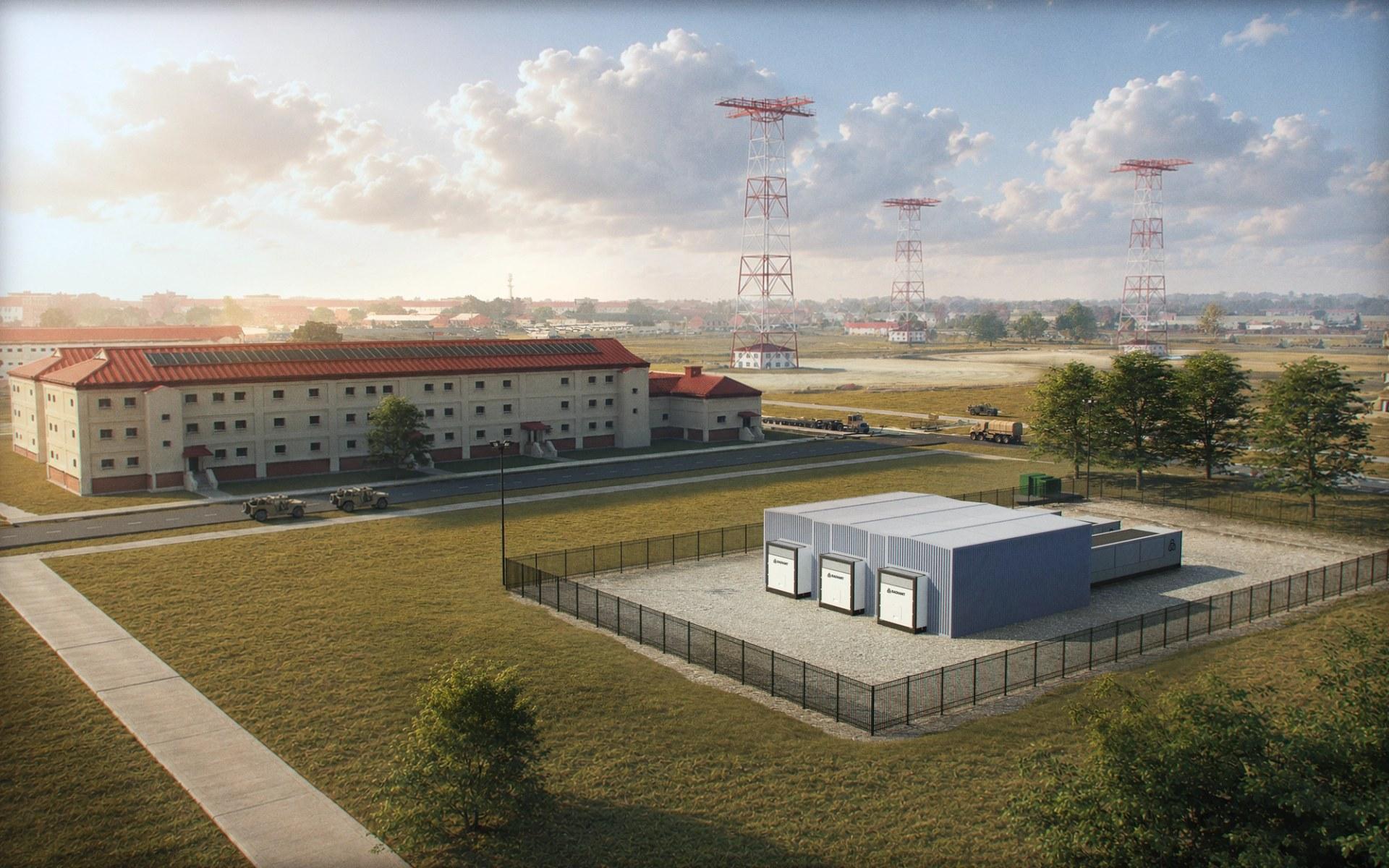
Radiant rendering of Kaleidos units at a military site; an illustration, not a photo of the INL test unit.
Image: Radiant (rendering)
Source · Press image from the Radiant website, used for news reporting.
Radiant's Kaleidos microreactor, a transportable unit rated at about 1 MWe, moved a step closer to a fueled test when the US Department of Energy (DOE) approved its Documented Safety Analysis, the next-to-last of DOE's five authorization steps for a test reactor, the company said on Oct. 29, 2026. As of Nov. 14, no newer step has been announced: the DOE Readiness Review, fuel loading and first criticality at Idaho National Laboratory (INL) are still ahead.
The approval covers operation at power as well as initial criticality, Radiant said. That matters for buyers because the INL run is meant to show whether a factory-built unit can run at full power for at least 150 hours without operator intervention, inside a campaign that totals 60 effective full-power days. Every customer named in reports so far is a military base, apart from Equinix's pre-order. Radiant plans to deliver its first commercial units in 2028, after the INL test campaign; that date is a target.
Voltgrid News reported that the safety-analysis approval is one step in DOE's authorization of a test reactor, not an NRC licence and not startup authorization. This file sets out the design, the customers, the regulator steps and what remains open.
Kaleidos Design: 1 MWe Electric, 3 MWth Thermal
Kaleidos is a high-temperature gas-cooled reactor (HTGR). Its core uses TRISO fuel, uranium kernels coated in layers of carbon and silicon carbide, set in prismatic graphite blocks and cooled by helium gas. The US Nuclear Regulatory Commission (NRC) describes it as designed to generate 3 MWth of heat and approximately 1 MWe of electricity. Each unit fits in a single shipping container.
The gap between those two numbers is the one to keep straight. A reactor makes heat first, and only part of it becomes electricity, so a Kaleidos unit is a source of roughly 1 MWe of electricity from about 3 MWth of heat, not a 3 MW one. Customers so far plan multiples: the Army has confirmed three Kaleidos reactors at Fort Benning, and Equinix signed a pre-order for 20.
Radiant built the test unit in El Segundo, California, and shipped it to INL in August 2026. The company says it shares a similar design and custom fuel with the units it plans to deliver.
Military Customers and the Equinix Pre-Order
The Army has confirmed that Radiant will deploy three Kaleidos reactors at Fort Benning, Georgia, under its Janus program, ANS Nuclear Newswire reported on Oct. 23. Radiant has said it is in a binding agreement totaling up to $650 million to deploy 15 Kaleidos reactors through Janus, ANS reported; the figure is Radiant's, and ANS gives no terms.
The Navy announced on Oct. 21 that it had picked Radiant to design, build and deliver a prototype microreactor power plant at Naval Weapons Station Crane in Indiana. Neither the Navy nor Radiant gave a unit count, though an Army official's remarks implied one reactor, ANS reported. The Air Force's Advanced Nuclear Power for Installations program has also selected Radiant for Buckley Space Force Base in Colorado. ANS's report gives no value for the Navy or Air Force selections.
The only data-center customer named in the reports reviewed is Equinix. Equinix announced in August 2025 a preorder agreement for 20 Kaleidos units of 1 MWe each, World Nuclear News reported, and Radiant said in a post on X that Equinix had signed a deal and submitted deposits. A pre-order is not a power purchase agreement (PPA), and WNN's report gives no price, site or delivery date.
DOE Readiness Review and NRC Licensing Path
DOE clears a test reactor in five steps, ANS reports: an other transaction agreement, a nuclear safety design agreement, a preliminary safety analysis, the Documented Safety Analysis (DSA) and a Readiness Review. Radiant has passed the fourth. The DSA documents how the reactor and facility will operate safely; the Readiness Review then checks whether the reactor and its operating team are ready to begin nuclear operations. None of this is an NRC licence.
DOE approved Radiant's Preliminary Documented Safety Analysis in February 2026 and the full analysis on Oct. 29. Next comes the Readiness Review, in which DOE checks whether the reactor and its operating crew are prepared to start. After that, Radiant plans to load fuel and run a five-phase campaign in the Demonstration of Microreactor Experiments (DOME) test bed at INL. The campaign is to climb from first criticality to full power and run for 60 effective full-power days over several months, including at least 150 hours of continuous full-power operation without operator intervention. No date has been published for the review or the fuel load.
DOE's DSA approval on Oct. 29 is done; the Readiness Review, fuel load and 60 EFPD run are planned without dates, and 2028 is a target.
Graphic: Voltgrid News
Radiant says it is the only microreactor design with DOE safety-analysis approval for full-power operation. That is the company's claim. Last Energy announced DOE approval of the Documented Safety Analysis for its own pilot reactor at Texas A&M's RELLIS campus on Oct. 7, ANS reported. ANS reports that Last Energy earlier described the pilot as showing low-power criticality before electricity generation, while Last Energy's Oct. 7 release does not state the power level its approval covers. The two approvals therefore cannot be compared from public statements.
The DOE path covers the test only. Radiant has been in pre-application talks with the NRC since October 2022. Radiant said in 2024 it expected to deliver a limited number of pre-ordered units as soon as 2028, after completing DOME testing and obtaining NRC licences, World Nuclear News reported. The NRC's page lists the R-50 factory's special nuclear material licence application as received and under review, with requests for more information issued in 2026. Radiant's target is to build units at R-50 in Oak Ridge, Tennessee, and deliver the first commercial ones to Buckley and Fort Benning in 2028.
What Kaleidos Means for Data Centers
At about 1 MWe a unit, Kaleidos is a small block of firm power by data-center standards. Equinix's other nuclear agreements show the scale gap: a 500 MW agreement with Oklo and a 500 MWe pre-order with Stellaria, according to World Nuclear News. That suggests microreactors would serve single sites or critical loads rather than whole campuses, and only after the INL test and NRC licensing.
One point of confusion is worth clearing up. The Radiant in Drax's Nov. 3 plan for a data centre at Drax Power Station is Brookfield's UK-based AI infrastructure platform, a different company from the reactor developer Radiant Industries.
What to Watch After the DOE Approval
The DOE Readiness Review is the next decision, followed by startup authorization, fuel loading and first criticality in DOME. The 60 effective full-power days of the campaign will show whether the unattended-operation claim holds. On the NRC side, watch the R-50 licence review and the first application for a commercial Kaleidos unit. On the customer side, watch for unit counts and contract values at NWS Crane and Buckley, and any delivery terms on the Equinix pre-order. The 2028 delivery date is Radiant's target, and its 2024 statement ties it to the DOME test and NRC licences.
Sources
- 01Radiant Achieves Industry Milestone as the Only Microreactor Design to Secure DOE Safety Analysis Approval for Full Power OperationsRadiant (Business Wire)financialcontent.com
- 02Radiant Industries chosen for naval station deploymentANS Nuclear Newswireans.org
- 03Equinix signs further agreements with SMR developersWorld Nuclear Newsworld-nuclear-news.org
- 04Antares, Last Energy, and Radiant hit DOE authorization milestonesANS Nuclear Newswireans.org
- 05US microreactor clears initial stage of pre-testing safety reviewWorld Nuclear Newsworld-nuclear-news.org
- 06Kaleidos: Pre-Application Activities for Advanced ReactorsUS NRCnrc.gov
- Published
- Sources
- 6 cited