Tokyo Electron Forecasts FY Operating Profit Up 87% to ¥1.169 Trillion
Tokyo Electron expects sales of 3.7 trillion yen in the year to March 2027 after a first-half operating profit of 506.7 billion yen, and sees WFE spending near $160 billion in 2026.
Chips & Power DeskEdited by Ege Erten
2 min readAI-assisted
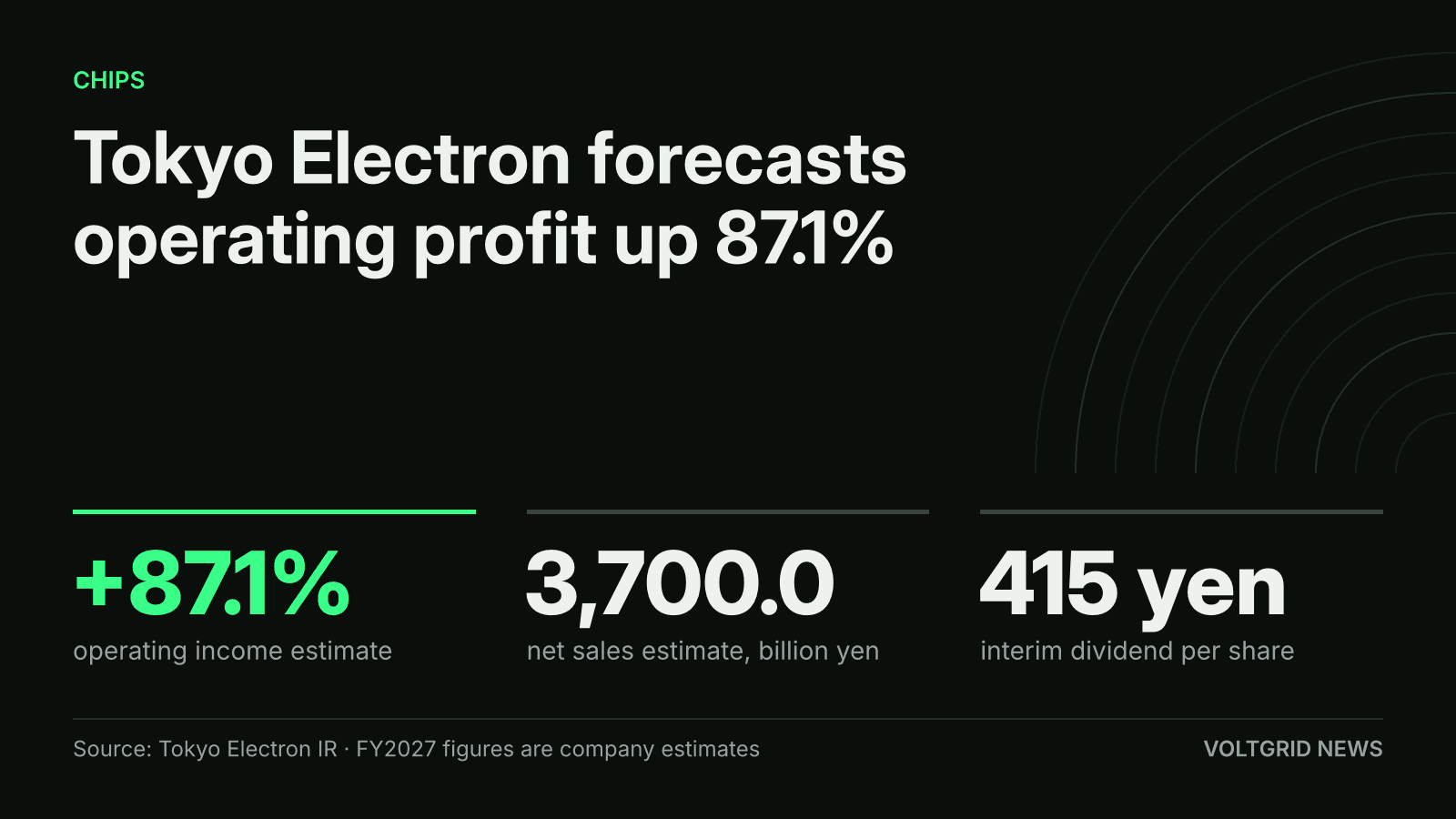
Tokyo Electron's full-year FY2027 figures are company estimates, from its Oct 30, 2026 investor presentation.
Illustration (AI-generated)
Tokyo Electron (TEL) forecast fiscal-year operating profit of 1.169 trillion yen, up 87.1% from 624.9 billion yen, on net sales of 3.7 trillion yen, in results released on October 30, 2026. Reuters put the profit figure at about $7.41 billion.
The forecast covers the year ending March 2027 and follows a strong first half. TEL's investor presentation shows April-September net sales of 1,667.4 billion yen and operating income of 506.7 billion yen, up 67.2% from the same half a year earlier. The company's July 30 estimate for the half had been 1,620.0 billion yen in sales and 458.0 billion yen in operating income.
Second-quarter numbers
In the July-September quarter, net sales were 935.0 billion yen, up 48.4% from a year earlier and 27.7% from the first quarter. Operating income reached 295.3 billion yen, an operating margin of 31.6%, and net income attributable to owners of the parent was 212.5 billion yen.
China was the largest region at 339.9 billion yen, or 36.4% of quarterly sales, ahead of Taiwan at 180.4 billion yen and South Korea at 190.7 billion yen, according to the same presentation.
What the full-year forecast assumes
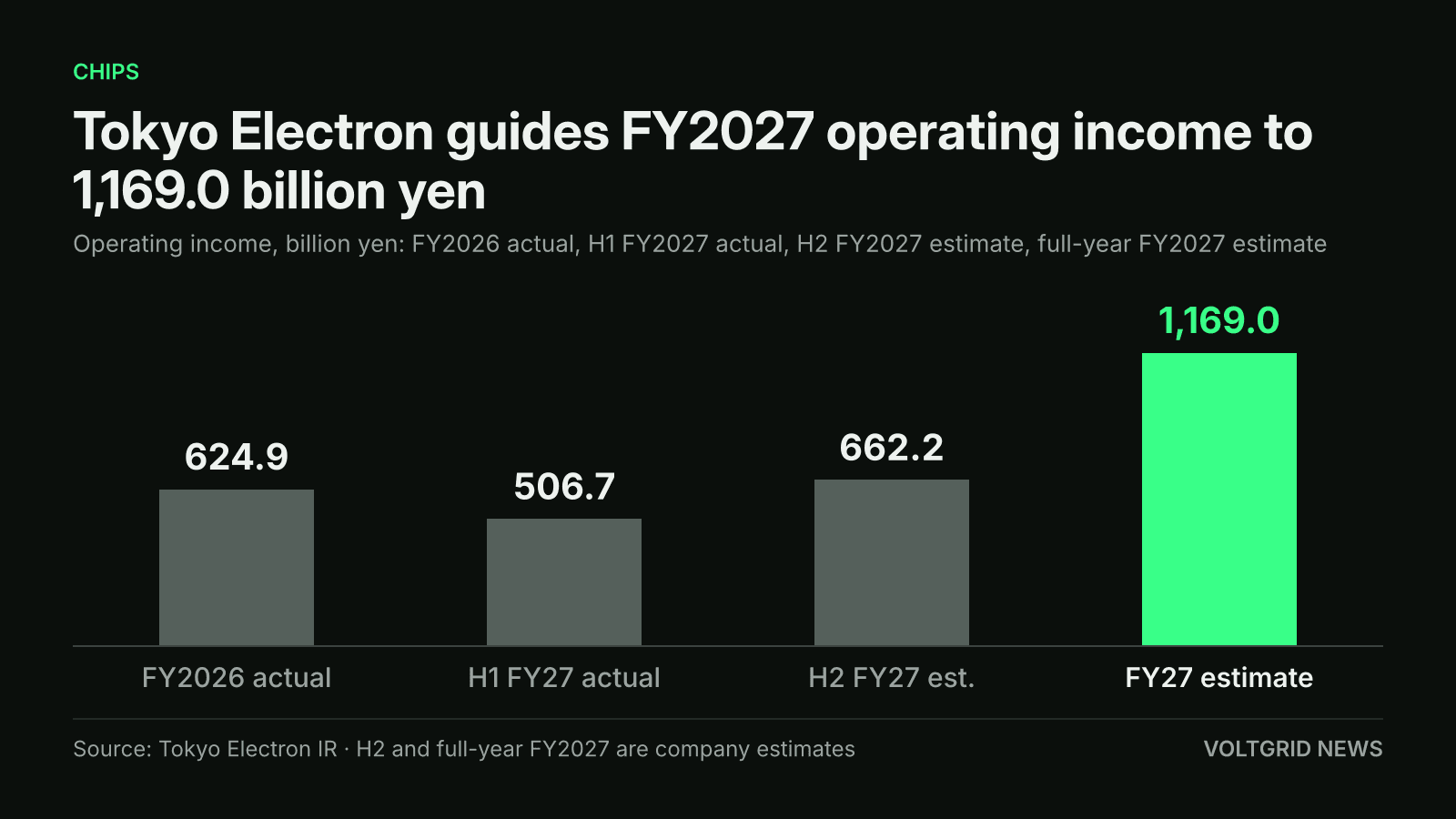
Tokyo Electron's FY2027 operating income estimate of 1,169.0 billion yen combines a 506.7 billion yen first half with a 662.2 billion yen second-half estimate, per its investor presentation.
Illustration (AI-generated)
TEL expects second-half net sales of 2,032.5 billion yen and operating income of 662.2 billion yen, a 32.6% margin. New-equipment sales of semiconductor production equipment are forecast to grow 59% for the year, with 1,560.0 billion yen expected in the second half.
For the market as a whole, TEL put wafer fab equipment (WFE) spending at about $160 billion in calendar 2026 and above $210 billion in 2027. The company ties that demand to AI data-center chips: GPUs and HBM (high-bandwidth memory), plus CPUs, DRAM and NAND flash for servers.
Chipmaking tools tied to AI packaging and memory
TEL said it expects more than 200 batch atomic-layer-deposition units for advanced packaging to ship in each of fiscal 2027 and fiscal 2028. It also expects record shipments of probers for leading-edge logic, up about 60% from a year earlier.
Tool demand of this kind is the first link in the chain that ends in more accelerators and more power draw at data centers. Voltgrid has also covered Lam Research's record quarterly revenue and Applied Materials' plan to raise its Besi stake.
Shareholder returns and what is not confirmed
TEL raised its interim dividend to 415 yen per share from the 384 yen it had forecast on July 30, payable on November 27. Its board also set up a repurchase facility of up to 25 million shares, or up to 150 billion yen, to run from November 1, 2026 to March 31, 2027. The company noted that it may buy only part of that amount, or none, depending on market conditions.
The full-year figures are company estimates, not results, and the second-half forecast depends on the WFE outlook TEL describes. Reuters framed the results against investor worries over returns on AI spending, a concern the company's release does not address.