Türkiye YEKA Solar Tender Awards 785 MW at €0.0325/kWh Tariff
Türkiye's Energy Ministry allocated 785 MW of solar in its YEKA GES-2026 tender, short of the 900 MW offered, as applications fell to 44 and winners committed €37.9 million in up-front fees.
Policy & Economics DeskEdited by Ege Erten
3 min readAI-assisted
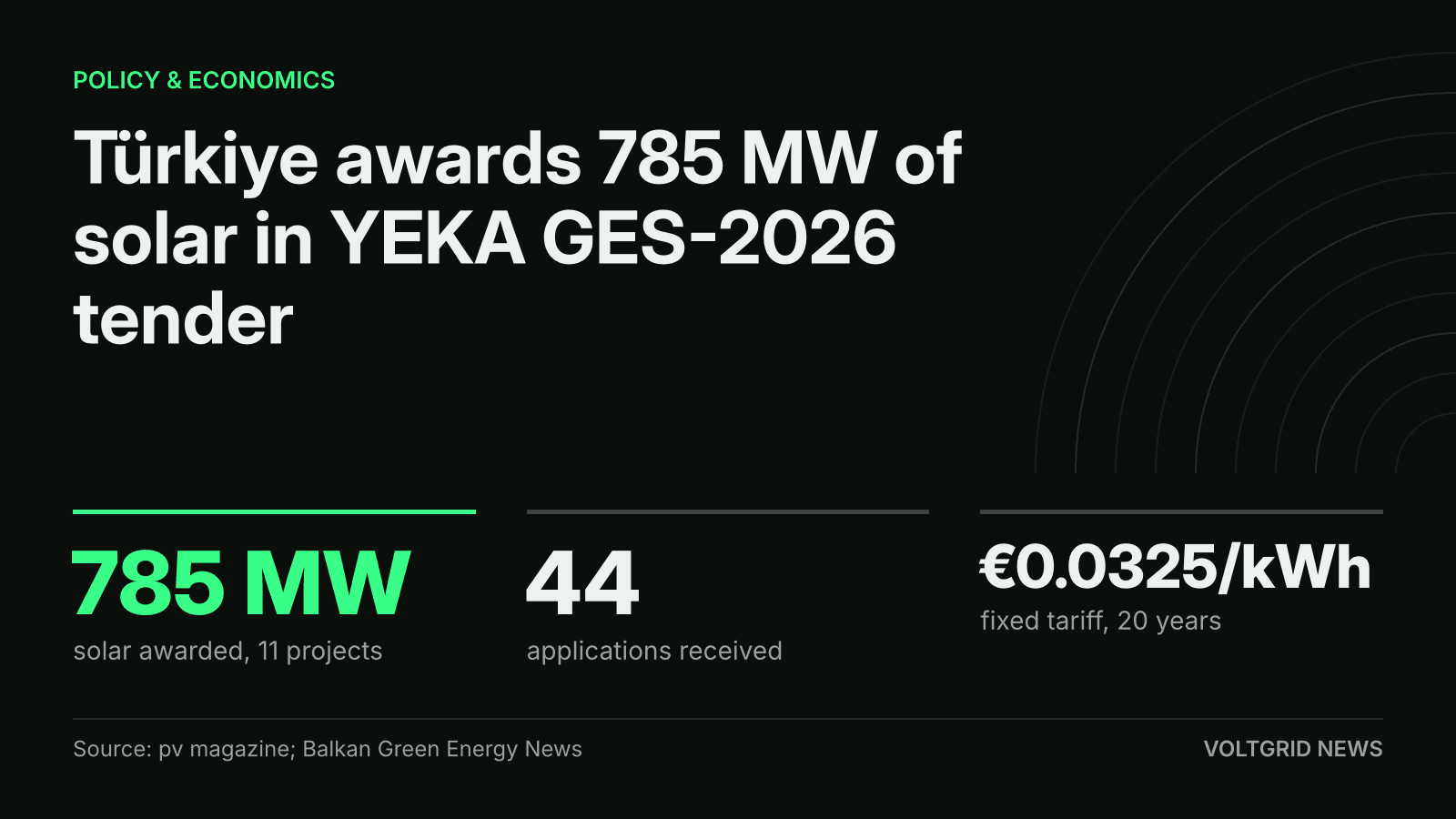
The Energy Ministry's YEKA GES-2026 solar tender in numbers.
Illustration (AI-generated)
Türkiye's Ministry of Energy and Natural Resources awarded 785 MW of solar capacity across 11 sites in the YEKA GES-2026 tender, with a fixed €0.0325/kWh tariff for 20 years, according to results reported on Nov. 3.
The tender drew 44 applications from 19 companies, pv magazine reported. Winners committed about €37.9 million in contribution payments including value-added tax, or €31.6 million before VAT, according to Balkan Green Energy News. YEKA stands for Renewable Energy Resource Areas, the programme under which the state offers grid-connection capacity at defined sites and developers bid for the right to build.
The result sits below the government's plan. It had offered 900 MW across 14 solar projects, but three zones drew no application: Malatya 2 (40 MW), Mardin 1 (30 MW) and Kahramanmaraş 1 (45 MW), together 115 MW, Balkan Green Energy News said. The remaining 785 MW went to 11 zones in Denizli, Ankara, Konya, Kahramanmaraş, Malatya, Diyarbakır, Mardin, Batman and Elazığ, according to the solar industry association GENSED, which republished the ministry's notice.
How the Tariff and Merchant Period Work
Winners may sell their output on the open market for 60 months, then deliver power to the transmission system for 20 years at €0.0325/kWh (€32.5/MWh), pv magazine reported. GENSED, quoting the ministry notice, counts the 60 months from the contract signing date. pv magazine describes it as the first 60 months of operation, and the sources do not settle which applies.
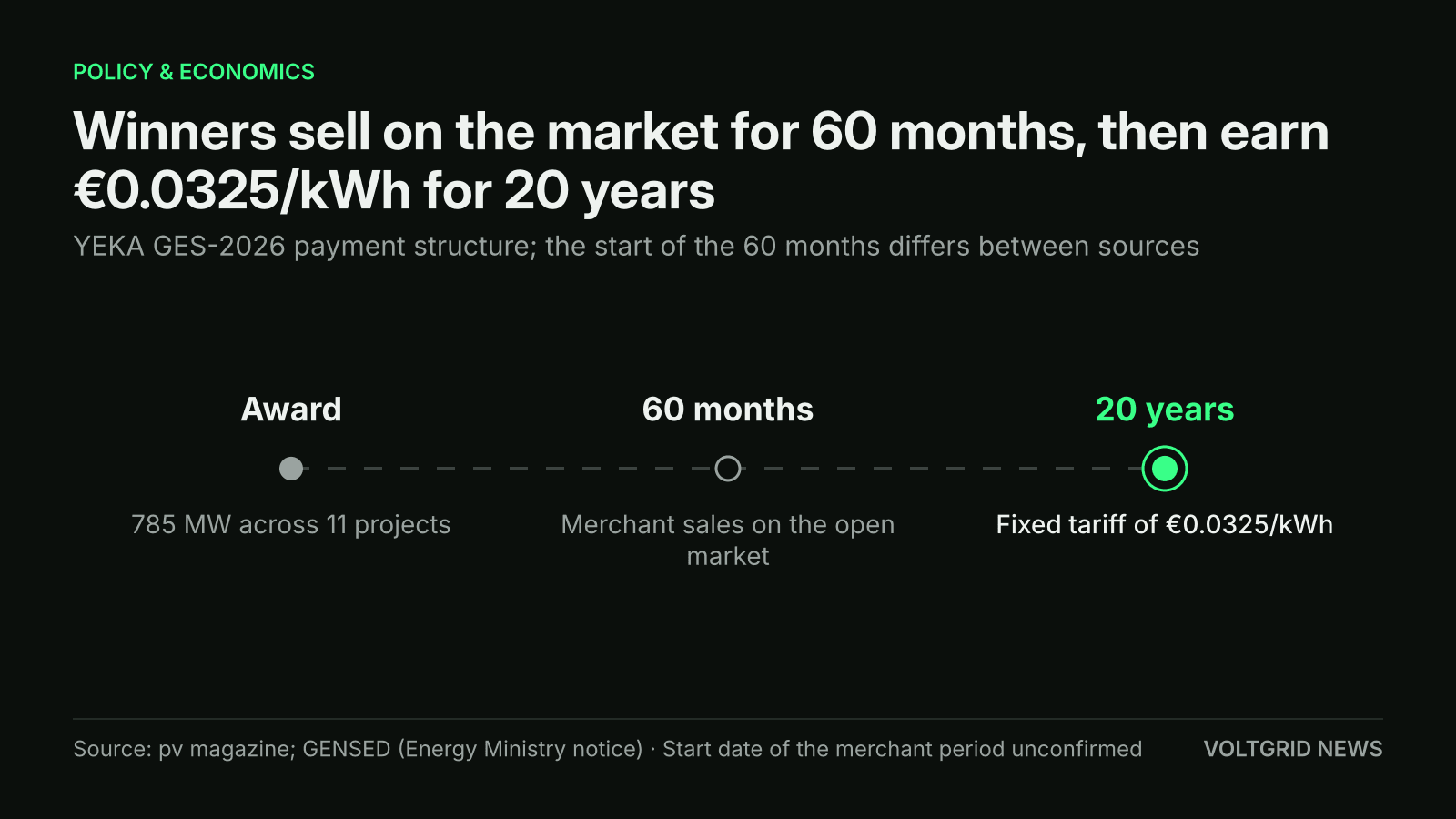
Winners sell on the open market first and move to the fixed tariff after 60 months; sources differ on when the 60 months start.
Illustration (AI-generated)
Balkan Green Energy News reported that bidding ran down to the €32.5/MWh floor and that every solar zone cleared there. Bidders still in the race at the floor then competed on a contribution fee, starting at €10,000/MW. So the competition happened in the up-front payment, not in the price paid to generators. The highest solar fee was €91,000/MW (excluding VAT) from Ezel Mensucat Sanayi for the 55 MW Malatya 1 zone. İklim Invest Enerji bid €12,000/MW for the 30 MW Ankara 2 zone.
What It Means for Financing
For a developer, the structure moves risk to the first five years. Revenue for that period depends on Türkiye's market price, and only afterwards does a fixed rate apply. The contribution fee is also paid before a single megawatt-hour is sold. On the reported figures, €37.9 million including VAT over 785 MW works out to roughly €48,000/MW of capacity, our calculation from those two numbers.
Participation fell against earlier rounds, pv magazine's figures show. In February 2025, the GES-2024 round awarded 800 MW across six projects after 146 applications from 67 companies. The November 2025 round attracted 77 applications from 38 companies for 650 MW across eight projects. The 2026 round drew 44 applications from 19 companies. pv magazine gave the February 2025 final price as $0.0325/kWh, quoted in dollars against €0.0325/kWh now, so the two are not strictly like for like. The sources do not explain the drop in bidders.
Minister Alparslan Bayraktar put the combined solar and wind awards at 2.29 GW across 18 sites, with investment he estimated at US$1.9 billion and annual output of 6.1 TWh, equal to 1.22 billion cubic meters of imported natural gas, according to Balkan Green Energy News. The wind round awarded 1.5 GW. These are the minister's estimates, not audited figures.
How Other Auctions Compare
Other markets pay for solar differently, so the numbers are not interchangeable. Austria's EAG market-premium auction, as Voltgrid reported on Oct. 23, awarded 173.4 MW at a €0.0642/kWh volume-weighted average, with bidders competing on the support level they request. India's regulator, in a SECI solar tariff decision reported on Nov. 3, adopted ₹2.42/kWh for a 2019-vintage auction. In Türkiye the price is fixed at the floor and the contest is over the up-front fee.
What Is Not Confirmed Yet
The sources differ on when the 60-month merchant period starts, and none gives commissioning deadlines. Balkan Green Energy News also reports one-way contracts for difference with a guarantee of at least €47.5/MWh. Neither pv magazine nor the ministry notice as republished by GENSED mentions this, so it is left out of the analysis above. Balkan Green Energy News said Türkiye plans its first offshore wind auctions in the first quarter of next year, the next dated step the sources name.