Vietnam's 2027 Chip Trial Has No Signed ASML Tool Yet
Reuters found no buildings at Viettel's Hanoi site and no signed ASML machine. ASML says planned 2027 and 2028 tool supply will not meet demand it already sees.
5 min readAI-assisted
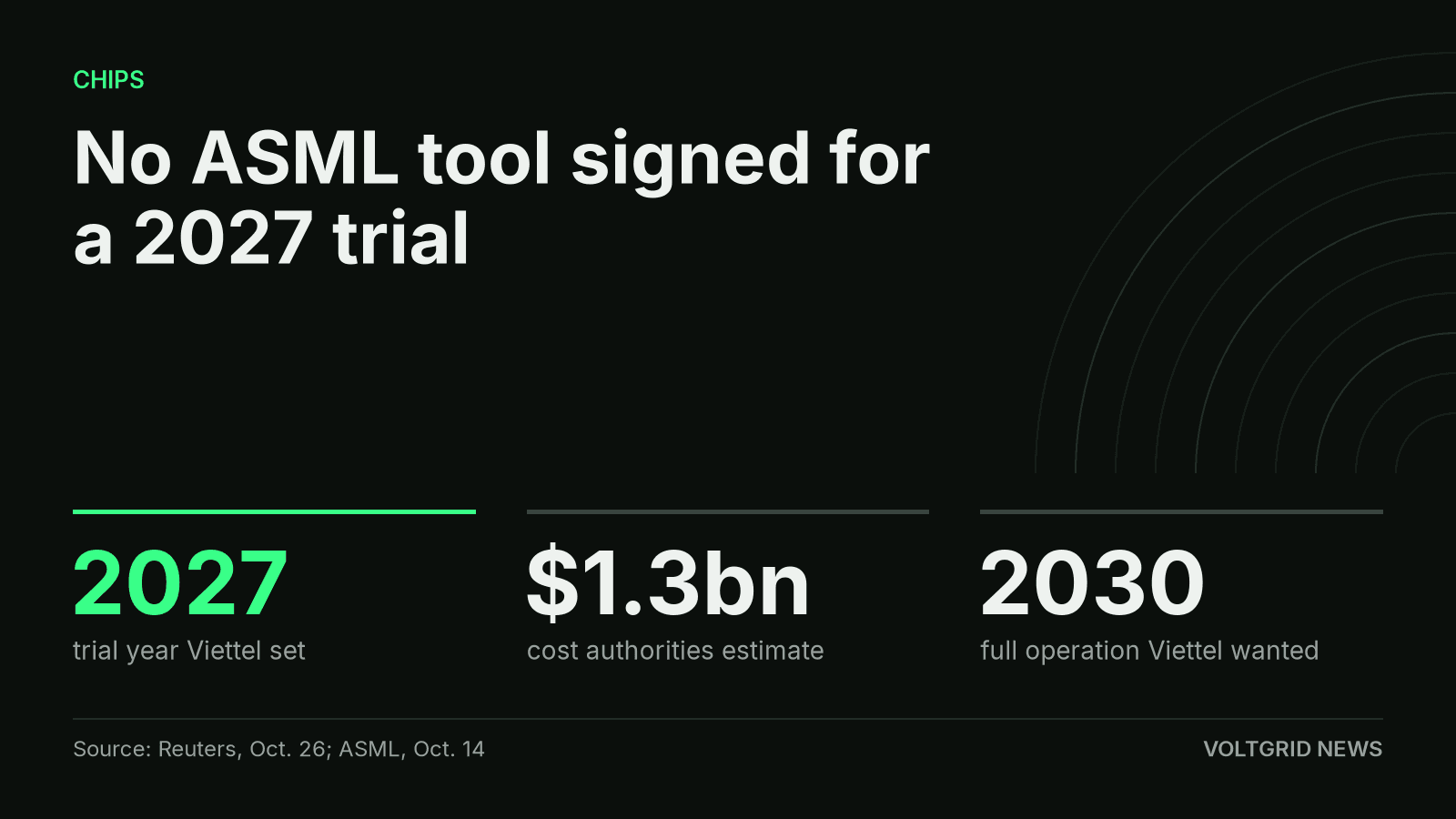
Authorities put the plant near Hanoi at about $1.3 billion. The 2027 trial and the 2030 operation date are Viettel targets, and Reuters found no signed ASML tool on Oct. 26.
Illustration (AI-generated)
Reuters reported on Oct. 26 that Vietnam is unlikely to start trial production at its first chip plant in 2027. Viettel has not reached a deal to buy a lithography machine from ASML. An empty site and no signed tool make that 2027 date a timetable, not a line that can print wafers.
What happened
Viettel, a military-run telecoms and defence group, broke ground in January on a site on the outskirts of Hanoi. Reuters visited last week and found the ground still covered in wild vegetation. Satellite images taken by Planet Labs in January and by Airbus in October show no buildings, Reuters reported.
A person with direct knowledge of the project told Reuters the 2027 target would probably be missed. The reasons given were Viettel's lack of experience building chip factories and administrative delays in securing government funding. The same person said the government-mandated project continues, but the timeline is unclear.
Three people familiar with the matter said talks with ASML have been underway for months. Two of them said those talks cover the purchase of a deep-ultraviolet (DUV) lithography machine, the tool that prints circuit patterns onto silicon wafers. Reuters could not learn which DUV model is under discussion, or why no agreement has been signed. The model would show whether a sale could fall under Dutch export controls, and it would frame the cost. An ASML representative declined to comment on the talks. Vietnam's finance ministry did not respond to Reuters.
Viettel told Reuters the project is progressing in line with the established plan and schedule, and that the work is being carried out in phases to match technical requirements. In January the company said it wanted the plant fully operational by 2030, supplying chips to aerospace, telecom and auto customers. A January presentation described production at 32 nanometres. Reuters reported that this 32-nanometre reference was later removed from Viettel's website. Authorities have estimated the plant's cost at about $1.3 billion.
Why it matters
A lithography machine prints the circuit pattern onto the wafer. Without one, a plot of land cannot run a trial, however firm the construction schedule sounds. ASML is the biggest provider of immersion DUV systems and the only maker of extreme-ultraviolet (EUV) machines, Reuters reported. The talks described to Reuters are about a DUV machine, not an EUV tool.
ASML's own third-quarter release, dated Oct. 14, says supply as currently planned for both 2027 and 2028 will not fully meet customer demand. A footnote ties that sentence to low NA EUV and to DUV immersion. The company had said it would raise 2026 capacity for both by 30% in 2027, and that it was investigating a further 30% increase in 2028. It is now looking at 2028 output beyond that further 30% step. Chief executive Christophe Fouquet also said some customers are expressing interest in placing orders for 2029 and even 2030. CNBC reported the same shortfall on Oct. 14, quoting Fouquet on supply planned for 2027 and 2028.
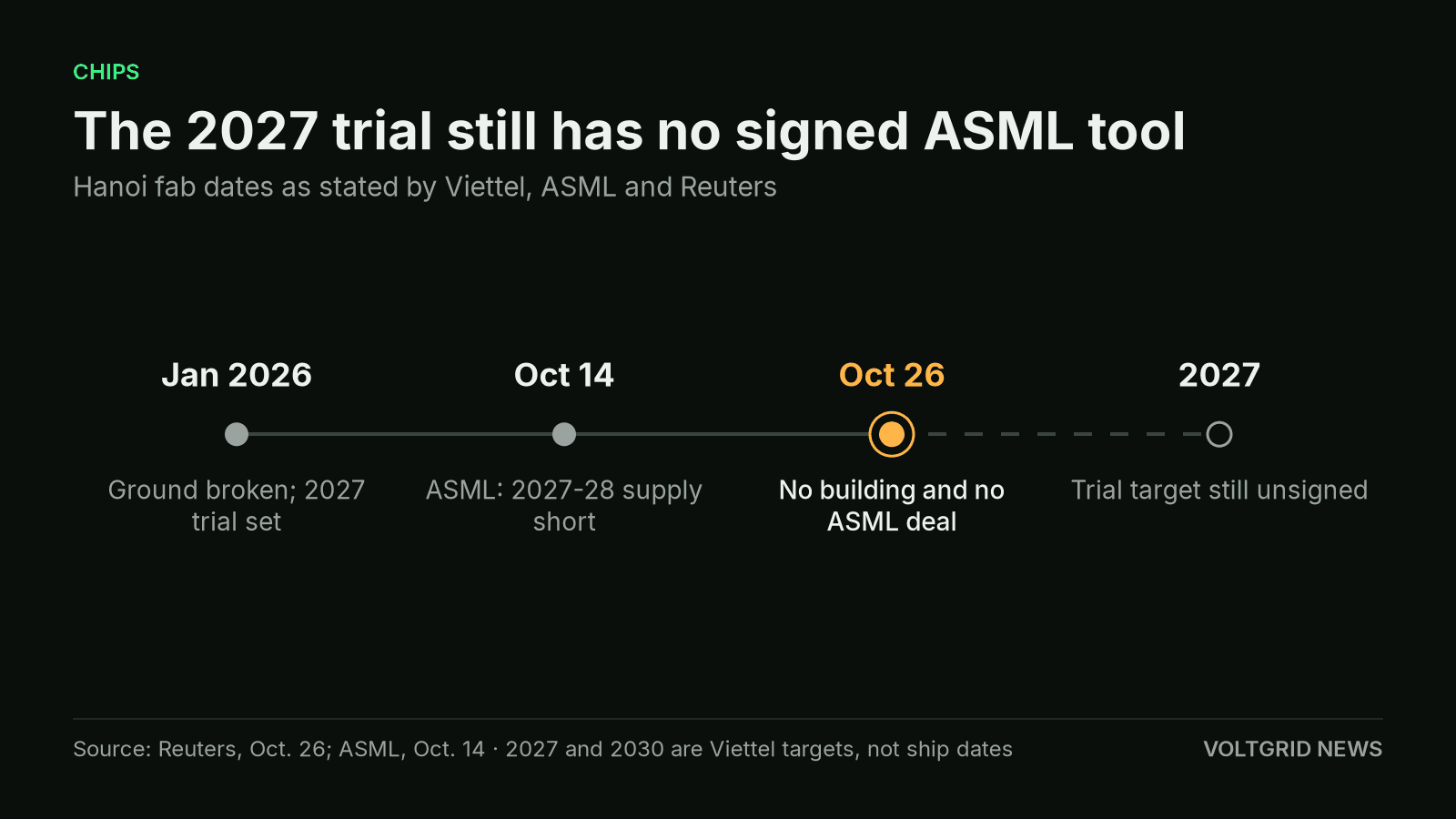
Reuters reported on Oct. 26 that the Hanoi site has no buildings and no ASML deal. ASML said on Oct. 14 that planned 2027 and 2028 tool supply will not meet demand.
Illustration (AI-generated)
That is the squeeze a new fab walks into. Trial production in 2027 needs a building and a machine that can print the process Viettel intends to run. The October satellite pass shows no building. The people familiar with the talks say there is no ASML purchase agreement. Customers who already have visibility are discussing tools for 2028, 2029 and 2030. A project with no order is behind them.
The process target, while it lasted, was ambitious for a first fab. Reuters set that ambition beside Tata Electronics. The Indian firm, it reported, has described an $11 billion Gujarat fab, built with Taiwan's PSMC, that starts on 55-nanometre and 90-nanometre processes and only later adds a 28-nanometre step. Viettel has not disclosed a manufacturing partner to transfer a process and the expertise that goes with it. Industry sources told Reuters that Vietnam's efforts to attract a foreign firm to build a chip factory have not succeeded. The country is already a base for the later steps of assembly, test and packaging. Reuters named Intel, Amkor Technology and Hana Micron as operators of large plants there, and said Samsung is planning a chip-testing facility. Packaging finished chips is not the same work as printing them.
The case against
Viettel's statement is the direct counter. The company says the project matches the plan, and that activities run in phases, so bare ground in October can still fit a later start of construction. ASML's decision not to comment does not show that the talks have ended. Reuters also could not name the DUV model. If the machine is an older tool, outside the immersion class, Reuters wrote that limits on older gear should be milder than on the most advanced machines. That line is Reuters' account of what the company said this month. It is not a sentence in the Oct. 14 release, which places DUV immersion inside the shortfall alongside low NA EUV. Until a model number appears, both readings remain open. Taking the 32-nanometre claim off the website could also mean the process goal has moved to something less demanding, which would soften the case that only a scarce immersion tool will do.
What it means for ASML and buyers
ASML does not need this plant to fill its order book. The Oct. 14 release says order-book momentum rose quarter after quarter this year, and that some customers want slots in 2029 and 2030. A cost of about $1.3 billion, the figure authorities gave Reuters, is a national project on a budget far below the tool spending of the leading-edge customers already in that queue. The pressure falls on the newcomer. If Viettel needs an immersion DUV machine, it is asking for a class of tool ASML says it cannot fully supply in 2027 or 2028.
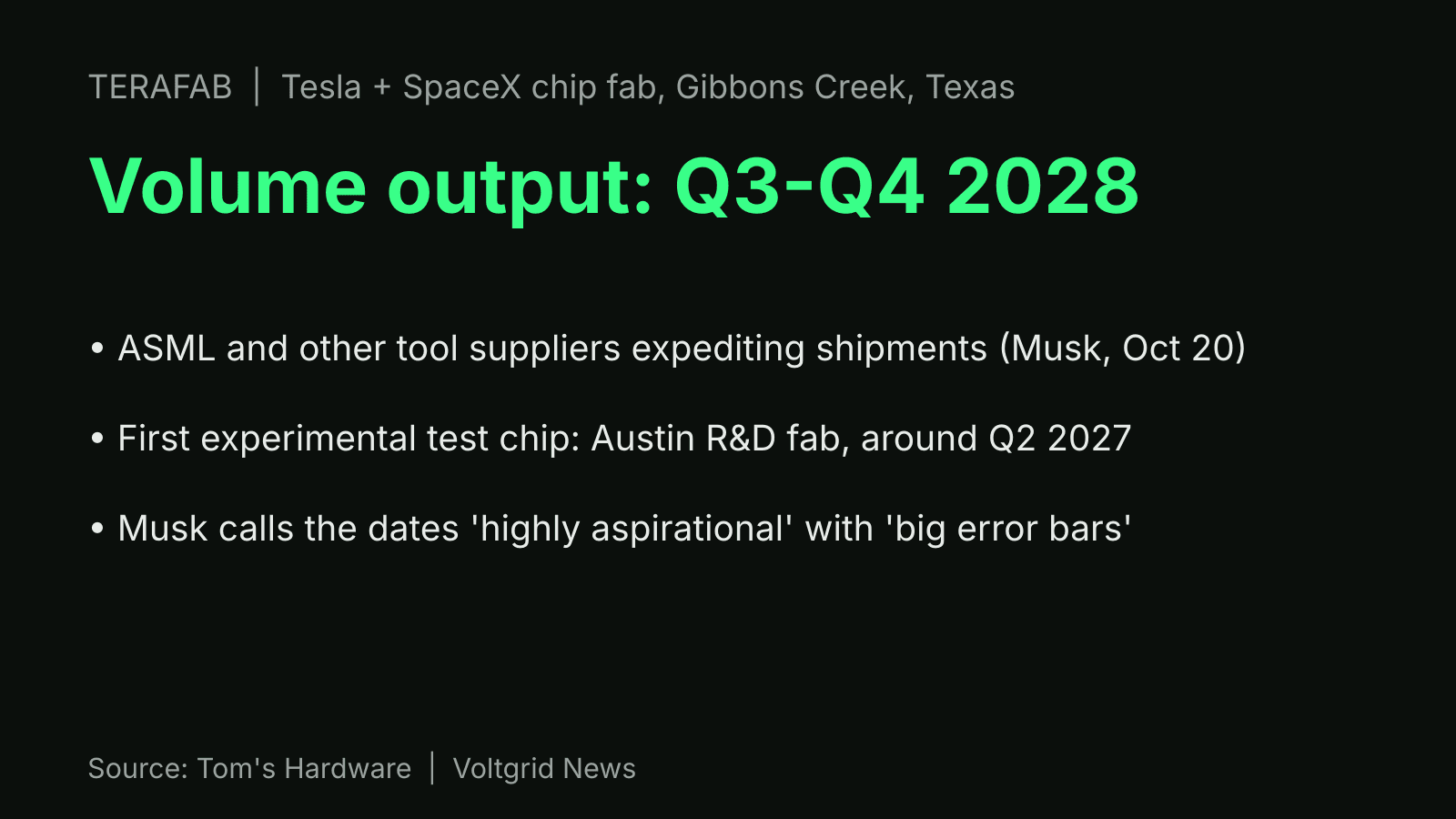
Other projects are already waiting on the same queue. Voltgrid reported that Elon Musk said ASML and other equipment suppliers have expedited shipments to Terafab, the Tesla and SpaceX plant, which he said is targeting volume production in the third or fourth quarter of 2028 on a timeline he called highly aspirational. That is a separate project. It points the same way: the year a new fab prints wafers is set by tool delivery, not by the groundbreaking.
Nikon of Japan competes with ASML in immersion DUV, Reuters noted. Nothing in these sources says Viettel has opened talks with Nikon. That route is possible, and it is unconfirmed.
What to watch
The next fact that would change this reading is a named machine, not another photo of the groundbreaking. A DUV model would show whether Dutch export controls even apply, which Reuters could not establish. A building on a later satellite image would show that construction has started. Viettel's 2027 trial target, and its claim of full operation by 2030, are the dates that either slip in public or gain a signed tool behind them. The other date to watch is ASML's own: how far it can lift 2028 output above the extra 30% increase it had already been studying for low NA EUV and DUV immersion.
Sources
- 01Exclusive-Vietnam's first chip plant unlikely to meet 2027 target, sources say no deal yet with ASMLThe Star · thestar.com.my
- 02ASML reports €11.7 billion total net sales and €5.0 billion net income in Q3 2026ASML · investor.asml.com
- 03ASML says it's getting order interest through 2030 as profit smashes expectationsCNBC · cnbc.com