Cadence Says Maestro Beats General Models by up to 30%
Cadence on Oct. 26 launched Maestro, chip-design models based partly on Nvidia's Nemotron, which customers can run in their own data centers. The 30 percent gain is Cadence's claim.
2 min readAI-assisted
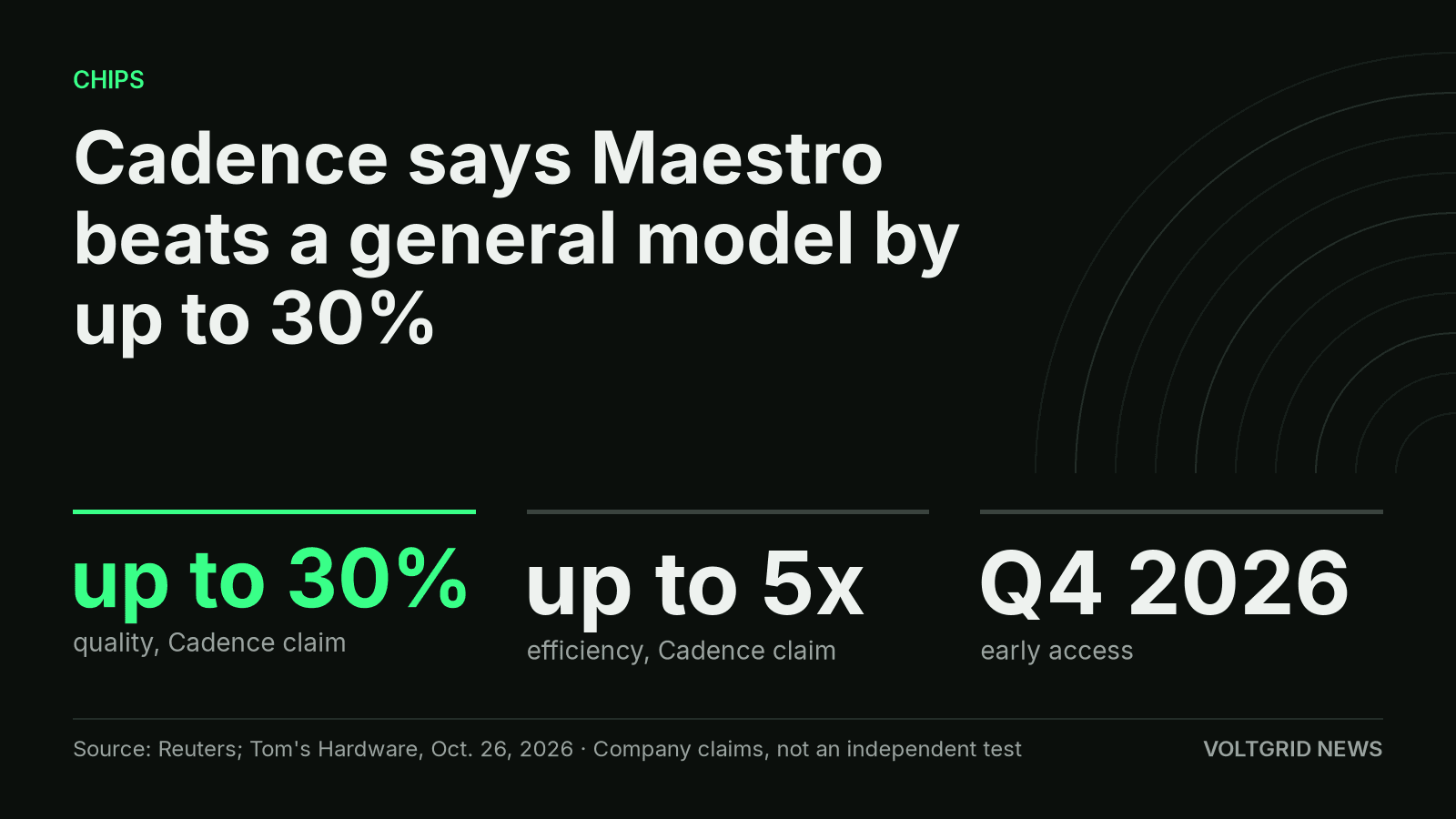
Both figures are Cadence's claims, reported by Reuters and Tom's Hardware on Oct. 26. No general-availability date was given.
Voltgrid News
Illustration (AI-generated)
Cadence Design Systems on Monday launched Maestro, a set of AI models tuned for chip design that customers can keep inside their own data centers, Reuters reported on Oct. 26.
Reuters said the models were built in part on Nvidia's open-weight Nemotron models and locked down with Nvidia's OpenShell technology. Cadence said customers can run them on Cadence's own cloud, on any public cloud, or behind their own firewall, and can train them further on their own designs. Cadence told Reuters that early results show up to 30 percent higher quality and up to five times better cost-efficiency than general-purpose models.
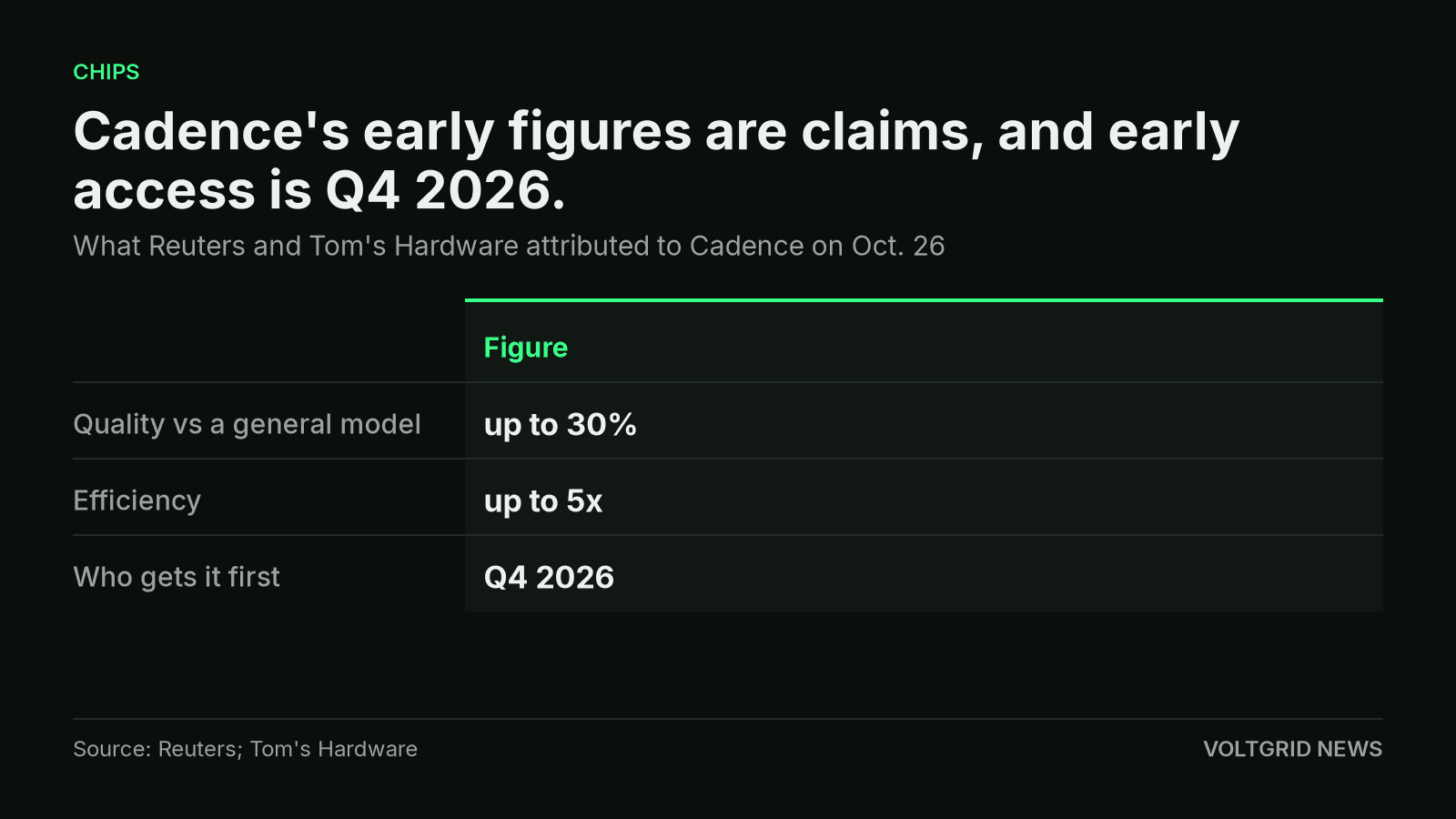
Tom's Hardware said Cadence did not define what the 30 percent measures, and did not name the baseline model.
Voltgrid News
Illustration (AI-generated)
Tom's Hardware, which published the same day after speaking with Cadence executives, reported the efficiency claim as up to five times the token efficiency. It said the first models go to a select group of early-access customers in the fourth quarter of 2026. Tom's Hardware said Cadence has not set a general-availability date, and has not said what the 30 percent measures. In chip design, quality of results usually means power, performance and area. Cadence did not confirm that this percentage is that comparison. Tom's Hardware said the baseline is the general-purpose model Maestro started from, and that Cadence did not name it.
Where the compute runs
The power question is which building draws the load. A chipmaker that keeps Maestro on its own GPUs pays for that inference in its own data hall. Reuters set that against Synopsys, which on Sept. 30 said it would build a model with OpenAI, called GPT-Synopsys, that runs on OpenAI's infrastructure. Cadence senior vice president Paul Cunningham told Reuters that open-weight and closed-weight routes are both in play, and he declined to name any further deals with commercial AI labs.
What is still a vendor claim
Both the 30 percent quality figure and the five-times efficiency figure are Cadence's early results. Reuters and Tom's Hardware attribute them to the company. No independent lab measurement is in either report. Cadence has not said when buyers outside the early-access group will receive the models. Reuters described Nvidia's role as the Nemotron base model and OpenShell. It did not report a new Nvidia chip, a watt rating, or a purchase of GPU capacity tied to Maestro.
Cadence itself is not on Voltgrid's company list. Nvidia is the tagged company because its models and safety layer are the part of the launch Reuters named.