China Energy Storage Plan: 300 GW by 2030, 3-Hour Duration
NDRC and NEA's dedicated 2026-2030 storage plan keeps the 300 GW 2030 target from earlier plans but adds a three-hour duration goal and capacity pricing in place of mandates.
3 min read
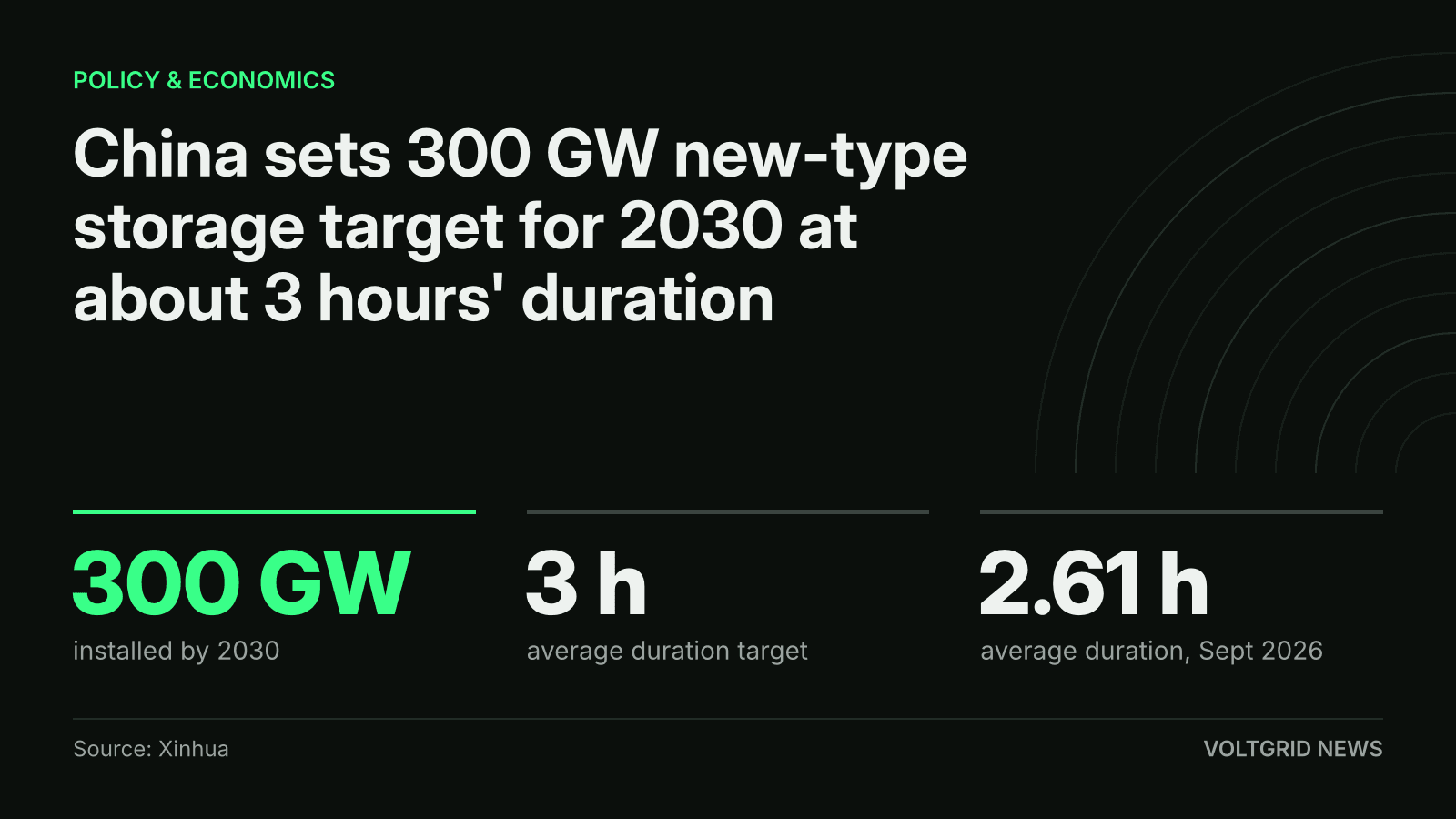
China's NDRC and NEA plan targets 300 GW of new-type storage by 2030 at about three hours' average duration, Xinhua reported.
Graphic: Voltgrid News
China's National Development and Reform Commission (NDRC) and National Energy Administration (NEA) issued a dedicated 2026-2030 plan for new-type energy storage on Nov. 13, targeting 300 million kW (300 GW) installed by 2030 at an average duration of about three hours, Xinhua reported.
The headline capacity is not new: the 300 GW figure already sat in the 15th Five-Year plan for the power system, as pv magazine described it on Nov. 5. What the stand-alone plan adds is a duration target, a pricing design and a stated aim to move the sector from scale-driven growth to market-driven growth. In Xinhua's definition, new-type storage means everything except pumped-storage hydropower, mainly electrochemical, compressed-air and gravity systems.
What the Plan Changes for Storage Revenue
The plan asks for storage to take part in electricity markets on fair terms and encourages renewable megabases that include storage to enter cross-provincial markets as one entity, Xinhua said. It also calls for pricing that reflects the value of stored power, with charging and discharging prices set through market trading.
Xinhua's Chinese-language report adds the mechanism: under a list-based management system, the plan sets up a capacity price for grid-side independent storage, and time-of-use price gaps are to be adjusted dynamically to push commercial and industrial users and industrial parks to build their own storage. An NEA official said the 300 GW goal should be matched to local market absorption and what compensation schemes can bear, in a "policy-guided, market-led" approach.
Huayuan Securities, quoted by Xinhua, described the earlier investment case as policy-driven, resting largely on mandatory deployment rules and subsidies. Xu Dongjie of the China Electric Power Planning and Engineering Institute called 300 GW a prudent minimum meant to avoid investment-driven boom-and-bust cycles. Both are views, not plan text.
How 300 GW Compares With the Fleet Today
The NEA put the fleet at 136 GW at the end of 2025 with an average duration of 2.58 hours, Xinhua reported. By the end of September 2026 it stood at 167 GW/435 GWh, up 63% year on year, with average duration at 2.61 hours, according to NEA figures that pv magazine reported on Nov. 5.
Voltgrid arithmetic from those figures: 300 GW is about 1.8 times the September fleet and 2.2 times the end-2025 fleet, and it needs roughly 133 GW more over the 51 months from October 2026 to December 2030, about 2.6 GW a month. The first nine months of 2026 added about 31 GW, or 3.4 GW a month, so the target asks for a slower build than 2026's pace. The harder number is duration. Moving from 2.61 hours to about three hours means energy capacity grows faster than power: 300 GW at three hours would be about 900 GWh, against 435 GWh now, if the averages hold.
The nearer milestone is already close. A separate action plan requires new-type storage above 180 GW by the end of 2027, as pv magazine reported on Aug. 5, which is about 13 GW above the September 2026 level. That same report said the 15th Five-Year renewable energy plan, released in July, set no standalone 2030 storage target.
The 2030 target of 300 GW compares with 167 GW installed at the end of September 2026, according to NEA data and the plans reported by Xinhua and pv magazine.
Graphic: Voltgrid News
How Asia's Approaches Differ
India chose a different route this month: its cabinet approved Rs 14,500 crore of viability gap funding for 92 GWh of grid storage, as Voltgrid reported, a direct subsidy with competitive bidding. China's plan points the other way, toward capacity payments and market prices, in a sector Huayuan Securities says is moving away from mandates and subsidies.
What Is Not Confirmed Yet
The plan's full text on the NDRC and NEA sites was not read for this story, so the figures come from Xinhua's reports of it. No capacity price level, no list-management rules and no provincial rollout dates have been published in the reports we read. Provincial market rules decide storage revenue in practice, pv magazine noted, so the first provincial capacity-price notices are the next thing to watch.
Sources
- 01China puts battery storage at center of renewable energy strategypv magazinepv-magazine.com
- 02China to boost new types of energy storage during 2026-2030Global Timesglobaltimes.cn
- 03China to boost new types of energy storage during 2026-2030Xinhuaenglish.news.cn
- 04China's energy storage fleet grows to 167 GW as utilization improvespv magazinepv-magazine.com
- 052030年全国新型储能装机规模有望达到3亿千瓦 (Xinhua, Chinese)Xinhuanews.cn
- Published
- Sources
- 5 cited