China's Southern Power Market Enters Formal Operation in 5 Provinces
China's southern power market, covering five provinces and more than 290,000 registered entities, now uses competitive bidding for cross-region transmission capacity.
2 min readAI-assisted
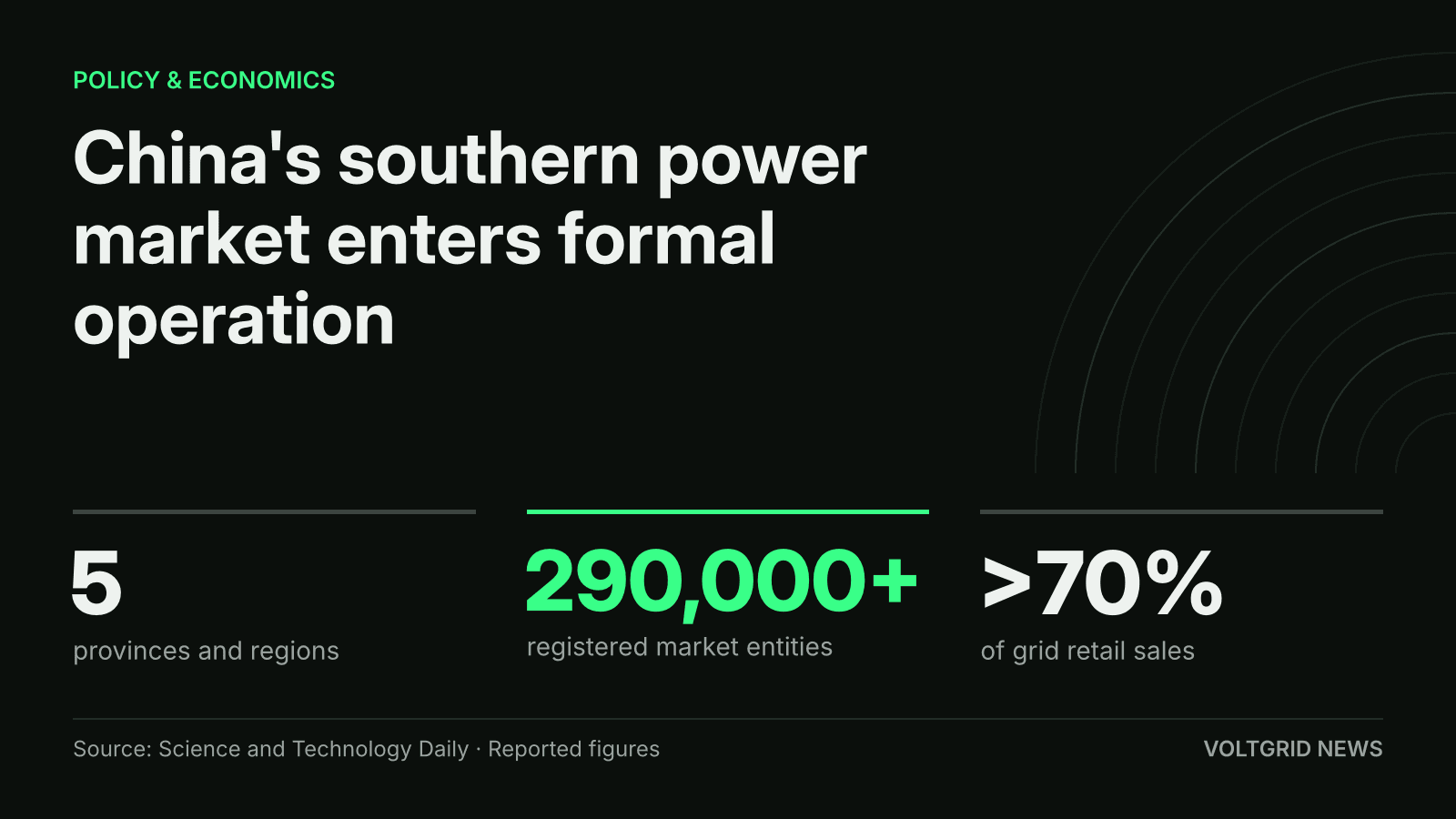
The southern regional market entered formal operation on Oct 24, 2026, according to Science and Technology Daily; figures as reported.
Illustration (AI-generated)
China's southern regional power market moved from trial to formal operation on October 24, 2026, covering Guangdong, Guangxi, Yunnan, Guizhou and Hainan, with more than 290,000 registered market entities, Science and Technology Daily reported.
The market is described as China's first regional power market and runs under the guidance of the National Development and Reform Commission (NDRC) and the National Energy Administration (NEA). Continuous settlement trial operation began in June 2025. The NEA held a promotion meeting in Guangzhou on the day of the switch, attended by NEA director Wang Hongzhi, according to the agency's website as carried by Sina.
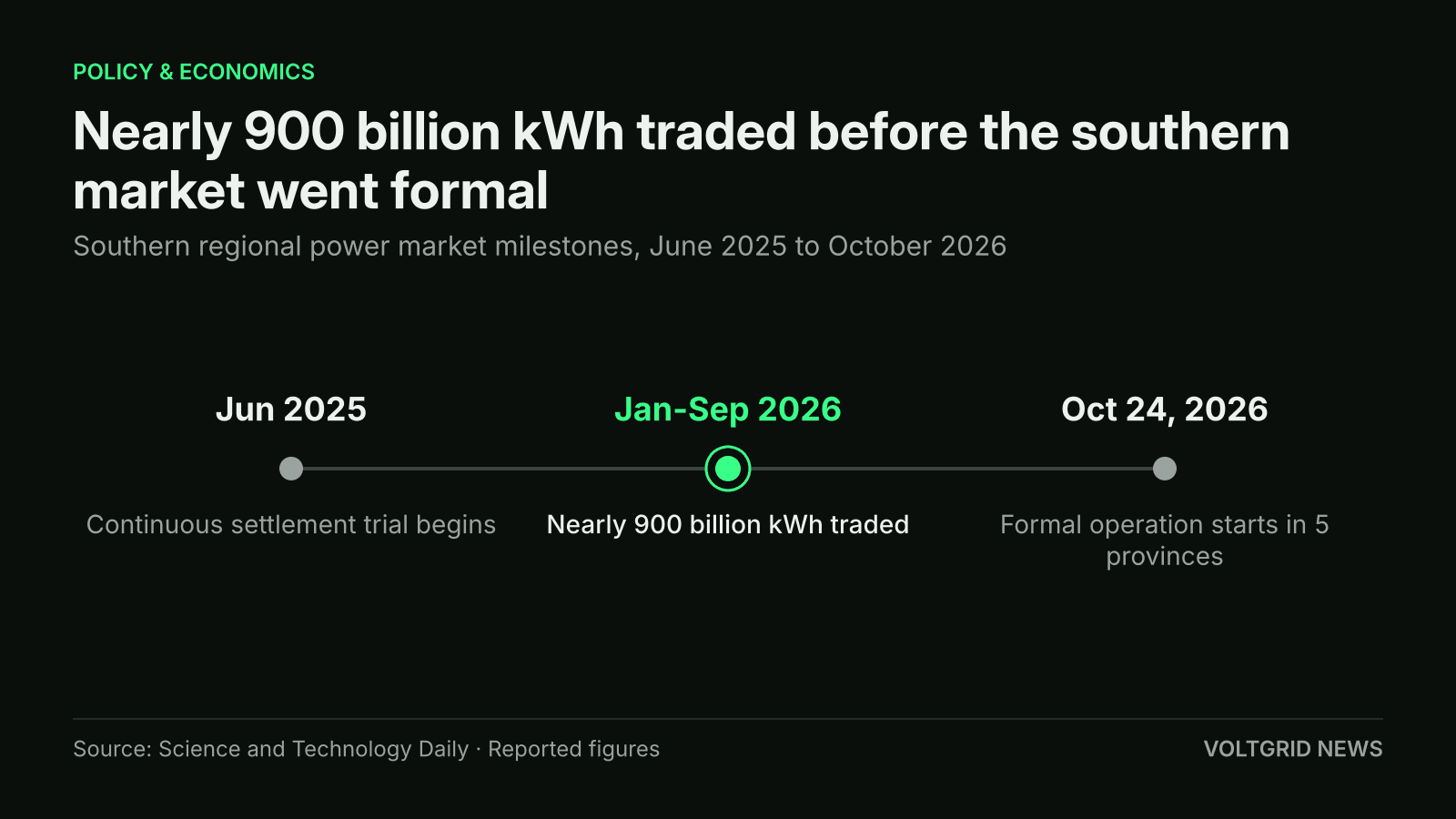
Nearly 900 billion kWh was traded from January to September 2026, before formal operation began on Oct 24, according to Science and Technology Daily.
Illustration (AI-generated)
Generators, power retailers, users, new-type energy storage and virtual power plants all take part. Coal, hydro, nuclear, wind, solar and gas generation bid under one set of rules. Science and Technology Daily reported that cumulative trading from January to September 2026 reached nearly 900 billion kWh, over 70% of the grid's total retail electricity sales, and that the largest single-day cleared volume exceeded 4 billion kWh.
What the rule changes
The main change for the grid is how power moves between provinces. Cross-region trading has shifted from energy-only deals to competitive bidding for transmission capacity, with prices that reflect how congested a channel is, the newspaper said. Cross-region trading volume exceeded 19.4 billion kWh, a record, with southwest hydropower supplying the Yangtze River Delta and northwest wind and solar supplying the Greater Bay Area as examples.
For developers of wind, solar and storage, a congestion-linked price on transmission capacity is a direct signal of where new capacity is worth connecting. Regional renewable utilization stayed above 95%, and renewables supplied about 40% of incremental sales in the period, per the same report.
Who pays
The reports give no price levels, caps or compliance costs, so the effect on bills cannot be quantified yet. Coverage citing official sources said residential and agricultural tariffs are not affected, while commercial and industrial users can choose among retail packages. Treat the household-tariff point as reported, since the NEA meeting summary read by Voltgrid did not repeat it.
How the pieces fit the national plan
The NEA framed the launch within the national unified market effort, described as "five unifications and one opening", and said it will expand cross-border power trading in an orderly way. It also called for stronger grid frame construction and coordination of main grid, distribution and microgrids. No timelines or investment figures were given.
What is not confirmed yet
Several numbers come from press reports of the launch rather than from the NEA text itself, which Voltgrid could not open in full. Price formation details, including any nodal or 15-minute pricing, were not confirmed in the sources Voltgrid read. Speakers quoted by Science and Technology Daily include Li Minhong and Huang He of China Southern Power Grid; the newspaper did not state how storage and virtual power plants will be settled. The next step to watch is the NEA's full meeting text and the first monthly market reports under formal operation.