Singapore Ties Renewable Claims to the Grid and Clears 1.3 GW
Singapore's revised SS673 requires renewable-electricity claims to rest on power delivered to its grid, as the EMA conditionally approves a Sembcorp import of 1.3 GW via Malaysia.
2 min readAI-assisted
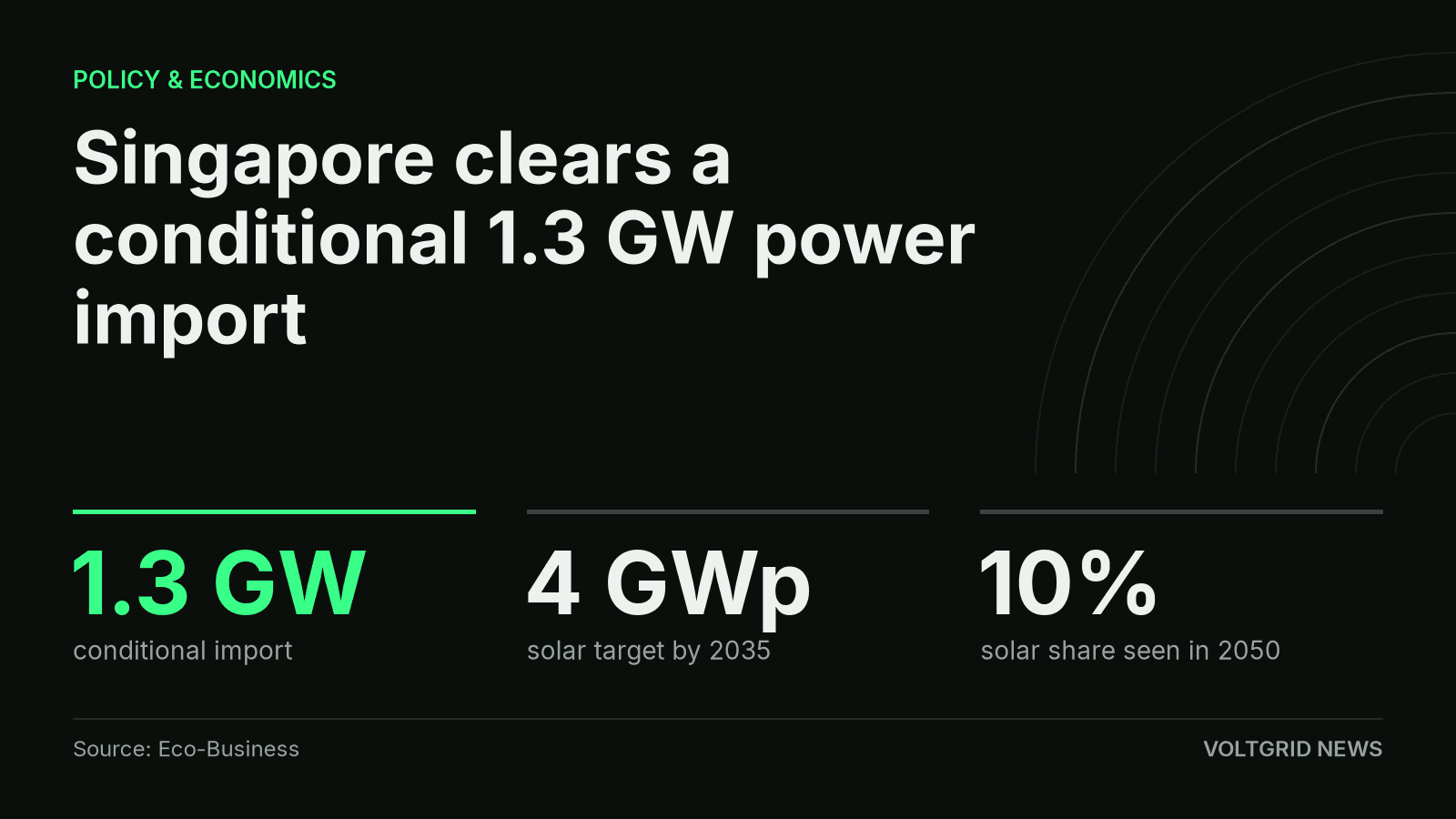
The 1.3 GW import approval for Sembcorp is conditional, Eco-Business reported from Gan Siow Huang's Oct. 27 remarks.
Illustration (AI-generated)
Singapore will let companies call electricity renewable only when the certificates behind that claim are tied to power that reaches its grid, Minister of State Gan Siow Huang said on Oct. 27, as regulators conditionally cleared a 1.3 GW import.
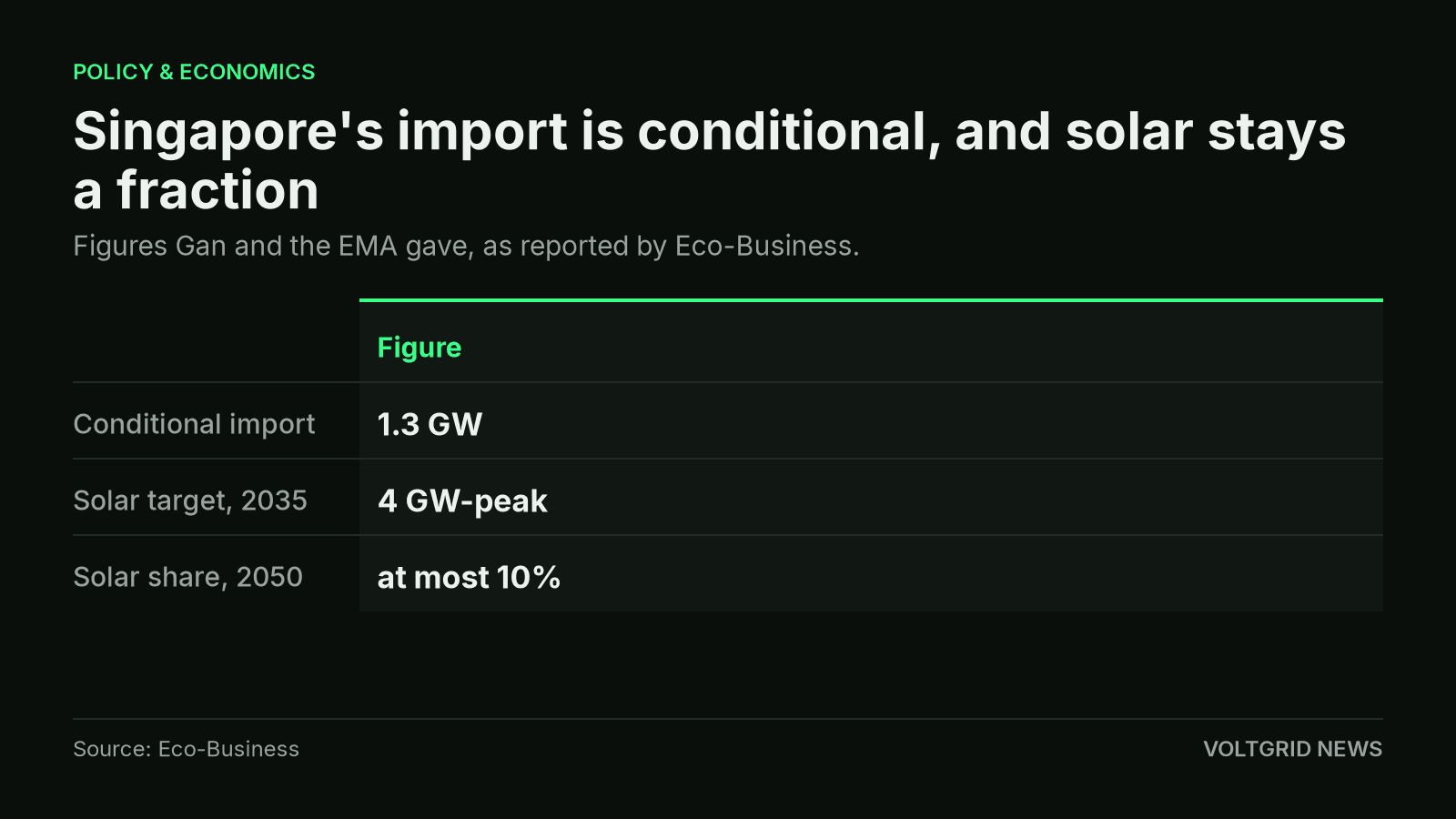
The import, the 2035 solar target and the 2050 share are different measures, all as Eco-Business reported them.
Illustration (AI-generated)
Eco-Business reported the remarks from the Asia Clean Energy Summit. Amended Singapore Standard 673 splits certificates into two uses. Projects abroad that do not deliver electricity into Singapore can still show support for renewable builds overseas. They cannot support a claim that power used in Singapore is renewable. Gan said firms had asked what each certificate can honestly back, and that the update should lower the risk of greenwashing in corporate reports. She added that counting certificates which travel with imported power could make buyers more willing to pay for those imports.
On Monday, Oct. 26, the Energy Market Authority gave Sembcorp Utilities conditional approval to import 1.3 gigawatts from or through Peninsular Malaysia. Eco-Business said the project would draw on sources that include Vietnamese offshore wind and Malaysian solar. Gan said cross-border lines need durable rules and competitive prices, and that Singapore will seek regional endorsement next year of guidelines for submarine power cables.
Why the rule changes the import case
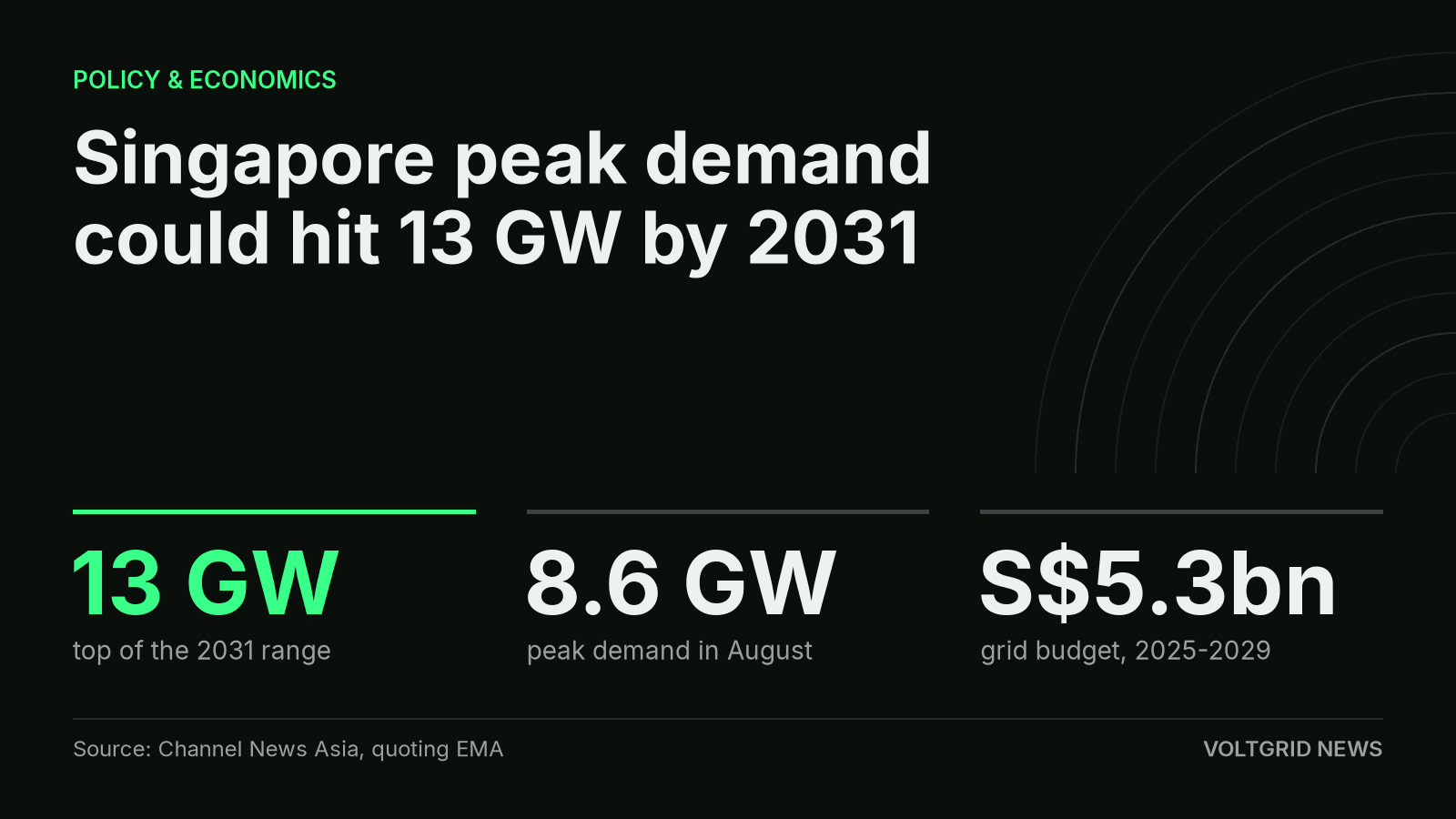
A certificate with no physical delivery no longer proves that a Singapore load, including a data center, runs on renewable power. Buyers are pointed toward imports that are wired in. The government has raised its solar deployment target to 4 gigawatt-peak by 2035, Gan said, yet it expects solar to meet at most 10% of electricity needs in 2050. Voltgrid reported that peak demand could reach 13 GW by 2031. Imports, and studies of nuclear and geothermal, are how the government talks about the rest. More than 5,000 public-housing blocks already have rooftop panels under SolarNova, and the market authority is lining up a tender for further public sites, including carports.
What is not confirmed yet
The 1.3 GW approval is conditional. Eco-Business does not give a start date, a contract price, a landing point or a capacity factor. Gan announced no nuclear project. The 4 gigawatt-peak figure is a panel-deployment target, not annual energy, and the 10% share is an expectation for 2050, not a measurement.