Portugal Requires Grid-Forming on Batteries of 45 MW or More
From Oct. 23, new batteries on Portugal's transmission grid, or rated 45 MW or more, must provide grid-forming capability and synthetic inertia, ESS News reported.
2 min readAI-assisted
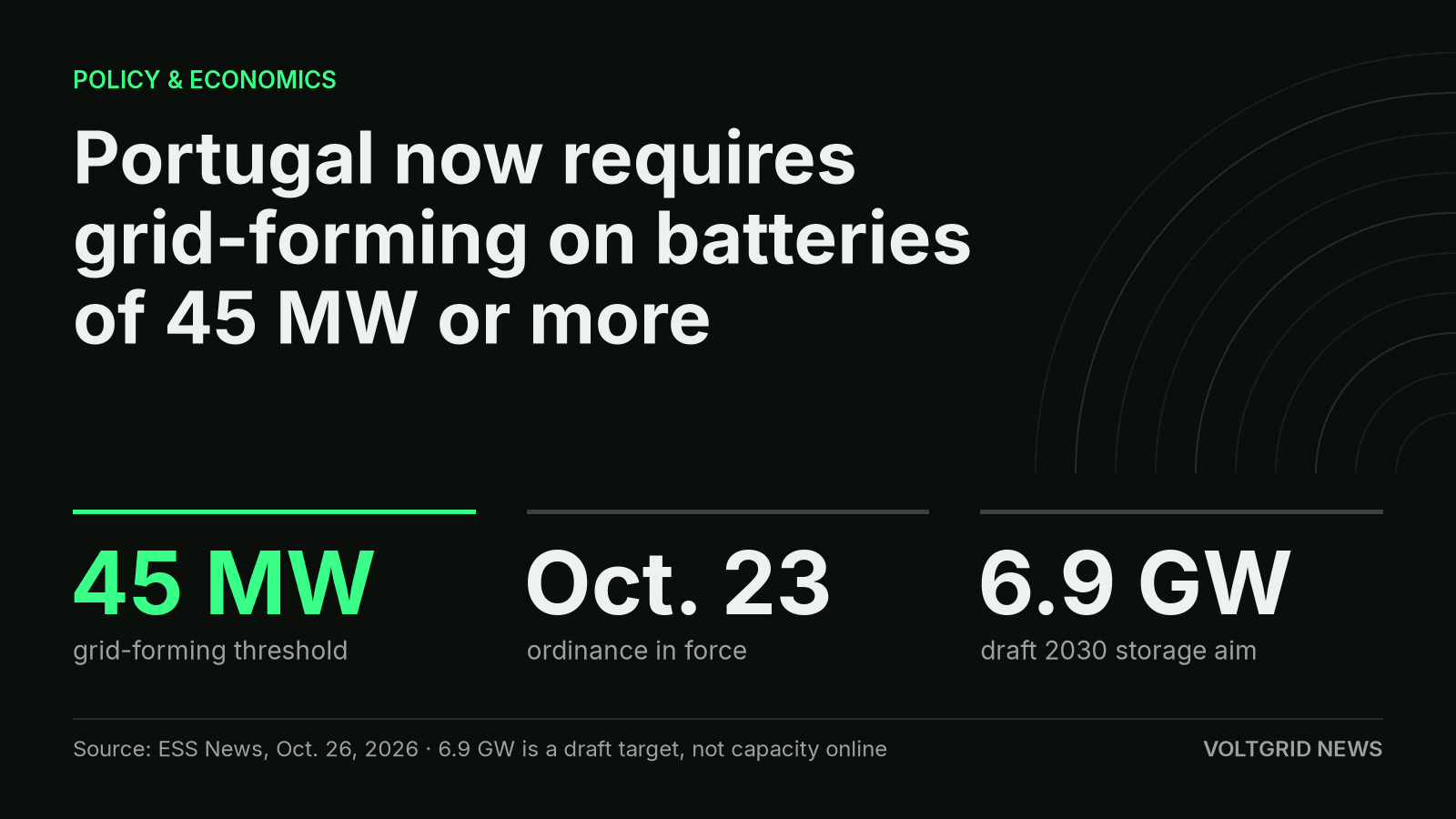
ESS News reported the ordinance on Oct. 26. The 6.9 GW figure is a draft 2030 target, not operating storage.
Voltgrid News
Illustration (AI-generated)
New battery plants on Portugal's transmission grid, or rated at 45 MW or more, must provide grid-forming capability and synthetic inertia, under an ordinance that took effect on Oct. 23, ESS News reported on Oct. 26.
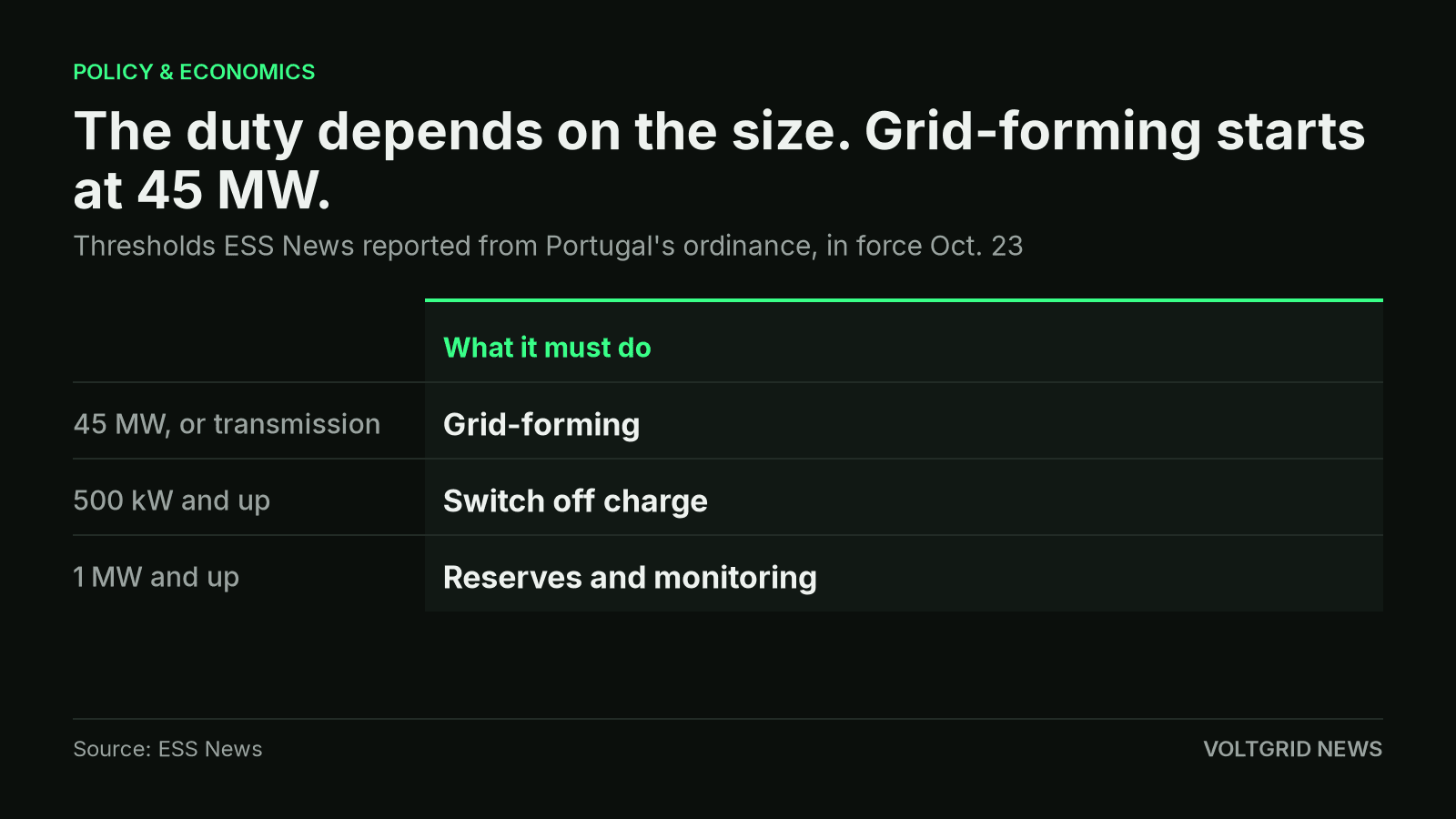
ESS News said the ordinance took effect Oct. 23 for new connection requests. Plants already built are covered only if they are significantly changed.
Voltgrid News
Illustration (AI-generated)
ESS News said Portugal's secretary of state for energy, Jean Paulo Gil Barroca, signed the ordinance. It applies Europe's generator-connection requirements to storage, including while a plant is charging or supplying its own auxiliary loads. Plants of 500 kW or more must be able to switch from charging to discharging on their own when frequency falls. ESS News said the default relay setting for that switch, while the plant is charging, is 49.2 Hz. Plants tied in at 110 kV or above are covered as well, on terms the grid operators set. For plants between 10 MW and 45 MW, ESS News said the technical annex leaves the grid-forming duty to the capacity title, the permit or the tender.
The rule is about keeping an inverter-heavy system stable. ESS News said plants must hold extra power and energy so they can provide synthetic inertia when frequency sits between 47.0 Hz and 52.5 Hz, and when it changes by as much as 2 Hz per second. The emulated inertia, stated as a mechanical starting time, must be adjustable from 1 second to 20 seconds, with a default of 12 seconds. Plants must damp oscillations between 0.1 Hz and 10 Hz at a damping ratio of at least 10 percent. Pumped hydro and other storage that already supplies synchronous inertia is outside the grid-forming duty.
Who must comply
Every plant of 1 MW or more must be technically able to offer frequency containment and restoration reserves, plus voltage and reactive-power control, ESS News said. Plants above 1 MW must give the operator live monitoring and remote control. Changes in load outside reserve activation are supposed to ramp over 10 minutes unless the operator directs otherwise. The ordinance does not force plants to keep a reserve state of charge for emergencies. Plants on the distribution grid must also be able to run in grid-following mode, and the operator picks the mode. The government said it is setting the requirements now, while the European Union revises the generator connection code, because Portugal's storage strategy and EU-backed funding calls together cover more than 1 GW of projects.
Targets that are not yet built
Portugal's draft storage strategy, issued for consultation in August, aims at 6.9 GW of storage by 2030, ESS News said. The government has also said it plans an auction for 750 MVA of batteries. ESS News said that in June the government put that auction on the calendar for September, next to a 300 MW round for storage paired with renewables. The Oct. 26 report does not say those rounds have been held. The operating fleet is still small. ESS News, citing renewable association APREN, said Portugal had 20 MW of batteries running at the end of 2025. In January 2025 the government awarded €100 million, which ESS News put at about $112 million, to 43 projects totaling about 500 MW. Plants already built fall under the new ordinance only if they are significantly expanded, modernized or refitted. Connection requests filed from Oct. 23 are the ones that must meet it.