Japan Plans About ¥100 Billion for Perovskite Cells to 2029
Yonhap, citing Nikkei, said Japan will provide about 100 billion yen through 2029 for perovskite lines at Ricoh and Choshu. Ricoh confirmed a METI slot and a Miyagi plant of several hundred MW a year by 2030.
2 min readAI-assisted
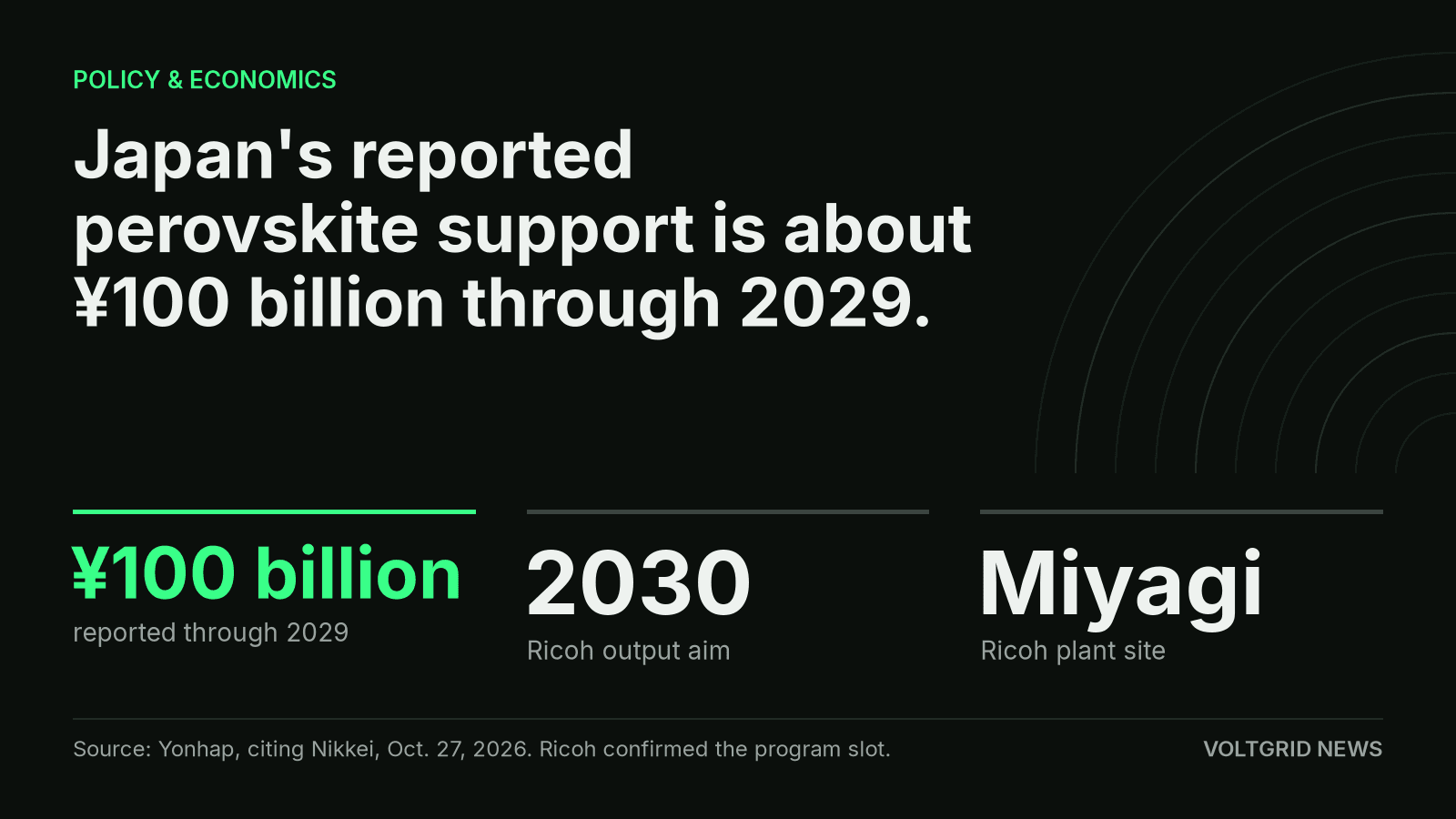
Ricoh's release photo shows an unnamed person holding a flexible module, so it is not used. The yen figure is Yonhap's account of Nikkei, not a line in Ricoh's release.
Illustration (AI-generated)
Ricoh said on Oct. 27 that Japan's Ministry of Economy, Trade and Industry has selected its inkjet-printed perovskite solar cells for the GX Supply Chain Development Support Program, and that it will build a production line at Ricoh Industry's Tohoku site in Shibata, Miyagi Prefecture.
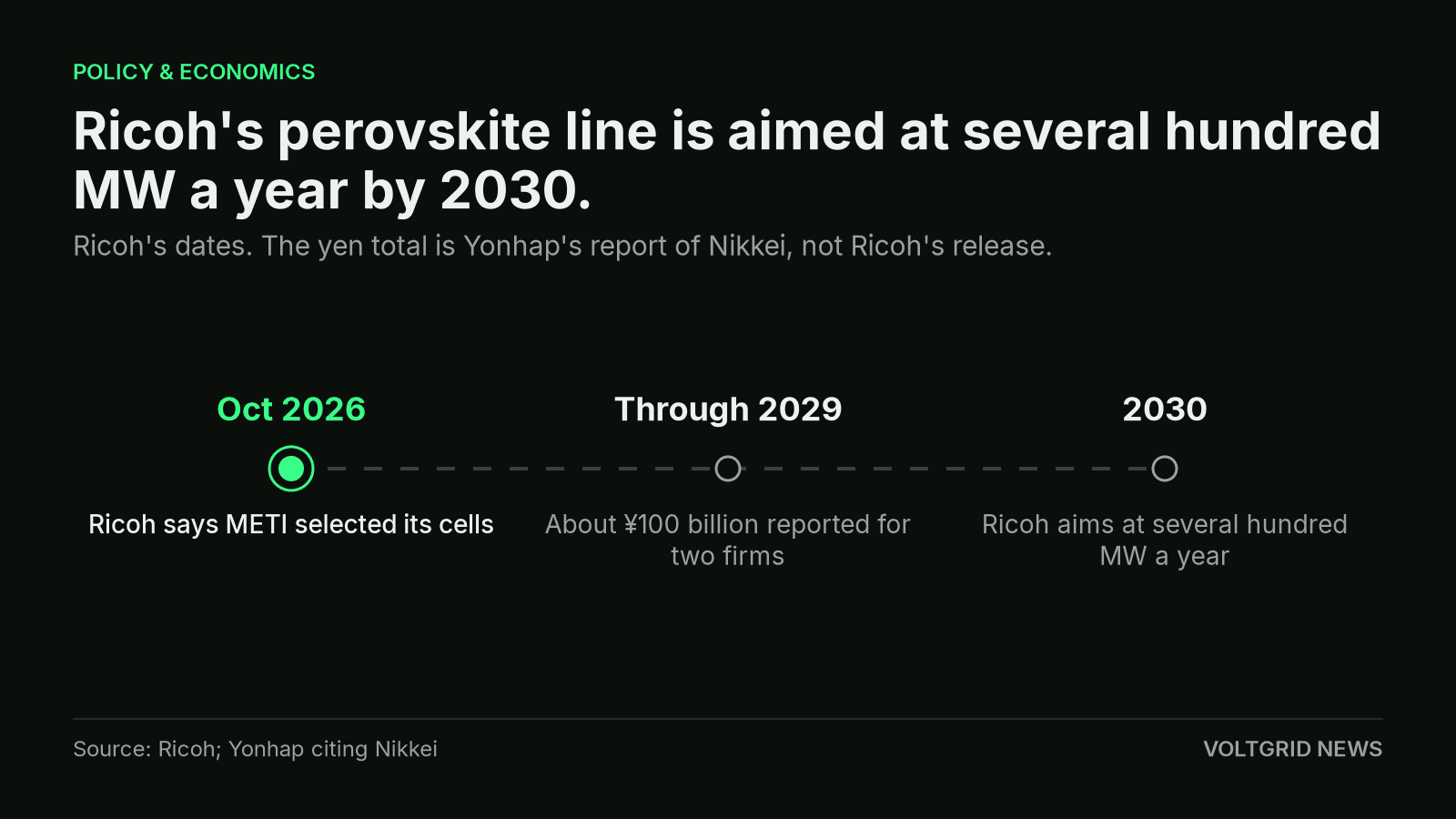
Ricoh confirmed the Miyagi plan and a target of several hundred megawatts a year by 2030. It did not state the yen amount.
Illustration (AI-generated)
Yonhap reported the same morning, citing the Nikkei, that the ministry will provide about 100 billion yen to Ricoh and Choshu Industry through 2029, and that the two firms plan to invest a matching sum or more in factories. Ricoh's release does not state a yen figure and does not name Choshu. Yonhap said Choshu is developing tandem cells that put perovskite on silicon, while Ricoh uses inkjet printing to make thin, bendable film cells. Ricoh said it is aiming for annual capacity of several hundred megawatts by 2030, with a later expansion toward gigawatt scale, and that mass production at the Miyagi site is targeted by 2030.
Power on surfaces that silicon panels do not use
Ricoh said the cells are thin and light enough for roofs and walls that cannot carry conventional silicon panels. That is the system point, if the factories are built: generation on building faces rather than only on open ground. Yonhap said the government also plans to ease the factory-location rule that requires at least 25 percent of a site to be green space, and to ease related fire and building rules. Those changes are described as plans, not as text that has already been adopted.
INA Solar and Caelux signed a 3 GW tandem-module deal with a 29 percent efficiency target by 2028, Voltgrid reported on Oct. 26. That is a supply contract between two companies. The Japanese step, as the Nikkei account has it, is public money for domestic lines. Ricoh's aim of several hundred megawatts a year by 2030 is not a 3 GW order, and the two announcements should not be read as the same kind of commitment.
What is reported, and what Ricoh itself confirmed
This account rests on Ricoh's release and on Yonhap's report of the Nikkei story. It does not rest on a ministry award document, and the Nikkei article itself was not read here. The roughly 100 billion yen, the inclusion of Choshu, the matching private investment and the regulatory easing all come from Yonhap's account of Nikkei. Ricoh confirms its own selection, the Miyagi site, the inkjet process and the several-hundred-megawatt target by 2030. No subsidy contract value is printed on Ricoh's page. In September 2025, Ricoh said, a separate demonstration project was selected for Japan's Green Innovation Fund run by NEDO. That earlier selection is not this production award.