Data Center Ballot Measures Results: Harwood, ND the Only Exception of 41
CNBC reports voters sided against data centers in every 2026 midterm ballot measure with results except Harwood, North Dakota, among 41 in 10 states. Counts are unofficial and some races remain open.
Chips & Power DeskEdited by Ege Erten
3 min readAI-assisted
Follows our story: Data Center Ballot Measures: 41 on US Midterm Ballots, 21 in Ohio

Downtown Piqua, Ohio, where voters passed a data center charter amendment with 67%, WOSU reported (unofficial).
Image: City of Piqua
Source · Image from the City of Piqua, Ohio website, used for news reporting.
Voters sided against data centers in every local ballot measure with results on Nov. 4 but one, CNBC reported, citing Ballotpedia's tally of 41 measures in 10 states and results CNBC gathered itself. The exception was Harwood, North Dakota, where voters turned down a rule that would have tightened review of industrial projects. All counts are unofficial and several races were still open.
This follows our Oct. 30 count of the 41 measures, which was a preview. The Nov. 3 vote is the first national read on how those measures landed.
Data Center Ballot Measures Results by Place
In Harwood, a city outside Fargo, voters rejected a charter amendment that would have required additional review before the city approved industrial developments, data centers included. Route Fifty reported that North Dakota's secretary of state put the no vote at 75% of the 430 ballots cast. The amendment would have covered future projects, not the Applied Digital campus the city had already approved.
Ohio held 21 of the 41 measures, spread across 18 municipalities, according to Fortune. In Piqua, a charter amendment barring a data center passed with 67%, WOSU reported, and unofficial Miami County results showed more than 70% of voters recalling Mayor James Vetter and two other commissioners who had backed the project. Forbes found all 13 Ohio municipalities with ban questions on track to approve restrictions as of Nov. 4, among them Pataskala, Urbana and Defiance. Fortune counted at least 14 Ohio municipalities passing bans or other limits.
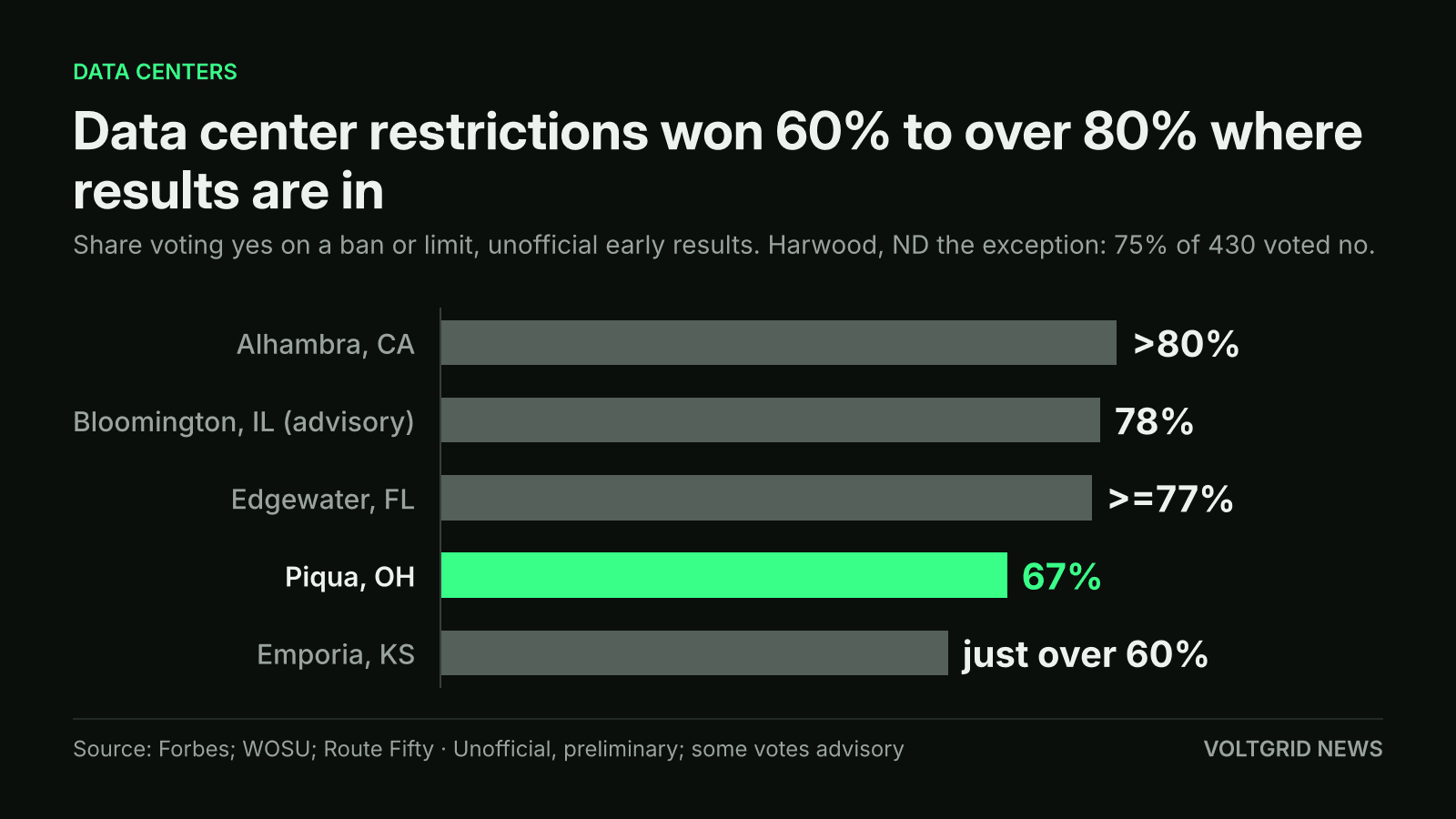
Where early results exist, data center restrictions drew 60% to over 80% yes; all figures unofficial and some votes advisory.
Illustration (AI-generated)
Outside Ohio, Forbes reported early results showing more than 80% support for a ban in Alhambra, California, at least 77% in Edgewater, Florida, and 78% for an advisory moratorium question in Bloomington, Illinois. Route Fifty said Emporia, Kansas, passed a ban on "high impact" data centers with just over 60%. Forbes reported that all four Maine towns on the ballot approved their moratorium or size-limit questions by wide margins. Some of the votes, such as the six Illinois questions, are advisory and do not bind local officials.
What the Results Mean for Data Center Siting
The measures that passed are mostly hard limits, several of them keyed to a 25 MW load threshold, and several were written into town charters or zoning, which a developer cannot settle with a single council vote. That moves the risk earlier in the process: land, power and equipment orders can be in hand before a town vote cancels the site.
Politics ran alongside the ballot questions. In a CNBC Voter Poll, 56% of voters called data centers a crucial or major factor in their choice. Democrat Sherrod Brown won Ohio's Senate race, and Democrat Amy Acton won the governorship on a "conditional moratorium" platform, CNBC said. CNBC noted that the largest planned project in the state, the 8 GW PORTS-Pike campus that OpenAI announced in August, is slated to start its first construction phase this year, with capacity arriving in phases from 2028. CNBC did not report that any measure affects it.
For earlier results, see our Nov. 4 reports on Gina Hinojosa's Texas moratorium pledge after she beat Gov. Greg Abbott and on the Georgia Public Service Commission results. The Sunbury, Ohio charter ban passed 2,809 to 763 in unofficial counts.
What Is Not Confirmed Yet
No page we read gives a final count of how many measures passed. CNBC says the opponents won everywhere with results, Route Fifty says "virtually all 40," and the tallies differ because races are still being counted. Fortune said results in Oregon, Ohio were not yet available on Nov. 4, and Forbes listed Ottawa, Kansas, and Boulder City, Nevada, as awaiting results. Route Fifty reported more votes expected next month in Arkansas and North Dakota. We found no reported result for the Yukon, Oklahoma recall.
County boards must still certify every count. Watch how developers with signed agreements, such as the one in Piqua, respond to the new charter language.
Sources
- 01Here's Where Voters Are Rejecting Data Centers On Midterm Ballots (Full List)Forbes · forbes.com
- 02Voters rebuff data centers in every ballot measure except one during the 2026 midtermsGoogle News · CNBC · news.google.com
- 03Piqua voters reject data centers, recall city commissionersWOSU · wosu.org
- 04Voters reject data centers in local ballot initiativesRoute Fifty · route-fifty.com