Data Center Cooling Q3: AAON BASX Sales +218%, Modine Unit +95%
AAON's BASX-branded sales grew 218.3% and Modine's Data Centers segment 95% in Q3, filings show. At a 10 K rise (10°C), a 140 kW rack needs about 202 L/min of water and a hypothetical 600 kW rack about 867 L/min.
Hardware & Analysis DeskEdited by Ege Erten
7 min readAI-assisted
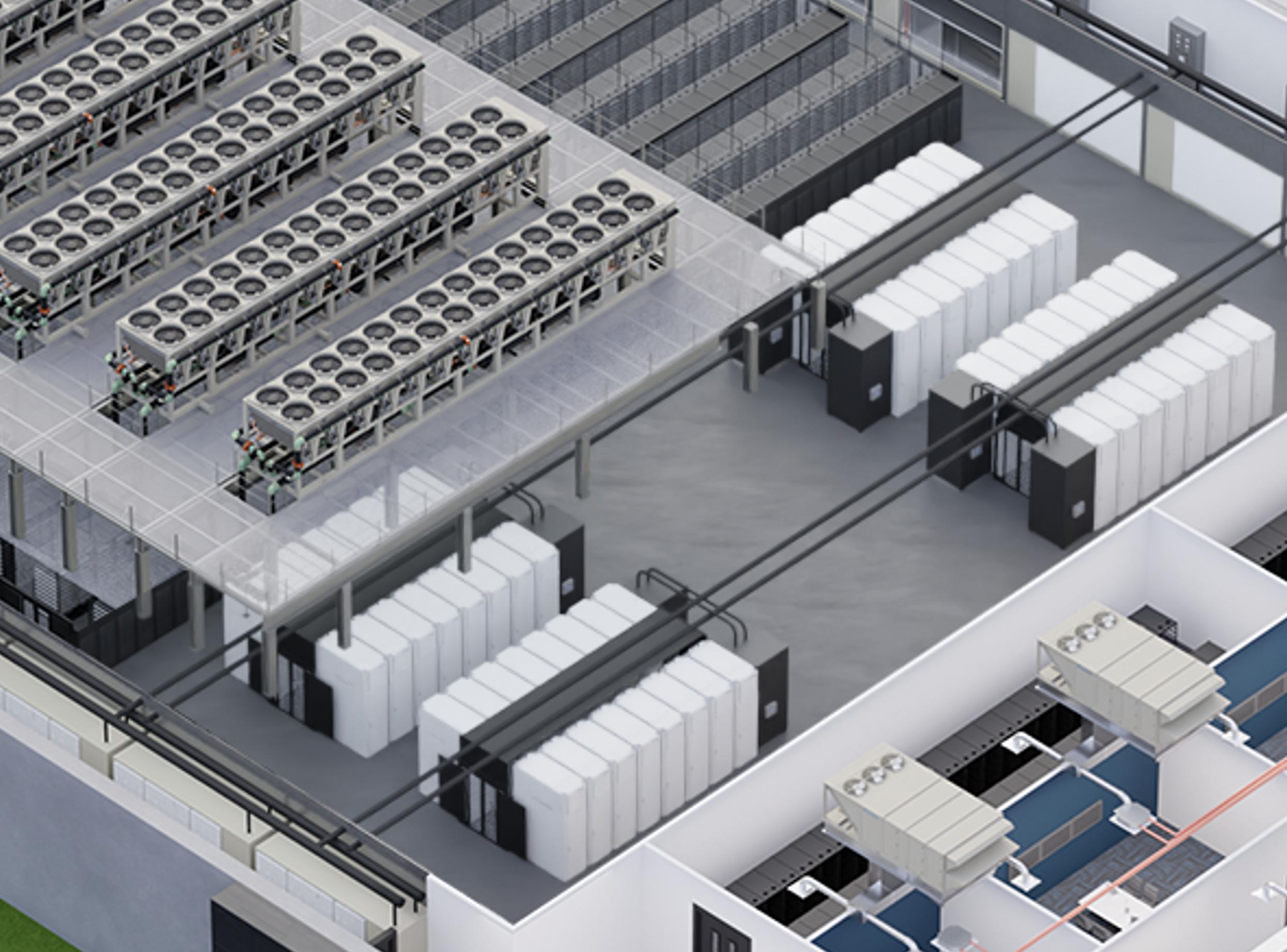
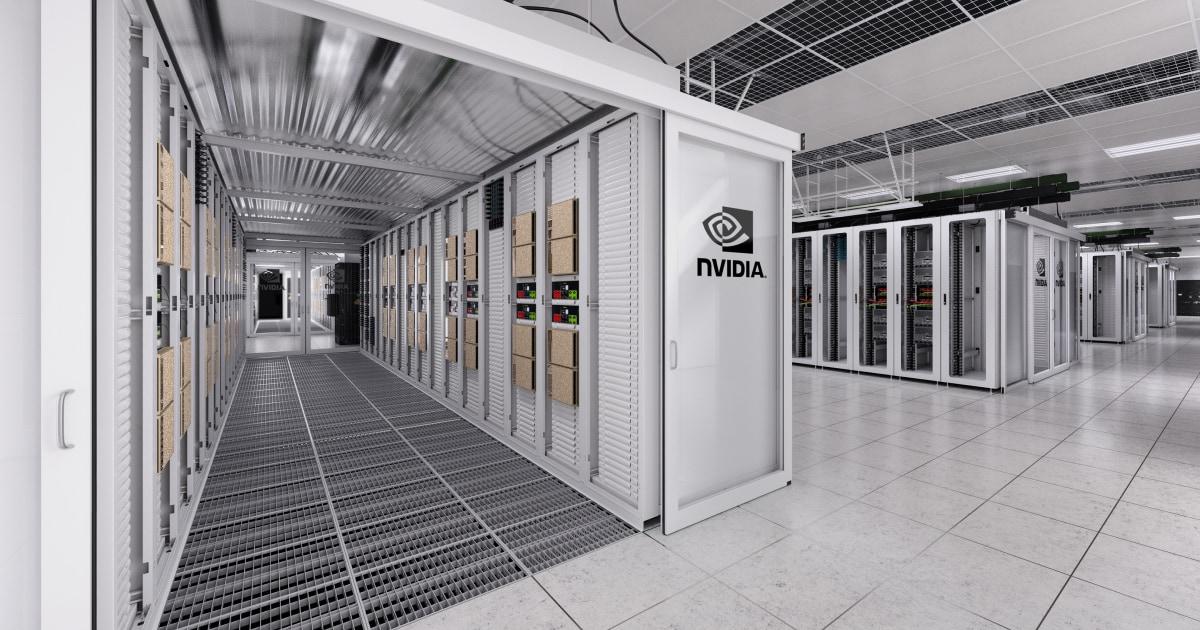
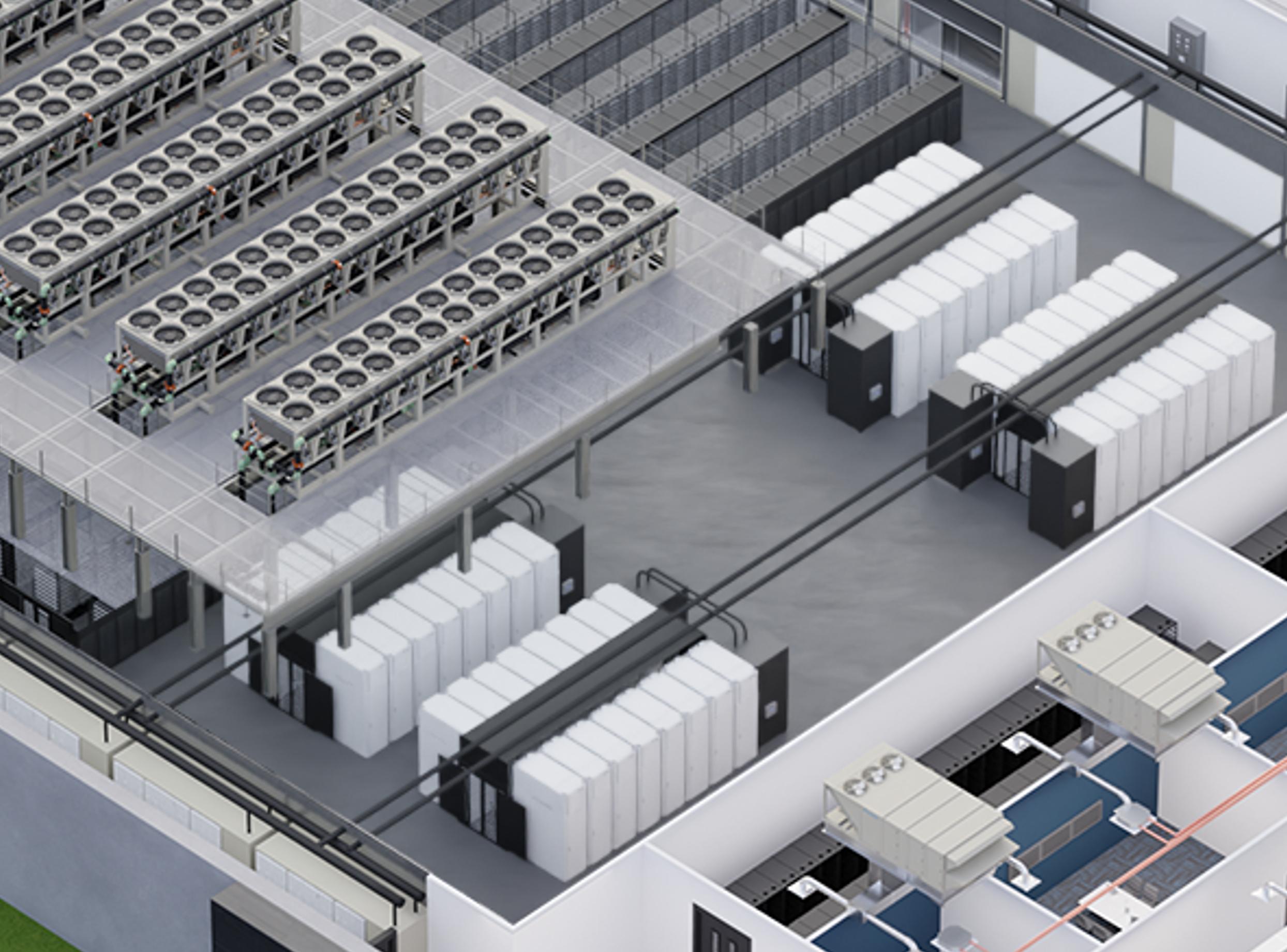
Daikin Applied's rendering of its 60 MW D60-W reference design, a vendor illustration rather than a photo of a built site.
Image: Daikin Applied
Source · Press image from the Daikin Applied release on PR Newswire, used for news reporting.
In data center cooling, AAON's BASX-branded sales grew 218.3% to $397.2 million and Modine's Data Centers segment grew 95% to $439.7 million in the quarter ended Sept. 30, 2026, according to their filings. Vertiv's total sales, power as well as cooling, rose 61% to $4,312.8 million.
By the arithmetic below, a 140 kW AI rack needs about 202 liters of water a minute at a 10 K rise (water leaving 10°C warmer than it enters), and a hypothetical 600 kW rack about 867.
Data Center Cooling Q3: Who Booked What
AAON said in its Form 8-K on Nov. 9 that BASX-branded sales were $397.2 million, which is 56% of its $707.4 million in total net sales (397.2 / 707.4). Nearly all of the brand total sits in two segments: $231.3 million in the BASX segment, up 207.4%, plus $165.5 million of BASX-branded liquid cooling sales, up 255.6%, booked in AAON Coil Products (231.3 + 165.5 = 396.8 of the 397.2). BASX backlog stood at $1,355.2 million on Sept. 30, up 51.1% from a year earlier but down from $1,419.8 million on June 30. AAON also restated its first two quarters, as Voltgrid reported on AAON's Q3.
AAON's BASX-branded sales rose 218.3% in Q3; each bar measures something different, and Vertiv's 61% covers the whole company.
Voltgrid News
Illustration (AI-generated)
Modine's Data Centers segment, in what is its fiscal second quarter of 2027, rose from $225.0 million to $439.7 million, according to its 8-K filed Nov. 3. That is about 44% of Modine's $994.4 million group sales (439.7 / 994.4), which still include the Performance Technologies unit spun off on Oct. 1. The segment mixes products: BizTimes Milwaukee reported a $400 million hyperscaler deal for air handling units, as Voltgrid covered on Modine's Data Centers sales.
Vertiv's Oct. 28 release gives net sales of $4,312.8 million, organic growth of 55%, and organic orders growth above 100%, but no backlog and no split between cooling and power, as we noted on Vertiv's Q3 results. Vertiv's fourth-quarter guidance is $4,313 million to $4,513 million. The 61% is company-wide and is not a cooling growth rate.
LG Electronics reports orders, not sales: cumulative AI data center cooling orders exceeded KRW 3 trillion through Q3, from approximately KRW 600 billion at the end of the first half, according to LG's Oct. 28 results release, about five times the half-year figure (3 / 0.6). Eco Solution, LG's whole heating and cooling business, earned KRW 87.2 billion in operating profit against KRW 132.9 billion a year earlier on the same KRW 2.17 trillion of revenue, down 34% by our arithmetic (87.2 / 132.9). LG said profit was partly affected by the cost of adding capacity for those orders, as Voltgrid reported on LG's cooling orders.
Lite-On sits on the power side: Taiwanese press reported AI products above 30% of Q3 revenue, as we reported, with no cooling revenue figure. AAON's BASX-branded $397.2 million and Modine's Data Centers $439.7 million, which share a quarter-end, sum to $836.9 million, but neither is liquid cooling alone: only $165.5 million is disclosed as liquid.
Liquid Cooling Heat Path, Chip to Outside Air
Heat leaves an AI rack in stages. A cold plate on each GPU passes heat into a rack coolant loop. That loop runs to a coolant distribution unit (CDU), a heat exchanger with pumps that hands the heat to the facility water loop. Facility water then travels to a chiller or a dry cooler, a large radiator with fans, which sends the heat to outside air.
Both liquid loops in Daikin's reference design run a 10 K rise, from the rack loop through the CDU to a dry cooler.
Voltgrid News
Illustration (AI-generated)
NVIDIA's design guidance sets the temperatures: its MGX racks take 45°C inlet water from CDUs fed with 41°C facility water, with de-ionized water or a propylene glycol mixture called PG25 as coolant. NVIDIA says warmer water matters because at 45°C data centers in many climates can reject heat with dry coolers and ambient air, with less need for compressors. Daikin Applied's 60 MW reference design runs 4°C below those limits in normal operation: its facility loop is 37°C supply to 47°C return and its rack loop 41°C to 51°C, rising to 41°C and 45°C supply only when dry coolers carry the whole load. It needs no cooling-tower make-up water, as we reported.
Coolant Flow per kW and What a CDU Carries
The relation is P = m_dot x cp x dT: heat power equals coolant mass flow times specific heat times temperature rise. NIST gives water near 37°C a specific heat (cp) of 4.1792 kJ/(kg·K) and a density of 993.4 kg/m3. At the 10 K rise both of Daikin's loops use, flow works out to 0.0239 kg/s per kW (1 / (4.1792 x 10) = 0.02393), or about 1.45 liters a minute per kW (0.02393 / 993.4 x 60,000). PG25 carries less heat per kilogram: Clariant lists 3.92 kJ/(kg·K) at 20°C and a density of 1.024 g/cm3, so it needs about 7% more mass flow, or about 3% more liters a minute, for the same rise.
At 10 K, a 140 kW rack, the class of NVIDIA's GB300 NVL72 rack as Vertiv configures it, which StorageReview reports at 120 to 142 kW, needs 3.35 kg/s, or about 202 L/min. A 600 kW rack, a figure Tom's Hardware reported in March 2025 from NVIDIA's mockup of its planned Kyber rack, then a 576-GPU design, needs 14.36 kg/s, or about 867 L/min. NVIDIA's March 2026 blog describes Kyber as a 144-GPU rack and gives no power figure, so treat 867 L/min as a what-if rather than a specification. Flow rises 4.3 times (600 / 140) for 4.3 times the heat.
Two vendor figures sit close to the arithmetic. Accelsius's whitepaper, a vendor document describing an integrator's test, reports 1.5 L/min per kW for a stock single-phase loop on a Dell PowerEdge XE9680L with eight NVIDIA B200 GPUs, within 4% of 1.45. Trane's LiquidStack CDU 2.X is rated up to 2.5 MW with up to 3,750 L/min, also exactly 1.5 L/min per kW; at that flow water would carry 2.5 MW at a rise of about 9.6 K. Trane's two numbers are maximum ratings, and its product page does not say which loop or coolant. By the same arithmetic a 2.3 MW CDU, the size in Daikin's design, moves about 3,324 L/min and, by heat capacity alone, serves about 16 racks of 140 kW (2,300 / 140) but 3.8 racks of 600 kW (2,300 / 600).
Daikin's design shows the scale. Each of its six units carries 0.8 MW of air cooling and 9.2 MW of liquid cooling, the liquid through seven 2.3 MW CDUs, six on duty and one on standby, so 13.8 MW of duty capacity. At 10 K, one unit's 9.2 MW means about 13,300 L/min. That is the volume the pipework and pumps must move if the loop is plain water, before any chiller is involved. The 13.8 MW of CDU duty capacity is 1.5 times the 9.2 MW liquid load, and Daikin notes that extra plant capacity is needed to use it fully.
Single-Phase, Two-Phase and Immersion Cooling Compared
Single-phase direct-to-chip cooling, where the coolant stays liquid, is what is being bought now. Vertiv's SmartIT packages it with DC power for GB300 NVL72, as we covered, with three CoolChip CDU 121 units of 121 kW each giving 242 kW with one unit spare (N+1) in a support rack, according to StorageReview's reading of Vertiv's catalog. Trane's CDU 2.X is due to ship from Q2 2027, as Voltgrid reported. KT Cloud says it already sells direct-to-chip cooling to a hyperscaler at its Gasan site and has built a load bank that reproduces 140 kW of heat, as we wrote.
Two-phase systems boil a dielectric fluid at the cold plate, so latent heat does more of the work. The Accelsius whitepaper reports 0.55 L/min per kW against 1.5 for single-phase, and a GPU cold plate up to 19°C cooler at the limiting position, 9 to 14°C at the full-system level. On those figures 140 kW would take 77 L/min of dielectric fluid in the rack loop against 210 L/min of water (0.55 and 1.5 times 140), and 600 kW 330 against 900. The saving is inside the rack loop only; the facility water in the same test ran at 1.5 to 3.0 L/min per kW. Chemours launched four direct-to-chip Faizeon fluids, 100, 110, 200 and 220, in a release carried by 3BL Media on Nov. 3, as we reported. Its 19°C claim links to the same Accelsius whitepaper, so it is one vendor-side result quoted by two companies, not independent confirmation.
The 0.55 L/min per kW two-phase figure comes from one test on one server, published by the vendor and not independently confirmed.
Voltgrid News
Illustration (AI-generated)
Immersion, where servers sit in a bath, is further from volume in these announcements. LG, GS E&C and Green Revolution Cooling signed a memorandum on Oct. 13 to develop standardized designs and a test bed, according to the Korea Herald, as covered here. Chemours also sells an immersion fluid, Faizeon 500. None of the suppliers cited here has named a megawatt-scale immersion deployment in the filings and releases above.
What Higher Rack Power Means and What to Watch
For engineers, the arithmetic says flow, pipe size and CDU count scale with rack power, so racks of the 600 kW class Tom's Hardware reported from NVIDIA's 2025 Kyber mockup would multiply plumbing unless designers accept a larger temperature rise or move the rack loop to two-phase fluid. For investors, AAON is converting backlog into sales and Modine's Data Centers sales nearly doubled, while Vertiv's orders and LG's order book show demand that has not fully reached earnings.
The next dated checkpoints are these. Modine holds its Analyst and Investor Day on Nov. 18, per its chief executive in the 8-K. Vertiv guides to $4,313 million to $4,513 million for Q4. Trane's CDU 2.X is due in Q2 2027 and Daikin's own CDU and dry cooler in the second half of 2027. Tom's Hardware's March 2025 report placed NVIDIA's Kyber rack, reported at up to 600 kW, in 2027, but SemiAnalysis said it had slipped to 2028, as SDxCentral reported on July 6, 2026.
No supplier splits liquid-cooling revenue from the rest except AAON, so the scoreboard is not like for like. NVIDIA has published no kW figure for Kyber; 600 kW comes from Tom's Hardware's report of remarks at GTC 2025, and KT Cloud calls it a forecast. The flow figures assume water and a 10 K rise; real racks run other rises and glycol blends, and the Accelsius result is vendor-reported on one server.
Sources
- 01NVIDIA Vera Rubin POD: seven chips, five rack-scale systemsNVIDIA Developer Blog · developer.nvidia.com
- 02LG Electronics secures supply agreement to advance AI data center cooling business in North AmericaLG Electronics newsroom · lg.com
- 03LiquidStack CDU-2.X product pageTrane Technologies · trane.com
- 04NVIDIA 800 V HVDC architecture will power the next generation of AI factoriesNVIDIA Developer Blog · developer.nvidia.com
- 05Vertiv Reports Strong Third Quarter 2026, 8-K Exhibit 99.1Vertiv (SEC) · sec.gov
- 06Chemours Launches Faizeon Two-Phase Liquid Cooling Solutions for AI Data CentersChemours (3BL Media) · 3blmedia.com