Deep Principle's Hydrogen-1.0: 753B Science Model Needs 1.5 TB in BF16
The open-weight chemistry and materials model, post-trained from GLM-5.3, beats GPT-6 Astra on one science benchmark in its maker's own tests. Its full-precision weights overflow an 8x B200 server.
Chips & Power DeskEdited by Ege Erten
3 min readAI-assisted
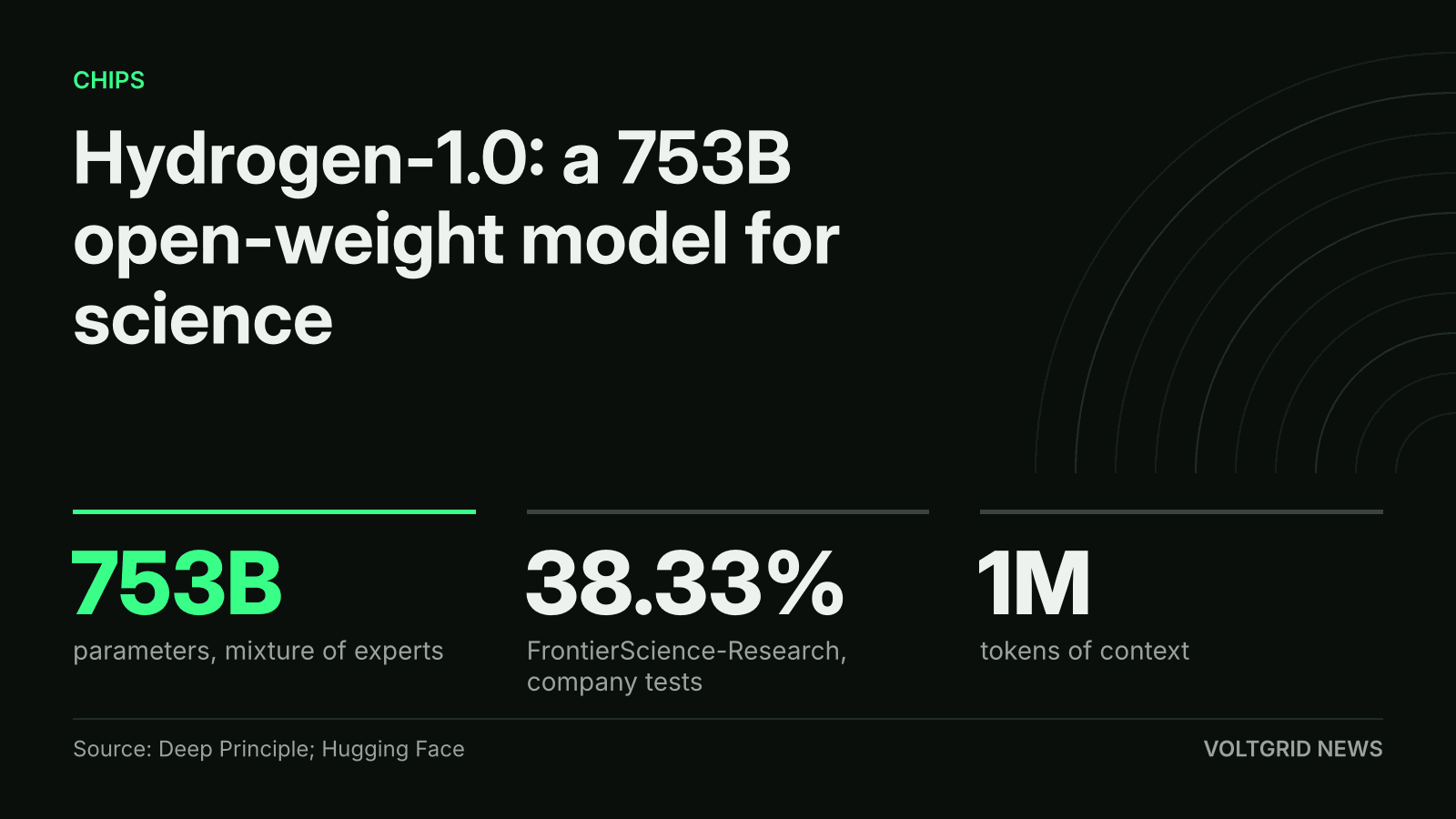
Hydrogen-1.0 at a glance, from Deep Principle's model card and launch post
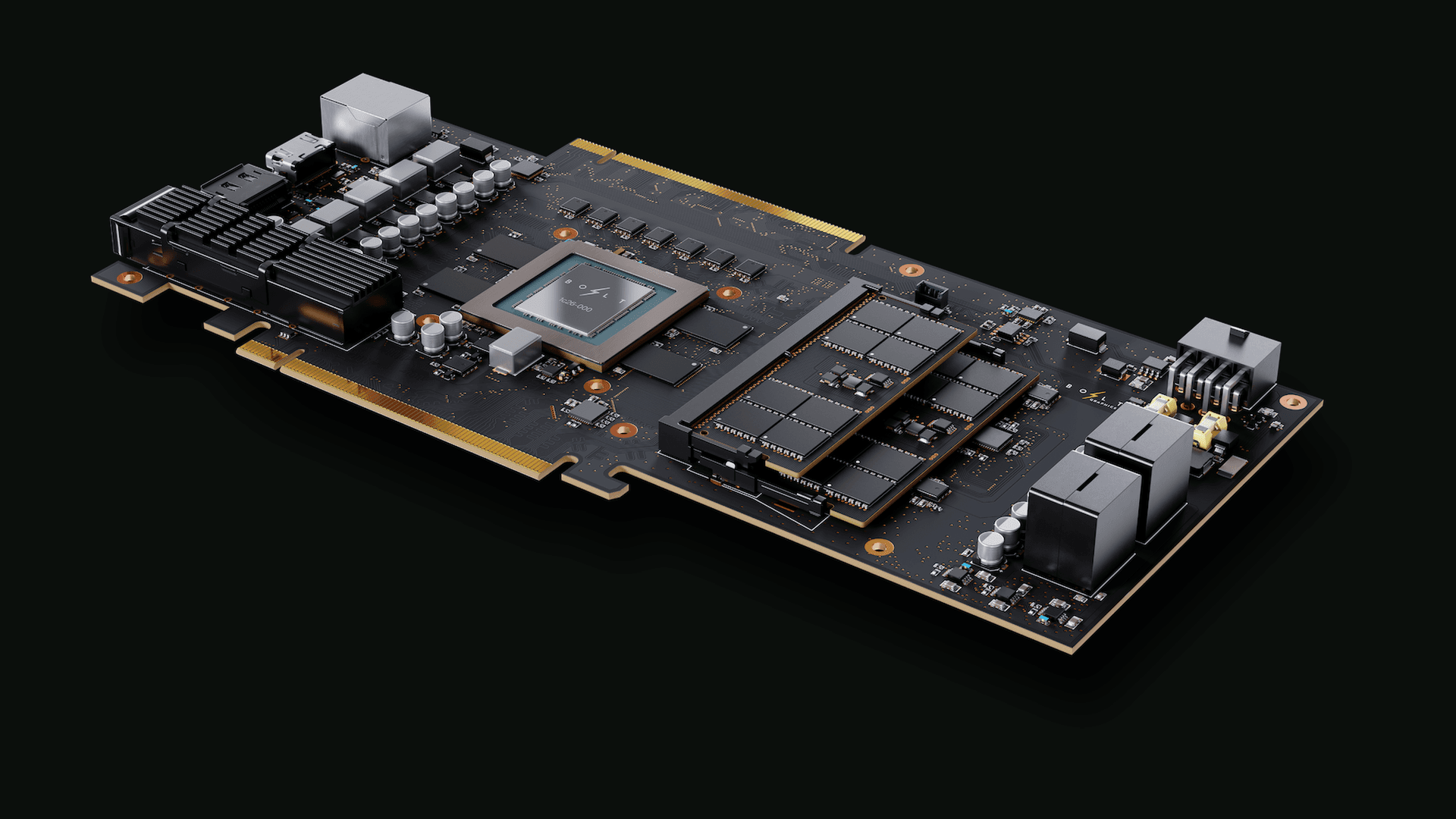
Illustration (AI-generated)
Deep Principle, a Hangzhou-based AI-for-science company, published the weights of Hydrogen-1.0 on Hugging Face on Nov. 2 under an MIT license. The 753-billion-parameter mixture-of-experts model is a post-train of Z.ai's GLM-5.3 on chemistry, materials and life-science data, plus records from the company's own labs. In full BF16 precision its weights total 1,506.7 GB, more than the 1,440 GB of GPU memory in an eight-GPU NVIDIA B200 server, by Voltgrid's count.
The company also ships two 4-bit builds: NVFP4 at 464.1 GB for NVIDIA Blackwell GPUs and MXFP4 at 422.8 GB for AMD's Instinct MI350X and MI355X. A press release distributed through PR Newswire on Nov. 6 dates the launch to Nov. 4; the model files and the company's launch post went up on Nov. 2.
What Deep Principle built
Hydrogen-1.0 keeps GLM-5.3's architecture and its parameter count of 753,329,940,480: 78 layers, 256 routed experts plus one shared expert, and eight routed experts per token. Deep Principle does not state the active parameter count; Voltgrid's estimate from the model's configuration file is about 41 billion per token. The model takes up to 1 million tokens of context, writes up to 128,000 output tokens and has low, high and maximum thinking settings. It was trained with supervised fine-tuning and reinforcement learning, and the press release says researchers can reach it through Mira, the company's AI scientist product, by download or through an API.
On FrontierScience-Research, Deep Principle reports that Hydrogen-1.0 solved 38.33% of problems at its maximum setting, against 33.33% for GPT-6 Astra (max), 29.72% for Kimi K3 and 24.44% for GLM-5.3 (max). These are the company's own runs, with data as of Oct. 27. On GPQA Diamond, Hydrogen-1.0 scores 92.93% and trails GPT-6 Astra at every setting (93.43% to 95.96%) as well as Kimi K3 (93.5%).
The company also prices the gap. At GLM-5.3's list rates of $1.40 per million input tokens and $4.40 per million output tokens, it puts a FrontierScience-Research problem at $0.250 for Hydrogen-1.0 against $0.882 for GPT-6 Astra (max), even though Hydrogen-1.0 used 3.2 times as many tokens (56,826 against 17,649). Deep Principle has not published a price for Hydrogen-1.0 itself.
What it takes to run
Deep Principle's serving recipes are all single-node. The NVFP4 build was tested with SGLang on eight NVIDIA B300 GPUs, with a 262,144-token context and an FP8 cache; the MXFP4 build runs on AMD's ATOM engine across four MI350X GPUs. The BF16 recipe uses SGLang across eight GPUs without naming the model.
By Voltgrid's arithmetic, BF16 across eight GPUs means 188.3 GB of weights per GPU. That is more than the 180 GB of a B200 or the 141 GB of an H200, so neither eight-GPU server holds the model, while the 270 GB of a B300 and the 288 GB of an MI350X or MI355X do. The 4-bit builds are far easier to place: on paper, NVFP4 weights fit on four B200s and MXFP4 weights on two MI355Xs, before cache and runtime memory.
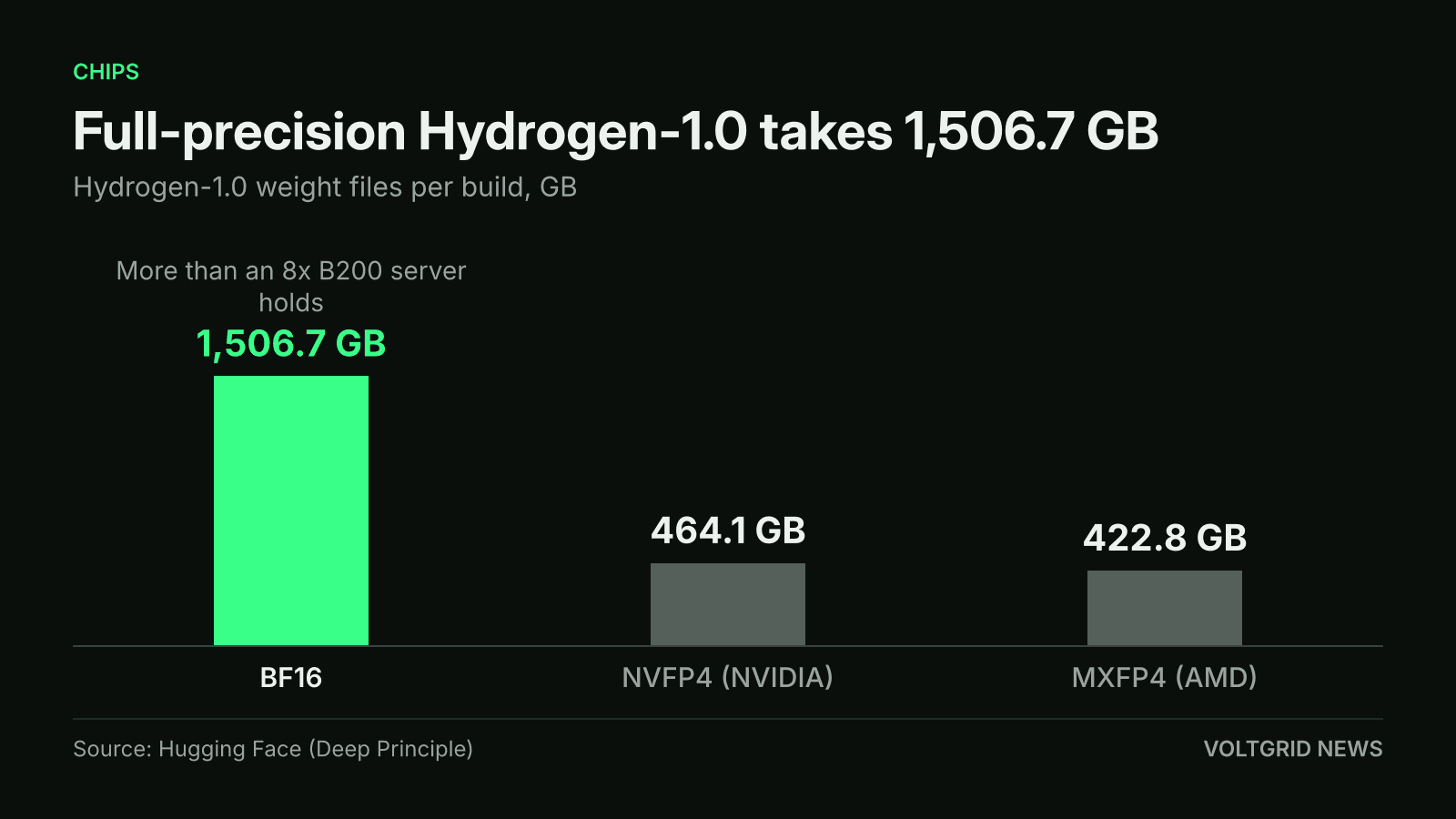
The BF16 build needs more memory than an eight-GPU B200 server has; the NVFP4 and MXFP4 builds fit in far less. Source: Hugging Face (Deep Principle)
Illustration (AI-generated)
Hydrogen-1.0 uses GLM-5.3's attention design, so its memory per session follows the same cache math as GLM-5.3: about 12.5 GB of FP8 cache for a 262,144-token session and 49.9 GB for a full 1-million-token session, by Voltgrid's calculation. Agent workloads that keep several long sessions open add up quickly.
What is still unconfirmed
No independent evaluation of Hydrogen-1.0 has been published, and several of its strongest results come from Deep Principle's internal tests. Its lab demonstrations, such as a 12-vial Suzuki coupling protocol, ran in a scripted virtual lab, and the company claims no customer or wet-lab result for the model. The weights are MIT-licensed, but GLM-5.3's own license adds a security review for model-as-a-service operators with more than $10 billion in revenue and covers derivative works; Deep Principle has not said whether that reaches Hydrogen-1.0. The company, led by co-founders Haojun Jia and Chenru Duan, says it has raised more than $100 million.
Sources
- 01Deep Principle Introduces Hydrogen-1.0 for AI-Driven Materials Discovery and Chemistry ResearchPR Newswire · prnewswire.com
- 02Deep Principle Releases Hydrogen-1.0: A 753B Open-Weight Model for Scientific DiscoveryMarkTechPost · marktechpost.com
- 03Introducing Hydrogen-1.0Deep Principle · blog.deepprinciple.com
- 04deep-principle/Hydrogen-1.0 model cardHugging Face (Deep Principle) · huggingface.co