Bolt Graphics Zeus GPU: Volume Slips to 2028, Speed Claims Untested
Bolt Graphics says its Zeus GPU test chip works, but volume cards slip to 2028 and no independent test has checked its RTX 5090 claims. Zeus adds memory up to 384 GB and runs on RISC-V.
Hardware & Analysis DeskEdited by Ege Erten
12 min readAI-assisted
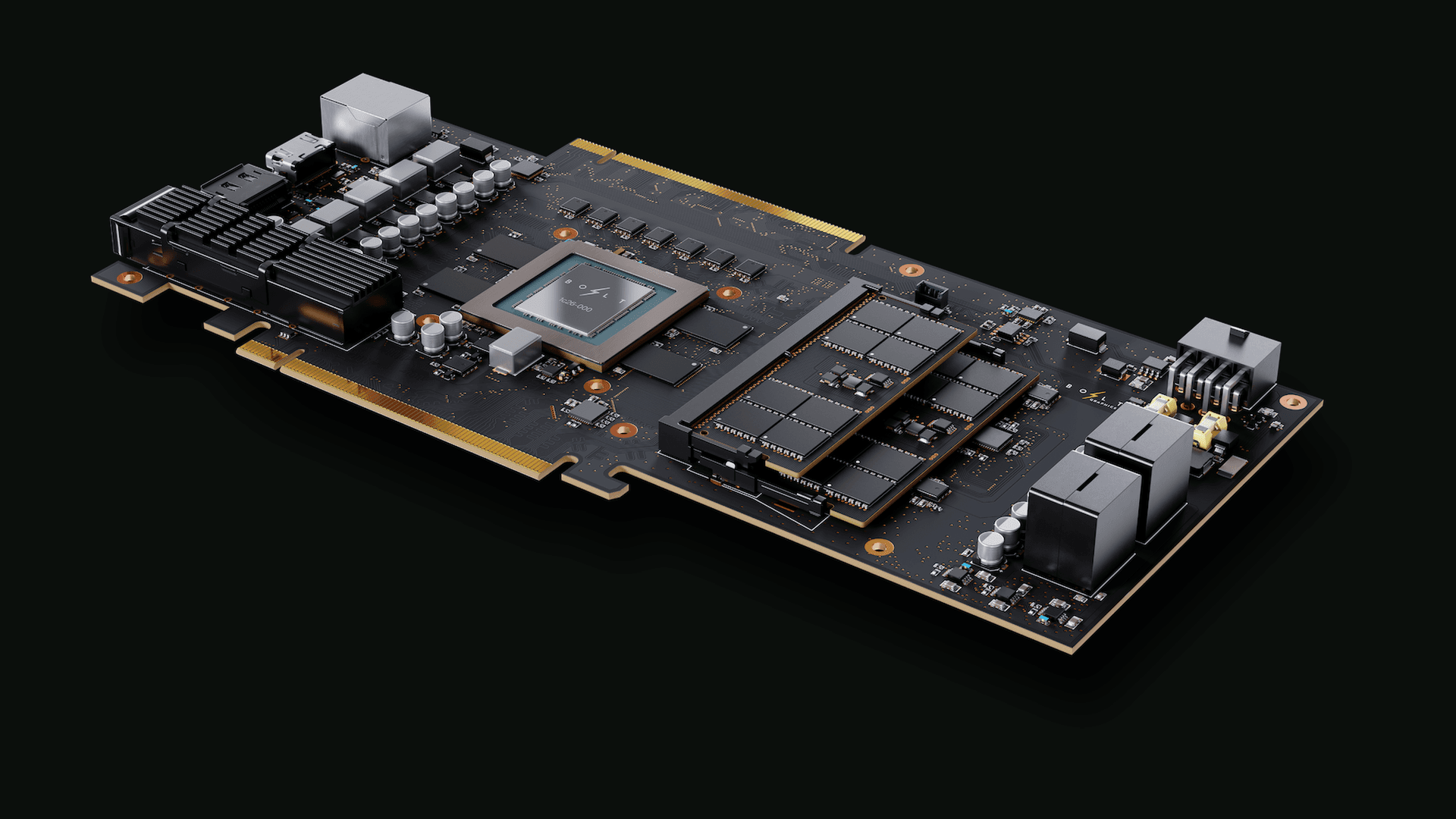
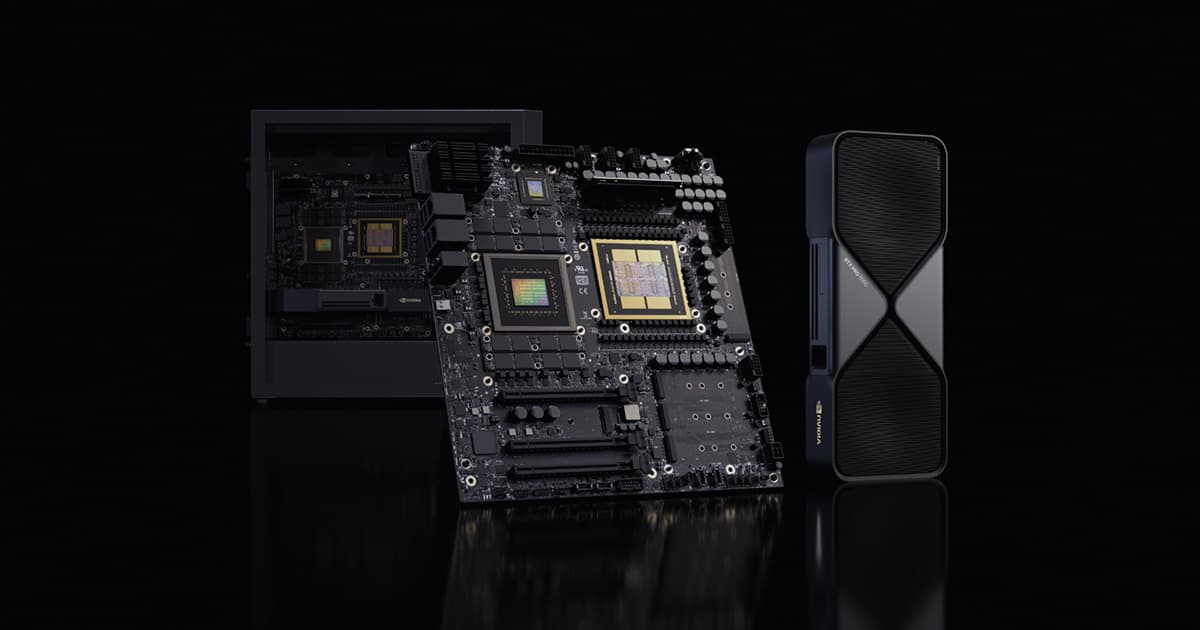
Bolt Graphics' render of a Zeus board, shown on a dark background. Zeus performance claims are Bolt's own and have not been independently tested.
Image: Bolt Graphics
Source · Press image from the Bolt Graphics website, used for news reporting.
Bolt Graphics said on Oct. 13, 2026 that the first test chip of its Zeus GPU works, but volume production is now planned for 2028, and Voltgrid found no independent test of any of its performance claims.
By Bolt's account, the test chip, made by TSMC on a 12nm process, measures 6 mm² and draws 1.4 W, against 35 W for the FPGA, a reprogrammable prototyping chip, that Bolt ran its design on before; the release names no workload, so it is a power figure, not a speed one. Bolt says it came up within 24 hours, with no functional issues, and beat internal estimates. The GPU it will sell is a separate chip on TSMC's N5P process: developer access is planned for the first quarter of 2027, early-access customers for late 2027 and volume PCIe cards and servers for 2028. On Oct. 15, Reuters reported that Bolt is seeking about $100 million at a valuation of about $700 million, citing three people familiar with the matter; the terms are not final. On Oct. 31, Engadget noted that Bolt has published no performance figures for the test chip.
Bolt, a Sunnyvale, California, startup that Darwesh Singh founded in 2020, makes three bets that set it apart from the established graphics-card makers. The first is memory you can add: each Zeus card pairs memory soldered beside the chip with the DDR5 slots a laptop uses, for up to 384 GB on its largest card, where NVIDIA's RTX 5090 has 32 GB and its RTX PRO 6000 workstation card 96 GB, fixed at purchase. The second is open processor cores: Zeus runs on RISC-V, an open instruction set, where NVIDIA, AMD and Intel use their own. The third is the work it is built for: path tracing, the slow, accurate way film and design studios render light, and FP64, the 64-bit arithmetic scientific simulation needs, rather than fast game graphics or AI.
That matters beyond the studios and laboratories that might buy one. NVIDIA's top GPUs give a growing share of each chip to the low-precision math AI uses, Jacob Feldgoise of Georgetown University's Center for Security and Emerging Technology told IEEE Spectrum, and gaming cards have become expensive: the RTX 5090's lowest in-stock US price was $9,400 in October, TechSpot found, against NVIDIA's $1,999 launch price. Tom's Hardware counted three discrete-GPU developers in the US and Western Europe in 2025, down from around 10 in 2000. By Tom's Hardware's count, a working Zeus would make Bolt a fourth, aimed at the simulations behind products such as radar sensors and camera lenses, and at real-time rendering in architecture and film.
What is proven so far is narrow: a 6 mm² test chip runs, by Bolt's account. Every speed figure for Zeus, from 10 times an RTX 5090 in path tracing to 300 times faster electromagnetic simulation, is Bolt's own, taken from its slides, spec sheet and simulations; Bolt says its methods run on real hardware, but it has not said which. Voltgrid found no independent measurement of any Zeus silicon in a search on Nov. 5, 2026 that covered ServeTheHome, Phoronix, Chips and Cheese, TechPowerUp, Tom's Hardware, Notebookcheck and MLPerf.
Zeus GPU Specs: Three Sizes, One Big-Memory Design
Zeus comes in three configurations, listed on Bolt's slides as Tom's Hardware tabulated them in March 2025. The Zeus 1c26-032 is a single-chiplet card rated at 120 W, with 32 GB of soldered LPDDR5X and two DDR5 SO-DIMM slots, for up to 160 GB at 363 GB/s. The 2c26-064 and 2c26-128 use two chiplets at 250 W; the 128 GB version reaches 384 GB at 725 GB/s with four SO-DIMMs. The 4c26-256 has four chiplets, 256 GB of LPDDR5X and eight DDR5 DIMMs, for up to 2,304 GB at 1.45 TB/s and 500 W. It is a server, not a card, and needs a full motherboard, HPCwire reported in April 2026 from Bolt's spec sheet.
Bolt lists 5, 10 and 20 TFLOPS of vector FP64 for the three sizes, and 77, 154 and 307 gigarays, its measure of path-tracing throughput. Each card has a 400 GbE network port and the 4c six 800 GbE ports. Bolt's slides describe out-of-order RISC-V cores with vector and FP64 units and Bolt's own extensions, beside dedicated path-tracing hardware. XPU.pub reported in May that Bolt licensed a RISC-V core from Akeana and builds Zeus from quarter-reticle chiplets on an organic substrate, cheaper, XPU.pub argues, than a silicon substrate or bridge, and smaller than the reticle-size dies NVIDIA makes. Singh told IEEE Spectrum he expects raster performance, the traditional 3D method, at about half that of a comparable NVIDIA card.
Why Memory Size and Speed Pull Apart
A graphics card's memory has two measures. Capacity is how much data it holds; bandwidth is how much it can read each second, set by how many wires join chip and memory and how fast each switches. Soldering memory next to the chip gives speed but fixes the size: NVIDIA's RTX PRO 6000 holds 96 GB and reads it at 1,792 GB/s.
Sockets add room and take speed. Bolt says a Zeus 2c26-128 can reach 384 GB, but at 725 GB/s, so it reads all of it about twice a second, against about 19 times for the RTX PRO 6000 (Voltgrid's calculation from those figures). Big scenes fit; jobs that keep rereading data wait.
FP64 is 64-bit floating-point arithmetic. It keeps far more digits than the 4- to 16-bit formats AI uses, which simulations need because small errors compound over millions of steps. NVIDIA lists 37 TFLOPS of FP64 for a B200 GPU and 33 for Rubin; Bolt lists 20 for its 4c, a vendor claim.
How Zeus Differs From NVIDIA, AMD and Intel Cards
Memory is the clearest split. Capacity is how much a card can hold; bandwidth is how fast the chip can read it. NVIDIA's cards put a fixed amount of fast GDDR7 beside the chip: 32 GB at 1,792 GB/s on the RTX 5090 and 96 GB at the same 1,792 GB/s on the 600 W RTX PRO 6000 Workstation Edition, a card family Voltgrid has reviewed. Zeus trades speed for room. By Voltgrid's calculation, a fully populated 2c26-128 holds four times the RTX PRO 6000's memory at about 40% of its bandwidth and 42% of its rated power. Put another way, the RTX PRO 6000 can read its whole memory about 19 times a second, the Zeus card about twice. That favours jobs that must fit before they can run at all, such as a large film scene or a full-product electromagnetic model, and penalises jobs that reread data constantly.

Zeus 2c is claimed to hold 4x the RTX PRO 6000's memory at 40% of its bandwidth (Voltgrid's calculation). Zeus figures are Bolt's claimed maximums with every DIMM slot filled; NVIDIA figures are specifications. Sources: NVIDIA; Bolt Graphics slides via Tom's Hardware.
Illustration (AI-generated)
Precision is the second split. FP64 numbers keep more digits and a wider range than the 16-, 8- and 4-bit formats AI favours, and some work needs them: Singh cites mapping software, where low-precision math on planet-scale coordinates can make objects drift. Bolt lists 20 TFLOPS of FP64 for the 500 W Zeus 4c. That is below the 37 TFLOPS NVIDIA lists for each B200 GPU, which HPCwire puts at about 700 W, and below the 33 TFLOPS NVIDIA lists for Rubin, which HPCwire says draws up to 2,300 W; NVIDIA's own Rubin page gives no per-GPU power. On paper, by Voltgrid's arithmetic from peak figures (Zeus's is vector FP64 from Bolt's spec sheet; NVIDIA's are its FP64 and FP64 Tensor Core figures), the Zeus 4c gives about 40 TFLOPS per kilowatt, the B200 about 53 at the 700 W HPCwire reports (37 at the 1,000 W NVIDIA allows per GPU on HGX B200) and Rubin about 14 at the up to 2,300 W HPCwire reports. So Zeus trails both NVIDIA chips per card and leads Rubin only per kilowatt. Bolt's slide puts the RTX 5090 at 1.6 TFLOPS, about a twelfth of the 4c. NVIDIA is counting on the Ozaki scheme, which emulates FP64 on lower-precision units, HPCwire reports, and parts of the HPC community are uneasy about it; AMD's MI430X, which AMD lists at up to 288 TFLOPS of peak theoretical hardware FP64 and expects to be available in 2027, is the chip HPCwire said in April will serve Oak Ridge National Laboratory's Discovery supercomputer, due in 2028.

On paper Zeus 4c (Bolt's claim: 20 TFLOPS, 500 W) is below the B200 and Rubin per card and above Rubin, but below the B200, per kW. Per-kW values are Voltgrid's arithmetic. Sources: Bolt Graphics slides; HPCwire; NVIDIA.
Illustration (AI-generated)
Software is the third split, and the hardest. NVIDIA's CUDA and AMD's ROCm are mature, widely used platforms, and Zeus has no equivalent yet, Tom's Hardware noted. Bolt's route, XPU.pub reported, is plain C on its RISC-V cores, with tools that port CUDA routines and vectorise code automatically, and OpenCL emulation to come. Bolt will include its Glowstick path tracer at no extra cost, offers an electromagnetic solver called Apollo, and says it is building support for Blender, Houdini, Maya and Unreal Engine, among others. Drivers are the gate: XPU.pub wrote that Bolt must finish them before it can ship development cards, and IEEE Spectrum pointed to Intel's own struggle with graphics drivers.
The business model is the fourth. NVIDIA sells a limited run of Founders Edition cards itself and offers stock and factory-overclocked versions through add-in-card makers such as ASUS, Gigabyte, MSI and PNY, as its RTX 50 launch listed. Bolt, which has fewer than 100 employees according to XPU.pub, plans to offer Zeus as PCIe cards, in servers and in the cloud, and has not said whether board partners will build its cards. Bolt says it chose TSMC's N5P, an older process, to avoid competing for wafer allocation, and that building 400 GbE networking into the GPU removes the need for a separate network card.
Zeus GPU Benchmark Claims and the Evidence Behind Them
Every figure here is Bolt's; none has been reproduced outside the company.
Path tracing. Bolt says the 1c, 2c and 4c deliver 2.5, 5 and 10 times the RTX 5090's path-tracing performance, from its gigaray figures set against 32 gigarays that Bolt itself assigns to the RTX 5090. When Bolt made the claim in March 2025, Zeus ran only in simulation, Tom's Hardware reported. A later Bolt microbenchmark puts the 4c at 13 times and the 1c at 3.25 times the RTX 5090 on ray-triangle tests; Jon Peddie Research called those internal simulations with predictable rays and static geometry, easier than a real game, while Bolt replied that its method is public and runs on real hardware.
Real-time 4K. Bolt says a single Zeus card path-traces at 4K and 120 frames a second without upscaling or frame generation. Its March 2025 release also says 28 Zeus GPUs match 280 of "the highest performing legacy GPUs"; IEEE Spectrum and Tom's Hardware name the RTX 5090 as that comparison, at up to 20 light bounces at 4K and 30 frames a second, per IEEE. It has not said which Zeus parts make up the 28.
Electromagnetic simulation. Bolt claims electromagnetic-wave simulation more than 300 times faster, at full IEEE-754 FP64 accuracy. Reports name different baselines: HPCwire and Jon Peddie Research say NVIDIA's B200, KitGuru says a single RTX 5090, and Bolt's March 2025 release names none, so Voltgrid does not set the figure against any GPU. Bolt says the test chip carries dedicated electromagnetic-simulation hardware, but it has released no numbers from it.
FP64 and cost. The 20 TFLOPS FP64 figure for the 4c is a spec-sheet peak. Bolt's "up to 17 times" lower total cost of compute, from its April 2026 tape-out release, comes with no stated baseline, workload or cost model, and Bolt has priced no Zeus product; igor'sLAB advised readers to treat the figure with caution.
Memory at scale. The 384 GB and 2.25 TB maxima assume every DIMM slot is filled, and rack-level figures differ: up to 180 TB per rack in Bolt's March 2025 release, up to 96 GPUs per rack in IEEE Spectrum, and up to 9 TB in a scale-up configuration in HPCwire.
Zeus GPU Release Date: Late 2026 Slips to 2028
When Bolt announced Zeus on March 6, 2025, it promised developer kits later that year and mass production from late 2026. Its April 22, 2026 tape-out release set production for the fourth quarter of 2027; XPU.pub called that a one-year delay. Architosh, reporting from SIGGRAPH in July, gave December 2027 as the target for first hardware deliveries. The Oct. 13 release set developer access for the first quarter of 2027, early-access units for late 2027 and volume cards and servers for 2028. Volume has moved from late 2026 to 2028. The funding Reuters reported is still open: Singh declined to discuss terms but said fundraising was "well under way", and Reuters could not learn who is leading the round.

Bolt's stated volume date moved from late 2026 to 2028 between March 2025 and October 2026, and Voltgrid found no independent measurement of any Zeus silicon on Nov 5, 2026. Sources: Bolt Graphics releases; Reuters; Engadget.
Illustration (AI-generated)
If the Claims Hold: What Changes, and What We Don't Know
Everything here depends on Bolt's figures surviving independent tests; the arithmetic is Voltgrid's.
Path-tracing studios and render farms would need less floor space and power. By our arithmetic, 280 RTX 5090s carry about 161 kW of rated card power; 28 Zeus parts would draw at most 14 kW if all were the 500 W 4c, the largest part Bolt lists, before host systems in either case. If the 1c's claimed 2.5-times lead held at 120 W, it would do about 12 times an RTX 5090's path-tracing work per watt of card power.
HPC centres would get a card-sized FP64 option at about 40 TFLOPS per kilowatt on paper, below a B200 at 700 W but well above Rubin. It would arrive in volume in 2028, a year after AMD expects its MI430X to be available and the year Oak Ridge's Discovery system is due, meeting AMD's FP64 push as well as NVIDIA's emulation route.
Memory-hungry AI and agent workloads are where capacity tempts and bandwidth bites. Voltgrid calculated that GLM-5.3's 16-bit key-value cache for a 1M-token context comes to 99.9 GB, more than a 96 GB RTX PRO 6000 holds before any weights load. A 384 GB Zeus card could hold that cache and a sizeable model. But each generated token rereads the model's active weights, and at 725 GB/s a dense model filling the card could be read only about twice a second, by our arithmetic. Agent software also leans on CPU cores and system memory, the shift Voltgrid set out on Nov. 5, the load that led Modal to add NVIDIA's Vera CPU to its agent sandboxes; whether Zeus's RISC-V cores could serve it is our question, not a Bolt claim, and Bolt's April release puts AI after HPC and rendering.
Power per card would fall for professional graphics. Zeus parts are rated at 120, 250 and 500 W, against 575 W for the RTX 5090, for which NVIDIA specifies 1,000 W of system power, and 600 W for the RTX PRO 6000 Workstation Edition. The memory, though, comes from the DRAM market: the DDR4 8Gb contract price hit a record in October, and TrendForce expects PC DRAM to rise 13% to 18% in the fourth quarter. The cheap side of the expandable-memory pitch rests on DIMM prices Bolt does not control.
Voltgrid's reading. This paragraph is our analysis, not reporting. Zeus is best read as a many-core RISC-V vector processor with path-tracing hardware and a large memory system, closer to a supercomputer node than to a gaming card. On paper it does not beat a B200 on FP64 per card or per watt; its pitch is FP64 and big memory at workstation power, the space NVIDIA's AI focus has thinned. The test chip shows Bolt can tape out and bring up silicon, steps XPU.pub tied to easing its skepticism and to raising money, but it says nothing about speed, drivers or price, which will decide whether studios and laboratories switch. The schedule has slipped at least once, by a year on XPU.pub's count, and volume is now put in 2028, 19 months after the March 6, 2025 announcement. Until developers get access and outside testers publish results, we treat every Zeus performance figure as a claim.
Bolt has not published a price for any Zeus card or server, named a customer, or said whether partners will build its cards. Its pipeline of more than $500 million and its more than 14,000 early-access sign-ups are its own figures. No performance data from the test chip or the FPGA platform has been released, and Voltgrid has not been able to review the benchmark method Bolt says is public. Reports differ on the 300-times baseline, on memory per rack and on the production node, which Bolt calls N5P and IEEE Spectrum called N5. The next dated checks are developer access in the first quarter of 2027, early-access units in late 2027 and the first independent benchmark.
Sources
- 01Exclusive-Chip startup Bolt Graphics seeking to raise $100 million at about a $700 million valuation, sources sayReuters (via WKZO) · wkzo.com
- 02Bolt Graphics Announces Zeus: Groundbreaking GPU for High Performance WorkloadsBolt Graphics (PR Newswire) · prnewswire.com
- 03Bolt Graphics Achieves Silicon Bring-up of Zeus Test Chip, Opens Taipei OfficeBolt Graphics (PR Newswire) · prnewswire.com
- 04Bolt Graphics Targets FP64 HPC Workloads with Zeus GPUHPCwire · hpcwire.com
- 05Startup claims its Zeus GPU is 10X faster than Nvidia's RTX 5090: Bolt's first GPU coming in 2026Tom's Hardware · tomshardware.com
- 06New GeForce RTX 50 Series Graphics Cards & Laptops Powered By NVIDIA BlackwellNVIDIA · nvidia.com