GlobalFoundries Q3 Revenue Rises 13% to $1.899B as Data Center Jumps 81%
GlobalFoundries guided Q4 revenue to $2.0 billion after a record 31.4% non-IFRS gross margin, as optical networking lifted data center sales and smartphone chips fell to 32% of revenue.
Chips & Power DeskEdited by Ege Erten
3 min readAI-assisted
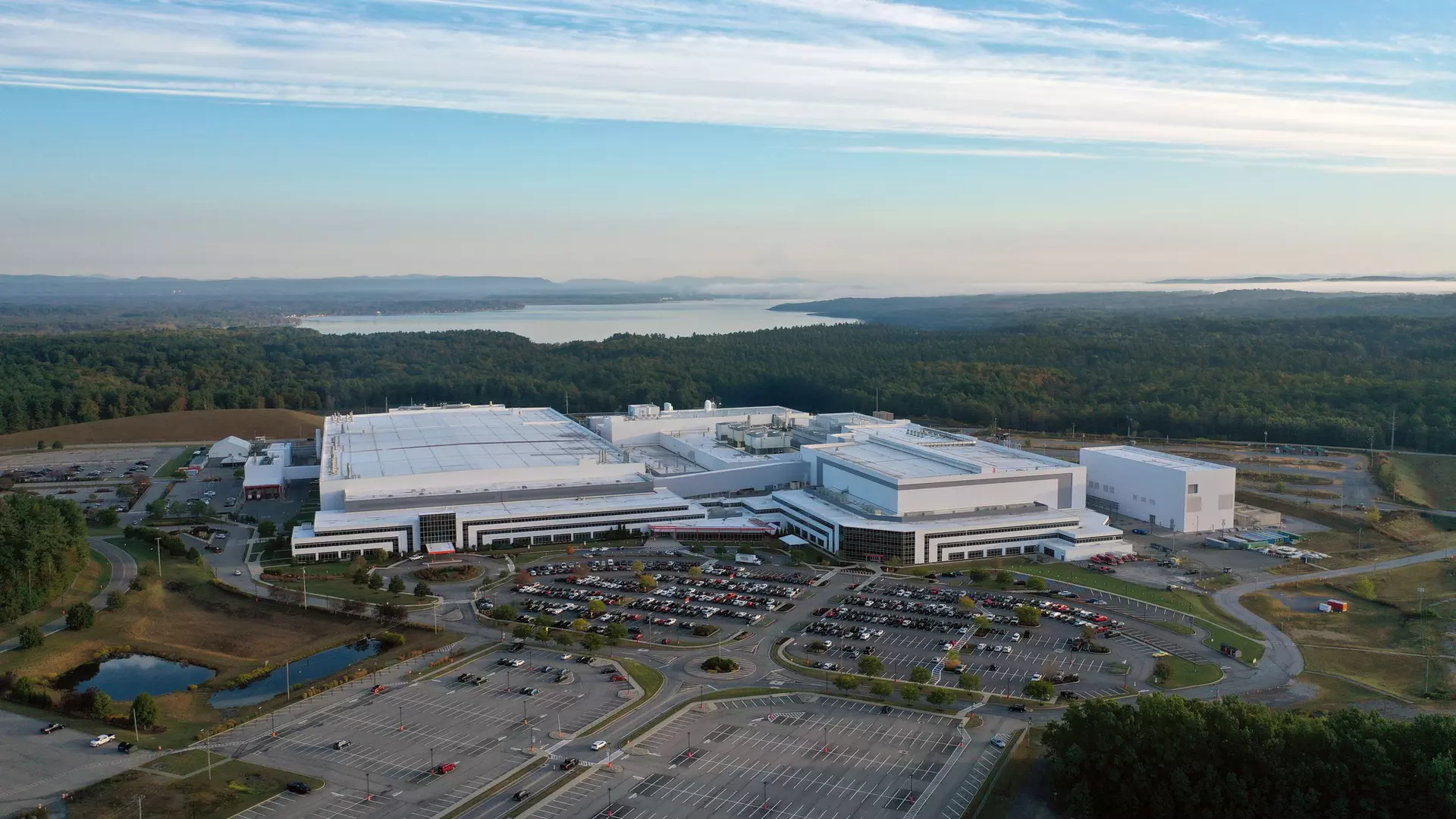
GlobalFoundries' campus in Malta, New York, where the company says it will build new capacity under the US-Japan initiative and the TSMC interposer deal.
Image: GlobalFoundries
Source · Press image from the GlobalFoundries website, used for news reporting.
GlobalFoundries reported third-quarter 2026 revenue of $1.899 billion on Nov. 4, up 13% from a year earlier and 6% from the second quarter, with communications infrastructure and data center revenue up 81% year over year.
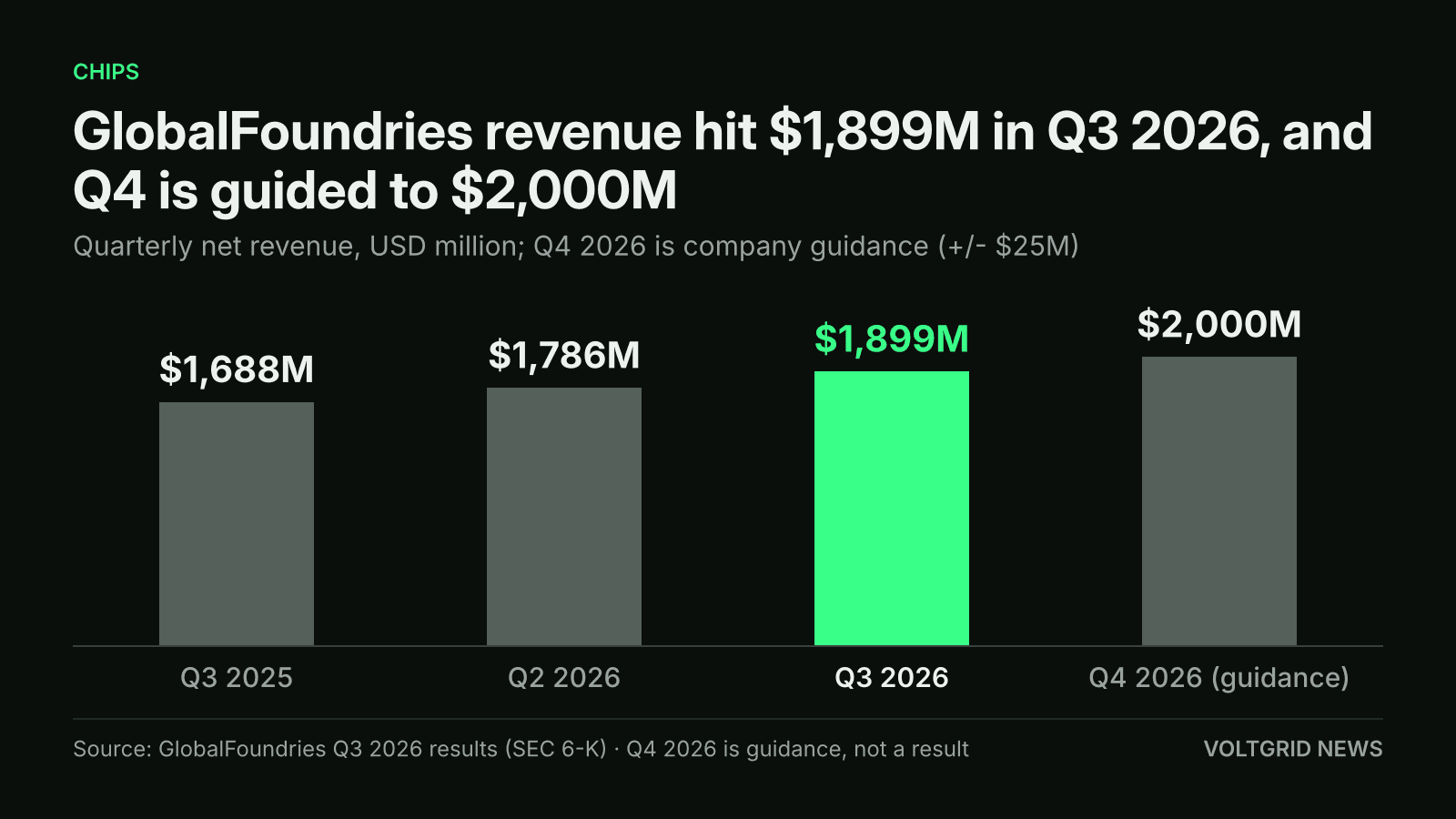
Revenue reached $1,899M in Q3 2026; the company guides Q4 2026 to $2,000M, according to its earnings release.
Illustration (AI-generated)
The company said in its earnings release that non-IFRS gross margin reached a record 31.4%, up from 29.9% in the second quarter and 26.0% a year earlier. Non-IFRS net income was $298 million, or $0.53 per diluted share. The IFRS result was a net loss of $(270) million, which the company attributed mainly to a $441 million non-cash charge for 9.9 million shares issued to the US government. Management said on its call that revenue and non-IFRS profit landed at the high end of guidance ranges. DigiTimes framed the quarter as a revenue base shifting from smartphones to AI-related networking.
Data center up 81%, mobile down 19%
On the earnings call, management put communications infrastructure and data center at about 17% of revenue, or $316 million, up 14% from the second quarter and driven by optical networking, which includes silicon photonics and silicon germanium. Smart mobile devices fell to about 32% of revenue, the lowest share in the company's history, with revenue down 5% from the prior quarter and 19% from a year earlier. Automotive made up about 19% of revenue, or $368 million, up 20% year over year. Wafer shipments were about 647,000 300mm-equivalent wafers, up 4% sequentially and 7% from a year ago, so the 13% revenue gain came from mix and price as much as from volume: management said blended average selling price rose 5% year over year, the first annual increase since 2023.
Guidance and the foundry supply picture
For the fourth quarter, GlobalFoundries guided to net revenue of $2.0 billion, plus or minus $25 million, about 5% above the third quarter at the midpoint. It guided non-IFRS gross margin to 31.5% plus or minus 100 basis points and non-IFRS diluted EPS to $0.59 plus or minus $0.05.
For the supply chain, the capacity commitments matter more than the quarter. In October, GlobalFoundries agreed a multi-year, $2 billion deal to make silicon interposers in Malta, New York for TSMC's CoWoS advanced-packaging flow, with volume production expected to ramp in the first half of 2028. TSMC's own price moves on that packaging line were covered earlier, as Voltgrid reported on a possible CoWoS price rise of up to 20%. On the call, management said it plans to roughly triple silicon photonics capacity over the next year. It expects about $500 million of silicon photonics revenue in 2026 and an annualized run rate near $1 billion by the end of 2027, a year earlier than previously planned.
In September, GlobalFoundries also expanded a multi-year agreement with Marvell for silicon germanium capacity in Burlington, Vermont, aimed at pluggable optics, near-packaged optics and co-packaged optics. Marvell is the company behind the $115 billion Lumentum all-stock deal, which Voltgrid covered on Nov. 2, so optical demand is reaching both sides of that supplier chain.
What is not confirmed yet
Management said 2027 net capital expenditure will be about $4 billion, roughly one-third supported by customer prepayments, but the release gives no capacity figures in wafers per month. The two new fabs in Malta under the US-Japan initiative, with up to $21 billion in funding, bring capacity online in 2029, so they do not ease supply in 2027. Management also cited custom-silicon design wins worth nearly $1 billion in lifetime revenue, across radar systems and data center computing; that is a lifetime figure, not 2027 revenue. The company has not given a Q4 split by end market, so how much of the $2.0 billion comes from data center remains unstated.