Xiaomi XRING O3 Specs and Benchmarks: Leads Most Tablet GPU Tests, Lags on NPU
Notebookcheck measured Xiaomi's XRING O3 at 85 fps in GFXBench 4K Aztec Ruins on the Pad 9 Pro Max, ahead of Apple's M5 iPad Pro, but its NPU trails Google's Tensor G5 on quantized work and the 18 Fold throttles hard.
Hardware & Analysis DeskEdited by Ege Erten
7 min readAI-assisted
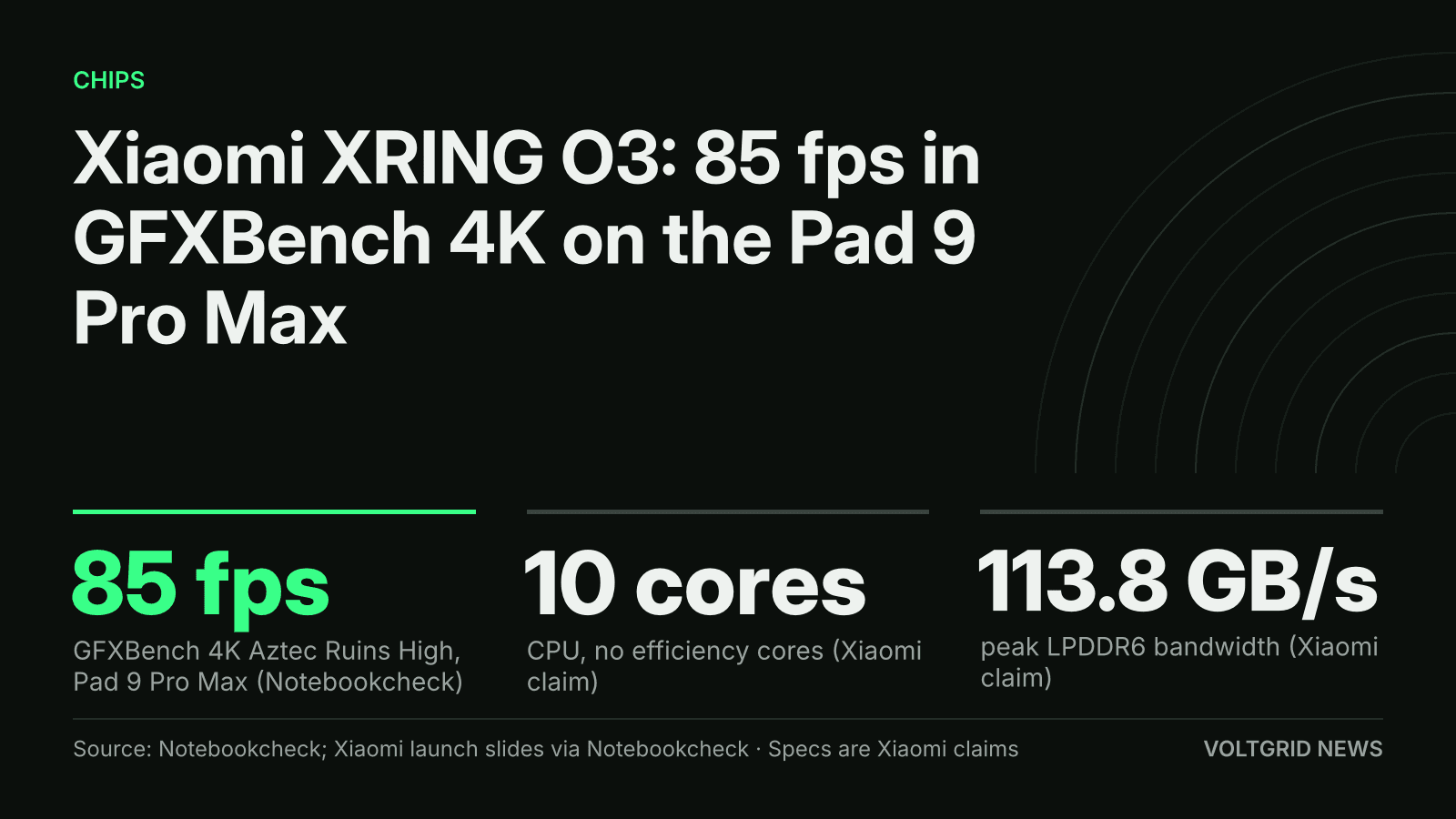
Xiaomi XRING O3 key facts: the 85 fps is a Notebookcheck measurement, the core count and bandwidth are Xiaomi claims.
Illustration (AI-generated)
Xiaomi's XRING O3, its second in-house phone and tablet processor, ran GFXBench's 4K Aztec Ruins test at 85 fps in the Xiaomi Pad 9 Pro Max, Notebookcheck reported in a review published on Nov. 1.
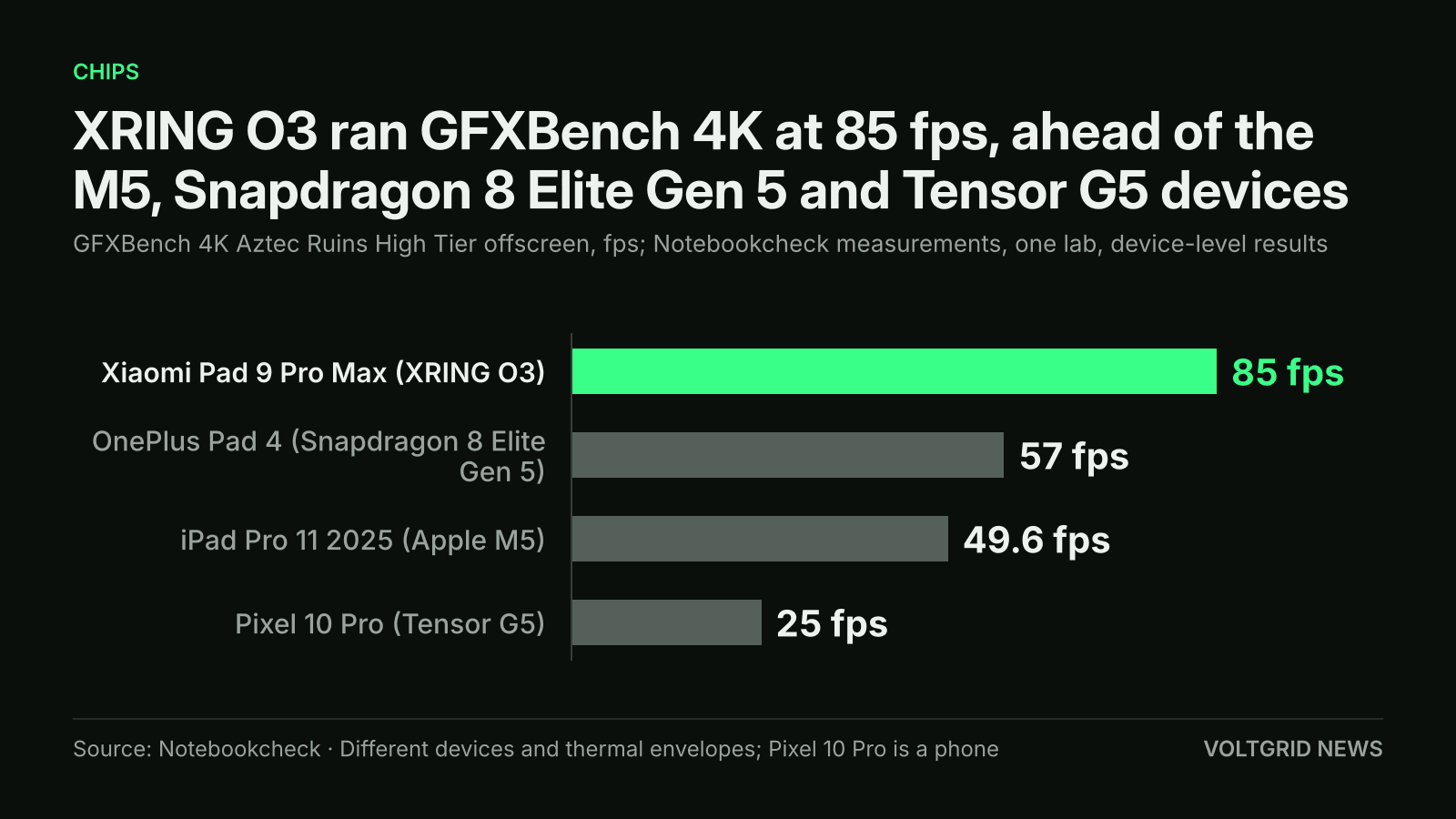
Notebookcheck measured the XRING O3 tablet at 85 fps in GFXBench 4K, the top result among these devices.
Illustration (AI-generated)
That result puts the chip ahead of the OnePlus Pad 4 at 57 fps, Apple's iPad Pro 11 with the M5 at 49.6 fps and the Pixel 10 Pro at 25 fps in that test, and the outlet now calls the O3 its GPU benchmark leader. The same lab measured the Xiaomi 18 Fold, the first phone to use the chip, on Oct. 20, and the two reviews tell different stories. In the tablet the O3 is a top-tier CPU and GPU; in the foldable it throttles hard. Its NPU, the block that runs on-device AI, is the weak point: it trails Google's Tensor G5 on quantized and half-precision work, Apple's M5 in the tablet, and Qualcomm's chip in the phone.
For engineers and investors the chip matters for what it says about Xiaomi, not only for its scores. A phone maker now ships its own SoC (system-on-chip, the processor that carries the CPU, GPU, AI engine and memory controller) made at TSMC, the route Google took with Tensor. It pairs that SoC with LPDDR6, the newest phone memory, while DDR4 contract prices sit at a record.
Inside the XRING O3
Every specification here is Xiaomi's own claim, from the launch slides Notebookcheck reported on Aug. 24; none has been checked against an official Xiaomi spec sheet. Xiaomi gives the O3 a 10-core CPU with no efficiency cores: two Arm C1-Ultra cores at up to 4.35 GHz, four C1-Premium at up to 3.68 GHz and four C1-Pro at up to 3.15 GHz. Caches are 12 MB of private L2, 16 MB of L3 and a 16 MB system cache. The GPU is Arm's Mali-G2 Ultra NX with 16 cores, eight with tensor accelerators for upscaling. Notebookcheck reports 24 billion transistors on a 133 mm² die.
The defining choice is memory. Xiaomi says the O3 is the first SoC with native LPDDR6 support, at 10,667 MT/s over four 24-bit channels, for up to 113.8 GB/s of peak bandwidth and 82 ns of latency. Bandwidth is how fast data reaches the CPU, GPU and NPU, which all draw on the same memory, so it sets how much of the chip's compute can be fed at once. TrendForce, citing Cailian Press, reports that China's CXMT is Xiaomi's key LPDDR6 memory partner, a report that neither company has confirmed. Xiaomi ships LPDDR6 only at the top: Notebookcheck says the Pad 9 Pro Max uses LPDDR5X in its base model, LPDDR5T in higher tiers and LPDDR6 only in the top version, and the 18 Fold gets it only in its largest memory configuration. None of the sources read gives a reason, and Notebookcheck does not say which memory type its 512 GB test tablet used. It does so while DRAMeXchange records a contract price of $27.5 for DDR4 8Gb, as Voltgrid reported, and while NVIDIA says it will keep buying large volumes of LPDDR for AI systems, as Voltgrid reported.
Reuters, citing sources, reported that TSMC makes the O3 on its 3 nm process, according to TrendForce's summary; Notebookcheck names the N3P node. Xiaomi was not read confirming either the foundry or the node, and "3 nm" and "N3P" are TSMC process names, not measured feature sizes. Xiaomi says it is in mass production; Reuters reports a 200,000 to 300,000 unit target for the foldable. "In-house" needs care. Xiaomi licenses its CPU cores and GPU from Arm. The parts it describes as its own are the SoC design, a quad-core NPU, a fifth-generation ISP and a RISC-V security core. The modem is not named in any source read for this piece. The 18 Fold supports 5G, but whether its modem sits on the O3 or is a separate bought-in chip is unknown. The Pad 9 Pro Max has no cellular option at all.
How it compares on Notebookcheck's bench
All figures below come from one lab, Notebookcheck, on the same benchmark versions. In Geekbench 6.7 the Pad 9 Pro Max scored 3,522 single-core and 12,976 multi-core. Google's Pixel 10 Pro with Tensor G5, also a TSMC 3 nm chip by Google's account, scored 2,308 and 6,314. The OnePlus Pad 4 with the Snapdragon 8 Elite Gen 5 scored 3,506 and 10,703. Apple's iPad Air 13 with the M4 scored 3,700 and 13,987, and the iPad Pro 11 with the M5 scored 4,128 and 16,544. On CPU the O3 lands between Qualcomm's chip and Apple's M4.
The GPU is where it leads. In 3DMark Wild Life Unlimited the tablet scored 31,077, against 20,274 for the OnePlus Pad 4 and 13,193 for the Pixel 10 Pro. In GFXBench's 1080p Aztec Ruins offscreen test it reached 387 fps, against 317.5 fps for the iPad Pro M5. The M5 still edged it in 3DMark Solar Bay, at 17,650 to 16,999. The Pixel is a phone, not a tablet.
The NPU result runs the other way. In Geekbench AI 1.7 on the NPU, the Pad 9 Pro Max scored 1,761 quantized and 852 half precision. The Pixel 10 Pro scored 3,792 and 907, the Lenovo Yoga Tab Gen 2 with MediaTek's Dimensity 9500s scored 12,941 quantized, and the iPad Pro M5 scored 57,388. Among the devices cited here, the O3 beat only the OnePlus Pad 4, at 1,501, and led the Pixel in single precision, at 839 to 478. Xiaomi rates its NPU at 200 TOPS at A8W4 precision (8-bit activations, 4-bit weights). Google gives Tensor G5 no TOPS figure, only a TPU "up to 60% more powerful" than its predecessor's, so Xiaomi's number cannot rank the two chips.
Why 200 TOPS Does Not Rank an NPU
TOPS counts trillions of operations per second, and the number means little without its format. Xiaomi rates the O3's NPU at 200 TOPS at A8W4 precision, meaning 8-bit activations and 4-bit weights, per its launch slides. Fewer bits per value means more operations per second on the same silicon, so an A8W4 rating cannot be set beside an INT8 one. It is also a peak rating, not a measurement.
Notebookcheck's Geekbench AI 1.7 runs show how far rating and result can sit apart. The Pad 9 Pro Max scored 1,761 quantized, against 3,792 for the Pixel 10 Pro and 12,941 for the Lenovo Yoga Tab Gen 2. Google gives Tensor G5 no TOPS figure, so same-test scores are the only like-for-like comparison, from one lab and one benchmark. For on-device AI, the score on the format an app uses outweighs the headline rating.
Phone against tablet: the thermal gap
The two reviews differ because the chips sit in different bodies. The 18 Fold scored 2,149 single-core and 11,736 multi-core by default, and 3,277 and 12,298 in its performance mode. Samsung's Galaxy Z Fold8, with the Snapdragon 8 Elite Gen 5 for Galaxy, scored 3,615 and 11,112. Notebookcheck wrote that even last year's Snapdragon chips beat the foldable on single-core, and that its GPU fell short in tests with ray tracing on. In 3DMark stress tests the 18 Fold held 56.9% of its Wild Life Extreme score and ended slightly slower than the Z Fold8. The tablet, with a vapor chamber, held 64.8% on the same test, which the reviewer still called a larger drop than expected; Notebookcheck puts the drop at up to about 40%. Its NPU scores in the phone were lower too, at 616 quantized against 1,390 for the Z Fold8. The gap likely reflects power mode and cooling, not the silicon alone; no source isolates the cause, and neither review measured the chip's own power draw.
Notebookcheck measured the whole tablet at 4.2 W to 4.7 W idle, against 1.3 W to 2.2 W for the OnePlus Pad 4, and 11.7 W in GFXBench's 1080p Aztec Ruins run, against 12 W for the OnePlus. In the outlet's Wi-Fi test the tablet ran 24.9 hours and the 18 Fold 26.8 hours, but the tablet has a 12,000 mAh battery and the 18 Fold 6,000 mAh, so the runtimes say nothing about chip efficiency.
Price and availability
In China the Pad 9 Pro Max costs the equivalent of about $730 with 12 GB and 256 GB, up to about $1,119 with 16 GB and 1 TB, Notebookcheck reports. Xiaomi has given no international launch details. The 18 Fold sells in China from RMB 10,999 to RMB 14,999 and was meant only for the Chinese market when Notebookcheck reviewed it.
What to watch
First, the modem: whether Xiaomi has one of its own or buys one in. Second, a second lab: every measurement so far comes from Notebookcheck, and another independent review would show whether the tablet and phone results hold. Third, the next chips. Reuters, as cited by TrendForce, reports Xiaomi has also tapped TSMC for a 6 nm XRING O100 NPU and a 3 nm XRING D100 for autonomous driving; both have completed development and are due for deployment in 2027, by that report. Apple has meanwhile moved its A20 Pro to 2 nm, as Voltgrid reported, a node the O3 skipped. Notebookcheck's data suggest Xiaomi's own SoC can beat Qualcomm's chip on graphics and, in some GFXBench and 3DMark runs, Apple's M5, at least in a tablet. The O3 has not yet shown it can do the same on AI, or inside a phone's thermal budget.
Sources
- 01Over 1,000 FPS: Xiaomi's new high-end chip becomes a nightmare for GoogleGoogle News · agenda, phone chips · news.google.com
- 02Xiaomi launches XRing O3, claims it is the fastest smartphone SoC with an AnTuTu score of over 5 millionNotebookcheck · notebookcheck.net
- 03Xiaomi 18 Fold review: Big display, big performance, big compromisesNotebookcheck · notebookcheck.net
- 04[News] Xiaomi XRING O3 Reportedly Features CXMT LPDDR6 and TSMC 3nm, May Expand TSMC Ties to AI and Auto ChipsTrendForce · trendforce.com
- 05An lightning-fast tablet with a brilliant feature & ridiculous battery life: Xiaomi Pad 9 Pro Max reviewNotebookcheck · notebookcheck.net