DRAM Contract Price Hits Record $27.5 for DDR4 8Gb, Up 5.77%
DRAMeXchange put October's DDR4 8Gb contract price at a record $27.5, up 5.77% from September, while MLC NAND held at $30.61. TrendForce sees PC DRAM up 13% to 18% in Q4.
Chips & Power DeskEdited by Ege Erten
2 min readAI-assisted
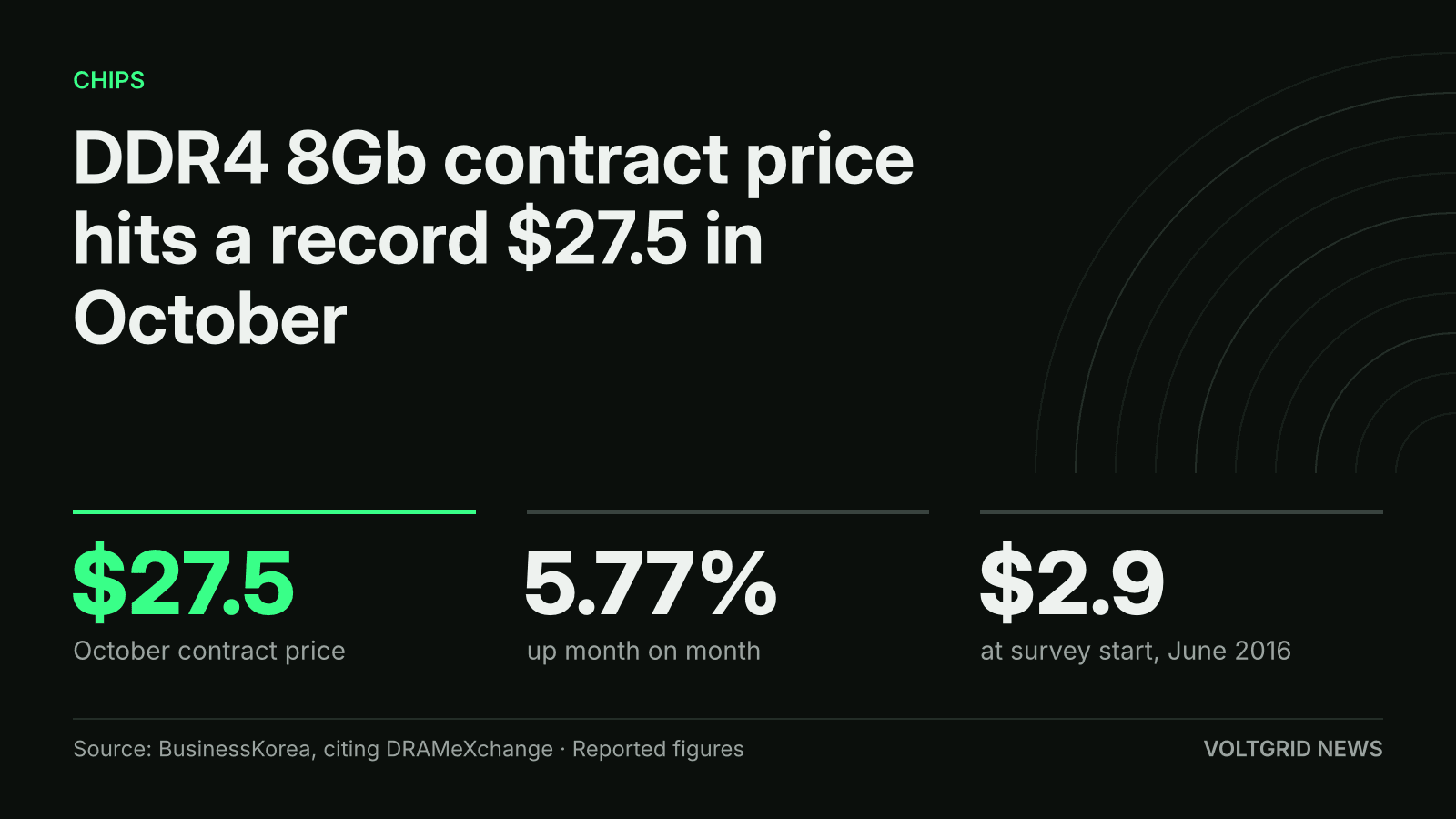
DRAMeXchange put the October DDR4 8Gb contract price at $27.5, against $2.9 when the survey began in June 2016, BusinessKorea reports.
Illustration (AI-generated)
DRAMeXchange, the price-tracking arm of TrendForce, said on Oct. 30 that the October average contract price of general-purpose DDR4 8Gb (1Gx8) DRAM reached $27.5, a new record, according to BusinessKorea.
That is up 5.77% from $26 in September. BusinessKorea, citing the same survey, put the price at about 9.5 times the $2.9 recorded when the survey began in June 2016.
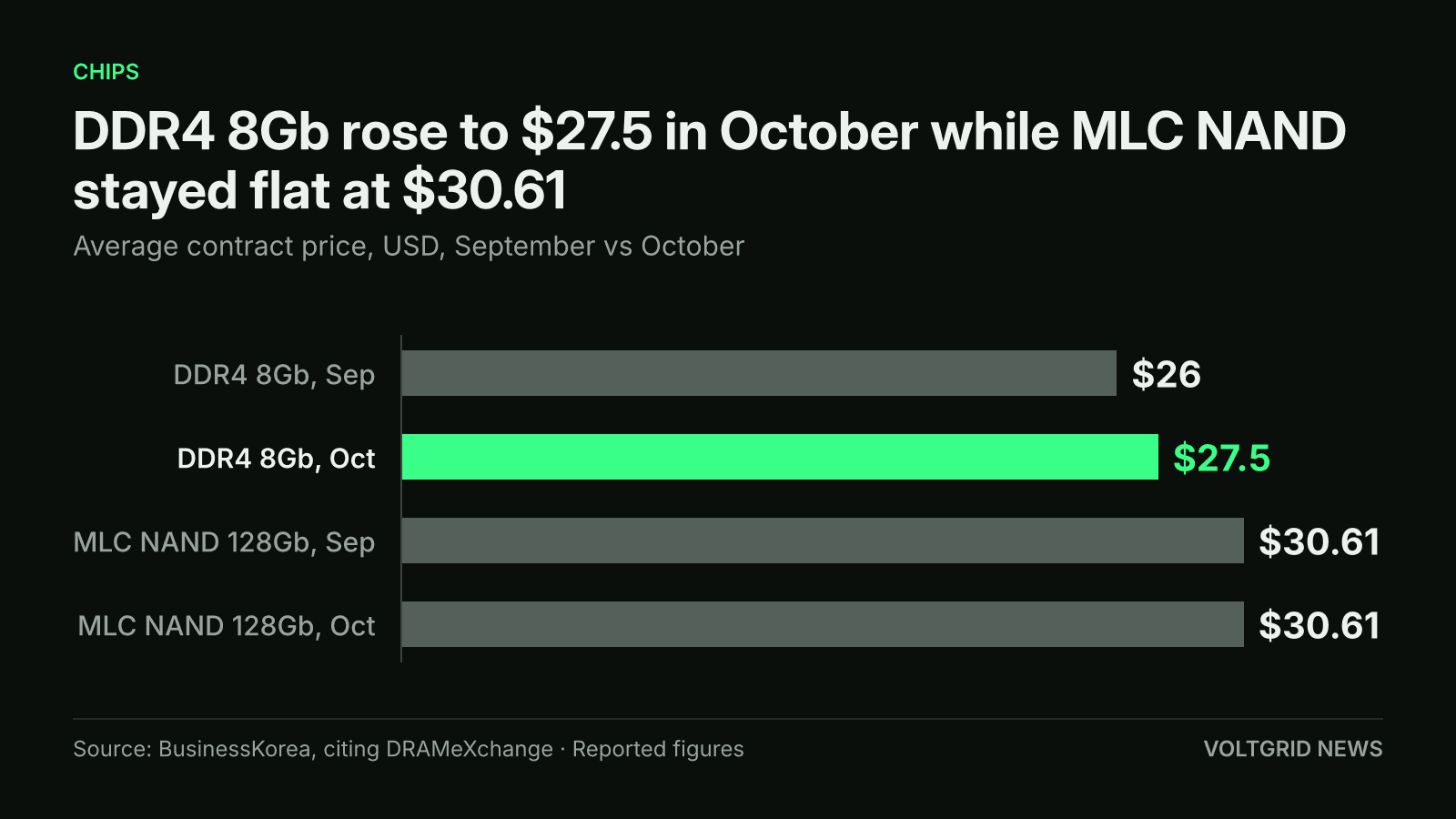
DDR4 8Gb moved up from September to October while MLC NAND 128Gb held at $30.61, per BusinessKorea citing DRAMeXchange.
Illustration (AI-generated)
The NAND side did not move on the main benchmark. The average contract price of general-purpose NAND (128Gb 16Gx8 MLC), the type used in memory cards and USB drives, was $30.61 in October, the same as the month before.
Why DRAM Contract Prices Keep Rising
TrendForce attributes the climb to memory makers adding server memory output while cutting PC DRAM supply. It forecast that PC DRAM contract prices will rise 13% to 18% in the fourth quarter compared with the third, and that Korean DRAM makers will cut PC DRAM production by more than 20% next year compared with this year.
Demand is not strong. According to the report, a proposed 15% to 20% fourth-quarter increase met resistance from PC customers, which kept large-volume deals from closing. TrendForce still expects the November contract reference to come in slightly above October because shortages continue.
For buyers of server and AI hardware, the signal is that PC and general-purpose DRAM are being squeezed by the shift toward server memory, the same pull Voltgrid has tracked in Samsung's record third-quarter memory sales and in Kioxia's AI-driven revenue. For PC makers, higher DRAM cost is already feeding into shipment plans, as Intel's plan for about 10% fewer PCs in 2027 shows.
NAND: MLC Flat, SLC Higher
TrendForce said older-process NAND supply is shrinking as manufacturers move capacity to advanced 3D NAND. MLC prices held across all capacities in October because high prices weighed on buyers who also struggled to secure volume.
Single-level cell (SLC) NAND kept rising, on demand from automobiles, industrial control devices and low Earth orbit satellites. The average SLC price rose 5% to 10% from September, and products of 4 gigabits (Gb) or more rose 9.0% to 9.9%.
TrendForce expects the two paths to diverge. It sees the rise in high-capacity SLC continuing through the fourth quarter, while MLC is likely to ease slightly as customers move to cheaper SLC or triple-level cell (TLC) products.
What Is Still Unconfirmed
The figures come from BusinessKorea's account of the DRAMeXchange release. The report gives the contract price for one benchmark part, DDR4 8Gb, and does not list DDR5 or server DRAM contract prices, so it is not a measure of what hyperscalers pay for server memory. The November price and the fourth-quarter range are TrendForce forecasts, not settled contracts.