Dell's ISG Takes 91% of Segment Profit as Consumer PC Sales Fall 15%
Dell's infrastructure group earned 91% of segment operating income on a $22.0B AI server quarter, and HPE's server revenue rose 94.7%. HPE's margins and Dell's PCs make the case against.
5 min read
Follows Dell, HPE Earnings Nov 23-24: AI Hardware and Energy Week Ahead
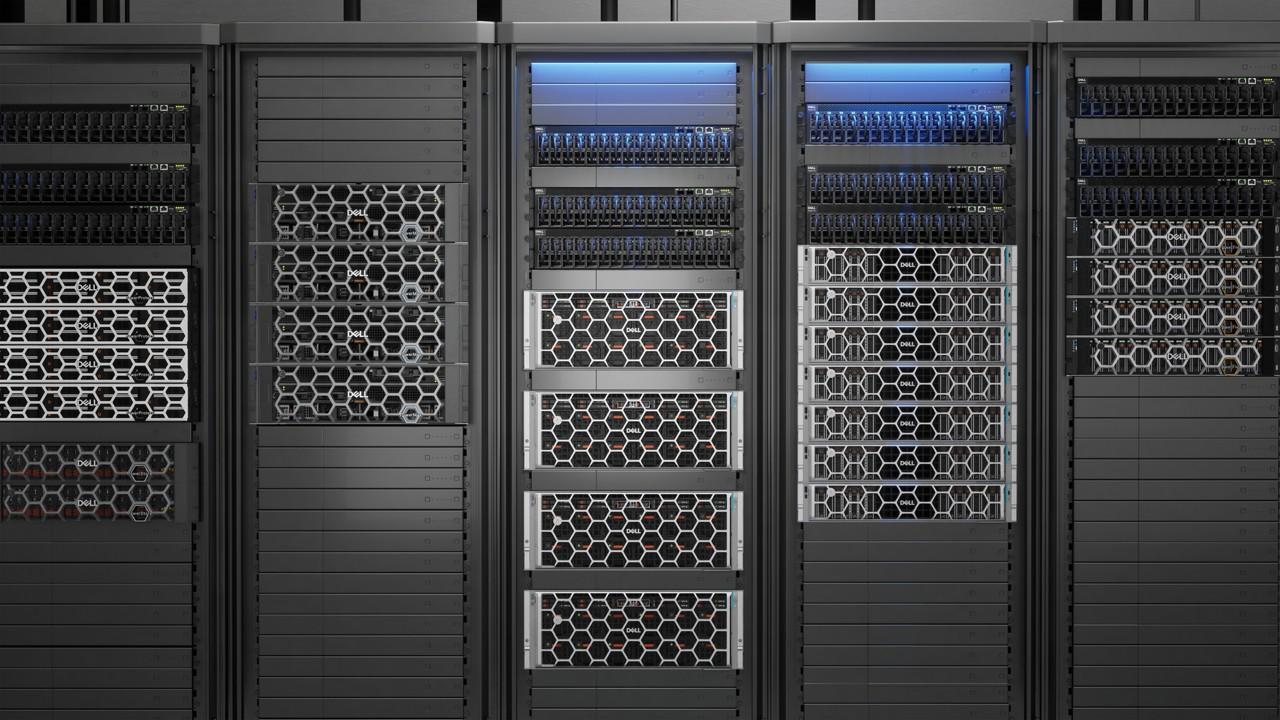
Dell server racks, in an image from Dell's investor relations site. The picture is illustrative and is not tied to the quarter's shipments.
Image: Dell Technologies
Source · Press image from the Dell Technologies investor relations site, used for news reporting.
Dell said on Nov. 24 that its Infrastructure Solutions Group (ISG) earned 91% of Dell's total reportable segment operating income in the quarter to Oct. 30, up from 70% a year earlier, on $22.0 billion of AI-optimized server sales, up 291%. A day earlier, HPE reported server revenue of $8.8 billion, up 94.7% from a year earlier. Read together, the two filings argue that AI infrastructure, not PCs, now sets the profits of the companies that built the PC era, though the margin evidence is weaker than the revenue evidence.
The peg is two results days that our Nov. 22 week-ahead preview flagged. All figures below are the companies' own, from their earnings releases filed with the SEC, unless another outlet is named.
What happened
Dell's revenue for its fiscal third quarter of 2027 was $54.9 billion, up 103% from a year earlier, the company said. AI-optimized servers brought in $22,031 million against $5,641 million a year before. Traditional servers and networking added $15.0 billion, up 235%, and storage $4.9 billion. ISG, which holds all three, reached $42.0 billion of revenue and $7,118 million of operating income, a 17.0% operating margin against 12.4% a year earlier.
Jeff Clarke, Dell's vice chairman and chief operating officer, said Dell ended the quarter with a record AI backlog of $132.3 billion after booking $60.2 billion of orders, and that more than 7,500 customers deploy its AI Factory systems. Dell raised its fiscal 2027 guidance for AI server revenue to $78.0 billion from $74.0 billion and for total revenue to $202.0 billion from $192.0 billion. It guided fourth-quarter revenue to $56.3 billion, up 69%.
The PC side moved the other way. Client Solutions Group (CSG) revenue rose 3% to $12.9 billion, but its operating income fell 6% to $704 million, a 5.5% margin. Commercial PCs rose 6% to $11,300 million, while consumer revenue fell 15% from a year earlier to $1,586 million. CNBC, citing LSEG estimates, reported that analysts had expected $14.33 billion from the client group and $49.32 billion of total revenue; on those estimates, Dell beat on the total and missed on PCs.
HPE's fourth quarter of fiscal 2026, to Oct. 31, brought revenue of $14.5 billion, up 50%, the company said. Its Cloud & AI segment took $11.3 billion, with an 18.4% operating margin against 9.3% a year earlier. Server revenue was $8,790 million, up from $6,766 million in the previous quarter; HPE does not split that line into AI and other servers. HPE's non-GAAP gross margin was 38.2%, down 220 basis points from the prior quarter, and the company raised its fiscal 2027 revenue outlook to $59.4 billion to $63.1 billion.
Why it matters
Dell reports profit by segment, and the segments differ sharply in scale and margin. ISG earned $7,118 million of operating income on $41,974 million of revenue, a 17.0% margin, Dell's table shows. CSG, the PCs, earned $704 million on $12,886 million, a 5.5% margin.
ISG earned $7,118M of Dell's segment operating income against $704M for CSG, 91% versus 9%; ISG's share was 70% a year earlier.
Graphic: Voltgrid News
The argument rests on three numbers. First, the profit split: ISG made about ten times CSG's operating income, and its share of Dell's total reportable segment operating income rose to 91% from 70%. Second, the mix inside ISG: AI-optimized servers were 52.5% of its revenue this quarter, by our arithmetic from Dell's table. Third, the pipeline: the $132.3 billion backlog is about 1.7 times the full-year AI server guide, though a backlog of orders is not one year's revenue and Dell gives no schedule for converting it. If Dell meets its $78.0 billion guide, its nine-month AI server revenue of $54,564 million implies about $23.4 billion more in the fourth quarter.
Dell does not report a margin for AI-optimized servers alone, so the filing cannot say whether they earn less per dollar than PCs. It shows that ISG's margin rose from 12.4% a year earlier while AI servers grew to $22,031 million of its revenue. Chief financial officer David Kennedy said profitability is rising even as AI servers become a larger part of the business.
If those orders ship on schedule, Dell's results will track rack deliveries, which depend on customers' access to land and power. Dell's release says each order is vetted for that access, and CNBC quoted Clarke on the call adding trade and export compliance to the list. That makes Dell's earnings a reading on how fast data-center shells and grid connections come online, not only on GPU supply.
The PC numbers fit the same picture. Consumer revenue fell 15% while commercial grew, and CSG's margin slipped to 5.5% from 6.0%. CNBC tied the weak PC market to rising memory prices pushing up device prices. Dell's release does not say that; it gives no memory cost figure at all. If memory is the cause, the same DRAM supply that AI servers absorb is squeezing the consumer laptop, which would make the profit shift self-reinforcing.
The case against
The thesis is stronger on revenue than on margin, and HPE's figures cut against its margin half. HPE's non-GAAP gross margin fell 220 basis points from the third quarter, but its release does not blame AI mix, and the same non-GAAP margin was up 180 basis points from a year earlier. Its Cloud & AI operating margin rose to 18.4% from 17.0% in the previous quarter, even as server revenue grew about 30% sequentially. HPE's gross margin covers Networking and Cloud & AI together and the release does not split it by segment, so the sequential drop cannot be pinned on servers.
Dell's own margins say AI scale has not cost it profitability. Its GAAP gross margin was 21.0% against 20.7% a year earlier, and Kennedy said non-GAAP operating expenses fell to 7% of revenue, the lowest in Dell's 42-year history. Nor have PCs collapsed: CSG revenue grew, commercial rose 6%, and nine-month consumer revenue was flat. The 91% share mostly reflects ISG's 308% profit growth, not a PC loss. A backlog is also not revenue; orders tied to sites that lack power can slip, and the filings give no conversion schedule.
What it means for suppliers and rivals
For GPU and memory makers, Dell's raised guide is a $78.0 billion AI-server revenue forecast for fiscal 2027, and the $132.3 billion backlog is the order figure behind it. Neither filing breaks out the GPU vendors in the backlog or the cost of DRAM and NAND, so the split between NVIDIA, AMD and the memory suppliers stays unknown; NVIDIA's own third-quarter results by platform show the other side of that trade. For Supermicro and other rack builders, Dell says it can stand a rack up within six hours of delivery, and its record AI backlog sets the bar on deployment speed. For PC rivals such as HP Inc. and Lenovo, Dell's consumer decline is a data point on the price-sensitive end of the market, not proof of a shared trend.
What to watch
NVIDIA's GTC conference in Washington, D.C., runs Nov. 30 to Dec. 3, with the conference and expo on Dec. 1 to 3, according to NVIDIA; any rack and memory roadmap news there bears on Dell's backlog. HPE pays its next dividend on or about Jan. 8, 2027, to holders of record on Dec. 9, and guided first-quarter fiscal 2027 revenue of $14.0 billion to $14.6 billion. Dell's fourth-quarter report, against its $56.3 billion guide, will show whether about $23.4 billion of AI server revenue lands; Dell has not dated it yet. A further raise to the AI server guide would support the thesis, and a gross margin decline at Dell with flat PC revenue would weaken it.
Sources
- 01Dell Technologies Delivers Third Quarter Fiscal 2027 Financial ResultsDell Technologies (SEC 8-K)sec.gov
- 02Dell again lifts forecasts as AI demand powers record resultsReuters (via The Star)thestar.com.my
- 03Dell earnings beat on AI strength, company authorizes $25 billion buybackCNBCcnbc.com
- 04HPE reports fiscal 2026 fourth quarter resultsHPE (SEC 8-K)sec.gov
- Published
- Sources
- 4 cited