First published Changes log
NVIDIA Q3 by Platform: Hyperscale $60.1B, ACIE $47.5B, 41.0% of Sales
Where NVIDIA's record $115.8 billion quarter came from, and what decides the next: its AI Clouds, Industrial & Enterprise (ACIE) platform rose to 41.0% of revenue from 28.2% a year earlier, while receivables reached $81.0 billion and commitments $518 billion.
11 min read
- Q3 fiscal 2027 revenue, up 103% from a year earlier
- $115.8B
- ACIE share of revenue
- 41.0%against 28.2% a year earlier
- Accounts receivable at Oct. 25
- $81.0B64 days of sales, up from 60
- Q4 revenue outlook, plus or minus 3%
- $130.0Bincludes an extra week
As ofSourceNVIDIA CFO commentary, Nov. 17, 2026
NVIDIA's AI Clouds, Industrial & Enterprise (ACIE) platform brought in $47.5 billion in the quarter to Oct. 25, 41.0% of its record $115.8 billion of revenue, against 28.2% a year earlier.
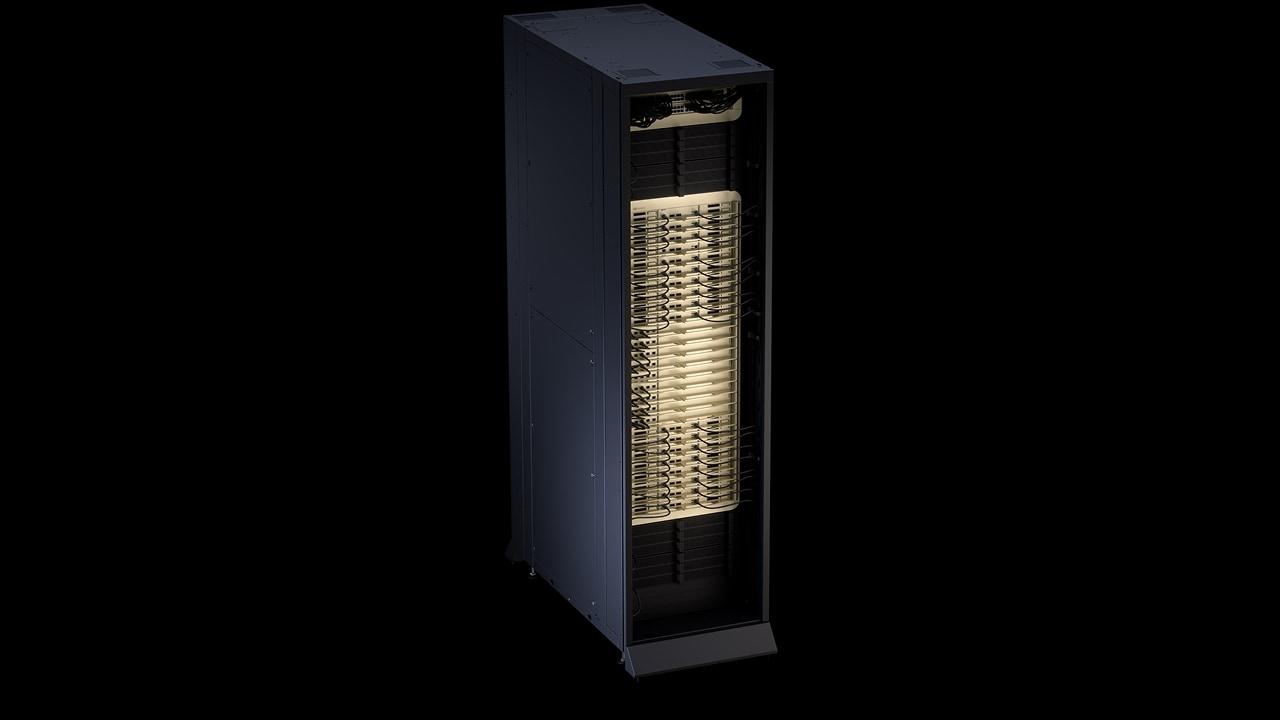
NVIDIA's Vera Rubin NVL72 rack. NVIDIA said on Nov. 17 that Vera Rubin NVL72 and Vera CPUs began volume shipments in the third quarter.
Image: NVIDIA
Source · Press image from the NVIDIA Vera Rubin NVL72 product page, used for news reporting.
Hyperscale, NVIDIA's name for public clouds and the largest consumer internet companies, still led with $60.1 billion and grew faster in the quarter, 23% against 18% for ACIE. The shares are Voltgrid's arithmetic on the platform figures in the CFO commentary NVIDIA filed with the SEC on Nov. 17. Read beside the balance sheet and the obligations NVIDIA reports off it, they show where the growth came from and what stands beside it, though NVIDIA does not split these lines by platform: receivables of $81.0 billion, $518 billion of commitments and up to $118.0 billion of guarantees, while memory, packaging, financing, power and export rules set the pace for the quarters ahead.
Where did the $115.8 billion come from?
Data Center, which holds both Hyperscale and ACIE, brought in $107.6 billion, up 21% from the second quarter and 110% from a year earlier. Hyperscale reached $60.1 billion, up 23% and 71%; ACIE reached $47.5 billion, up 18% and 195%. Edge Computing, which since the first quarter of fiscal 2027 gathers PCs, game consoles, workstations, AI-RAN (AI radio access network) base stations, robotics and automotive in one platform, reached $8.2 billion, up 14% and 42%. NVIDIA's two reportable segments cut the revenue along a different line: Compute & Networking brought in $106.0 billion and Graphics $9.8 billion.
| Platform | Q3 FY27 | Q2 FY27 | Q3 FY26 | Q/Q | Y/Y |
|---|---|---|---|---|---|
| Data Center | $107.6B | $89.0B | $51.2B | 21% | 110% |
| Hyperscale | $60.1B | $48.7B | $35.1B | 23% | 71% |
| AI Clouds, Industrial & Enterprise | $47.5B | $40.3B | $16.1B | 18% | 195% |
| Edge Computing | $8.2B | $7.2B | $5.8B | 14% | 42% |
| Total | $115.8B | $96.2B | $57.0B | 20% | 103% |
NoteHyperscale and ACIE are the two parts of Data Center. NVIDIA computes growth rates on figures in millions. Quarters end Oct. 25, 2026, July 26, 2026 and Oct. 26, 2025.
SourceNVIDIA CFO commentary, Nov. 17, 2026
As of
As shares of revenue, Hyperscale fell from 61.6% a year earlier to 51.9%, ACIE rose from 28.2% to 41.0% and Edge Computing slipped from 10.2% to 7.1%. The latest quarter ran the other way for a moment: Hyperscale's share rose from 50.6% in the second quarter, and ACIE's eased from 41.9%. NVIDIA credited the Data Center growth to the start of its Rubin infrastructure, standalone Vera CPUs and Blackwell Ultra. On the call, Colette Kress, interim chief executive since Jensen Huang resigned on Nov. 11, said the Rubin platform brought in nearly $20 billion in its first quarter of production shipments, Tom's Hardware reported; NVIDIA's release calls it the fastest product ramp in the company's history.
ACIE grew to 41.0% of NVIDIA's revenue from 28.2% a year earlier
Share of revenue by market platform, percent, quarters ended Oct. 26, 2025, July 26, 2026 and Oct. 25, 2026
- Hyperscale
- AI Clouds, Industrial & Enterprise
- Edge Computing
- Note 1: Up 195% from a year earlier, to $47.5 billion
NoteShares are Voltgrid's arithmetic on NVIDIA's platform revenue in billions of dollars. Hyperscale and ACIE make up Data Center; all three quarters are on NVIDIA's basis after its second-quarter recast.
SourceNVIDIA CFO commentary, Nov. 17, 2026
As of
Data table
| Category | Hyperscale | AI Clouds, Industrial & Enterprise | Edge Computing | Total |
|---|---|---|---|---|
| Q3 FY26 | 61.6% | 28.2% | 10.2% | 100.0% |
| Q2 FY27 | 50.6% | 41.9% | 7.5% | 100.0% |
| Q3 FY27 | 51.9% | 41.0% | 7.1% | 100.0% |
One caution on the comparison. In the second quarter NVIDIA moved one company from ACIE to Hyperscale after a change in that company's business model and recast earlier quarters, so the year-ago and prior-quarter figures here are on the revised basis, which differs from the split NVIDIA published in May.
What did margins, costs and cash do?
Revenue came in $7.8 billion above the $108.0 billion midpoint NVIDIA had guided in August. GAAP gross margin was 74.8%, above the top of its guided range of 74.0%, plus or minus 50 basis points, and just under the second quarter's 75.0%; NVIDIA put the slight dip down to the initial Rubin ramp. Operating expenses rose 9%, to $9.2 billion, of which research and development took $7.5 billion, leaving operating income of $77.5 billion, or 66.9% of revenue. Net income was $65.3 billion, or $2.70 a diluted share, including $1.8 billion of net gains on equity stakes; non-GAAP net income, which leaves such gains out, was $64.9 billion.
Cash followed with a lag. Operating cash flow was $48.3 billion, double the second quarter's $24.1 billion, a jump NVIDIA said also reflected the timing of federal tax payments. Free cash flow, NVIDIA's non-GAAP measure after spending on property and equipment, was $43.8 billion. NVIDIA returned $28.1 billion to shareholders, $22.1 billion through buybacks and $6.0 billion in dividends, and has $227.3 billion of buyback authority left, which it plans to use through fiscal 2028. Cash, cash equivalents and marketable debt securities fell to $53.5 billion from $56.6 billion a quarter earlier.
What do NVIDIA's own filings flag?
Two balance-sheet lines grew faster than revenue's 20%. Accounts receivable rose $18.0 billion in the quarter, or 28.5%, to $81.0 billion, which is 64 days sales outstanding (DSO) against 60. NVIDIA tied the rise to shipment timing in the Rubin launch and to extended payment terms on large, multi-quarter agreements with some investment-grade customers. Inventory rose $8.1 billion, or 25.8%, to $39.7 billion to support the Rubin ramp, and raw materials alone reached $15.8 billion, against $3.8 billion in January. Two direct customers accounted for 18% and 17% of receivables.
| Measure | End of Q2 FY27 | End of Q3 FY27 |
|---|---|---|
| Accounts receivable | $63.1B | $81.0B |
| Days sales outstanding | 60 days | 64 days |
| Inventory | $31.6B | $39.7B |
| Operating cash flow in the quarter | $24.1B | $48.3B |
| Free cash flow in the quarter | $21.3B | $43.8B |
| Capital returned in the quarter | Nearly $26.0B | $28.1B |
| Cash and marketable debt securities | $56.6B | $53.5B |
NoteQuarter ends: July 26 and Oct. 25, 2026. Changes are computed on figures in millions, so they can differ slightly from the rounded values shown. Free cash flow is NVIDIA's non-GAAP measure: operating cash flow less purchases of, and principal payments on, property, equipment and intangible assets.
SourceNVIDIA CFO commentary, Aug. 26, 2026, NVIDIA CFO commentary, Nov. 17, 2026, NVIDIA supplemental financial information
As of
Sales stay concentrated. Three direct customers, the buyers NVIDIA invoices, such as server makers and clouds, made up 14%, 11% and 11% of revenue, 36% together, all mainly in Compute & Networking. By the headquarters of all its direct customers, the United States accounted for $72.9 billion, Taiwan $30.3 billion and China, including Hong Kong, $11.05 billion, against $2.97 billion a year earlier; NVIDIA notes that the end customer and the shipping point can differ from the headquarters. Its commentary puts shipments of Hopper data-center products to China at $2.4 billion. Non-marketable securities, mainly stakes in private companies, reached $65.5 billion against $22.3 billion in January, $61.7 billion of it privately held equity securities.
Off the balance sheet, the obligations grew faster still. Supply and capacity commitments rose $111 billion to $390 billion, mainly from multi-year memory procurement, as we reported from the results. Data center leases that have not started stand at $74 billion, against $25 billion in the July 26 table. They run up to 20 years, start between the fourth quarter of fiscal 2027 and fiscal 2033, and NVIDIA says it may assign some of them to third parties. Its July 26 table also listed $20 billion of leases meant for third parties on a separate line, which the Oct. 25 table no longer shows. NVIDIA's own comparison counts that line: it sets $102 billion of cloud service agreements and data center leases against $74 billion a quarter earlier, so the lease rise on a like-for-like basis is from $45 billion to $74 billion. All commitments came to $518 billion, against $366 billion in the July 26 table, or $386 billion with the third-party line counted.
Two more lines sit outside that total. Neocloud agreements of $32 billion take effect only if those customers secure financing and NVIDIA accepts the deployed capacity, as we reported. The maximum gross exposure under guarantees rose to $118.0 billion from $108.5 billion at the end of July, the cap our earlier report found in the 10-Q, through a new $9.5 billion line for power and systems. The SB Energy guarantees for OpenAI's Ohio leases remain the largest at $105.0 billion, and NVIDIA says it has made no payment under any guarantee.
| Measure | July 26, 2026 | Oct. 25, 2026 |
|---|---|---|
| Supply and capacity | $279B | $390B |
| Data center leases not started | $25B | $74B |
| Cloud service agreements | $29B | $28B |
| Equity investment commitments | $25B | $20B |
| Capital expenditures | $8B | $6B |
| Total commitments | $366B | $518B |
| Neocloud agreements, contingent | $36B | $32B |
| Guarantees, maximum gross exposure | $108.5B | $118.0B |
NoteNeocloud agreements were called AI cloud agreements in the July 26 table, which also listed $20 billion of data center leases for third parties, a line the Oct. 25 table does not show. With it, as NVIDIA's own comparison counts, July leases were $45 billion and total commitments $386 billion.
SourceNVIDIA CFO commentary, Aug. 26, 2026, NVIDIA CFO commentary, Nov. 17, 2026
As of
What does the fourth-quarter outlook assume?
NVIDIA guides fourth-quarter revenue to $130.0 billion, plus or minus 3%, about 12% above the third quarter at the midpoint, in a quarter that has an extra week. The outlook assumes no Data Center compute revenue from China. Gross margin is guided to 71.0% to 72.0%, and GAAP operating expenses to about $11.0 billion. On the call, Kress said NVIDIA had absorbed higher costs to honor orders already booked, called the fourth-quarter margin the bottom, and said new pricing in fiscal 2028 should bring margins of 72% to 73%, Tom's Hardware reported; our margin analysis weighs that reading. She also said NVIDIA is no longer shipping licensed Hopper data-center products to China, Reuters reported, as we covered.
The quarter was the first reported under interim leadership. On Nov. 11 the board accepted Jensen Huang's resignation as president, chief executive and director, effective at once, and named Colette Kress, chief financial officer since 2013, interim chief executive while it searches for a successor; she keeps the finance role, and Harvey C. Jones became chair, NVIDIA's filing says, as we reported. On Nov. 17 the board formed a three-director committee to oversee national security and export-control compliance, chaired by Suzanne Nora Johnson. NVIDIA says it will file the quarter's 10-Q in the coming weeks.
Which developments decide the next quarters?
Memory comes first, since memory drove most of the $111 billion rise in supply commitments. SK hynix said on Oct. 28 that long-term agreements with 14 major customers cover more than 50% of its 2027 and 2028 production capacity, at prices that move within an agreed range, and that it expects demand to exceed supply through 2030. It also expects HBM4, the newest generation of high-bandwidth memory (HBM), to pass HBM3E in its shipments and revenue in the fourth quarter of 2026. Micron guided its first quarter of fiscal 2027 to revenue of $61.5 billion, plus or minus $1.5 billion, at a GAAP gross margin of about 85.95%, well above the 71.0% to 72.0% NVIDIA guides for itself. Our supply chain file sets the memory makers' quarters side by side. If memory makers keep margins like these, the fiscal 2028 pricing Kress described on the call, as Tom's Hardware reported, is where NVIDIA's answer would show.
Packaging and substrates set how many racks can leave the factory. NVIDIA said on Nov. 17 that Vera Rubin NVL72 and Vera CPUs began volume shipments in the third quarter on TSMC's 5nm and 3nm processes and its CoWoS packaging. Kinsus Interconnect Technology, as we reported, plans to lift its capacity for ABF package substrates, the layered boards a GPU package sits on, dedicated to NVIDIA by more than 3.5x, with production from the second half of 2027 and the added capacity targeted for the third quarter of 2028, and an expansion at Siliconware Precision Industries (SPIL) is to raise contracted packaging capacity for NVIDIA by the middle of 2029. TSMC, which makes NVIDIA's GPUs, reported October revenue of NT$586.89 billion, up 59.7% from a year earlier; it gives no split by customer.
Demand rests on two kinds of buyer. Alphabet, Microsoft, Amazon and Meta guide $720 billion to $740 billion of 2026 capital spending between them, each counting it differently, by our capex ledger; that is spending by four of the companies in NVIDIA's Hyperscale platform, which it defines as the public clouds and the largest consumer internet companies. ACIE includes the AI clouds, many of which borrow to build. CoreWeave reported on Nov. 10 more than 1.7 GW of active power against more than 4.6 GW contracted, as we covered, and NVIDIA's own commentary says many neoclouds and frontier labs are growing faster than their balance sheets and long-term credit profiles can support.
Power and sites are now in NVIDIA's own accounts. Its commentary calls securing land, power and shell the next critical phase of the AI build-out. The largest exposure is SB Energy's PORTS-Pike campus in Ohio: guarantees on about 4.25 GW across nine buildings for 20-year leases to OpenAI, each taking effect only when its building is ready for service, the first in fiscal 2029, with an option on about 3.8 GW more, as our project file describes. The pace of those buildings sets when that exposure begins.
Rivals and rules press from two other sides. AMD said on Nov. 12 that its MI455X reached 21,333 tokens per second per GPU on DeepSeek-R1 in its own tests, up to 30% above NVIDIA's latest published Vera Rubin NVL72 result in MLPerf Inference v6.1 offline, measured in a configuration AMD tested itself, a vendor claim rather than an independent measurement, as we noted. Asked about hyperscalers' custom accelerators, Kress did not directly address their effect on NVIDIA's pricing, Tom's Hardware reported. The Commerce Department's interim final rule on remote access, effective on its publication on Nov. 19, requires licenses for exports to overseas data centers that supply significant compute to companies headquartered in Country Group D:5 or Macau, and for advanced chips sent to Indonesia, Malaysia, Singapore, Thailand and Brazil, unless they go to companies headquartered in the United States that meet reporting requirements.
| Development | Date | Source | Status | Why it matters for NVIDIA |
|---|---|---|---|---|
| SK hynix: long-term agreements cover more than 50% of 2027-28 capacity; shortage seen through 2030 | SK hynix Q3 release | Company statement | Memory drove most of the $111 billion rise in NVIDIA's supply commitments | |
| Micron guides revenue of $61.5 billion, plus or minus $1.5 billion, at about 85.95% GAAP gross margin | Micron results release | Company guidance | Micron guides a higher gross margin than the 71.0% to 72.0% NVIDIA guides (both GAAP) | |
| Kinsus to lift ABF substrate capacity for NVIDIA by more than 3.5x; SPIL adds packaging | NVIDIA release | Announced | Substrates and packaging cap how many Rubin racks ship | |
| TSMC October revenue of NT$586.89 billion, up 59.7% from a year earlier | TSMC 6-K | Company figure | TSMC makes NVIDIA's GPUs and packages them with CoWoS | |
| Alphabet, Microsoft, Amazon and Meta guide $720 billion to $740 billion of 2026 capex between them (Voltgrid's sum of four company guides) | Company statements | Company guidance | Spending by four of the buyers in Hyperscale's $60.1 billion | |
| CoreWeave: more than 1.7 GW active, more than 4.6 GW contracted | CoreWeave Q3 release | Company figure | AI clouds sit in ACIE, up 195% from a year earlier | |
| Commerce interim final rule on remote access and five higher-risk countries | Bureau of Industry and Security | Effective Nov. 19 | NVIDIA's Q4 outlook assumes no Data Center compute revenue from China | |
| AMD says MI455X reaches 21,333 tokens per second per GPU, up to 30% over Vera Rubin | AMD newsroom | Vendor claim | A rival's own test; no independent result yet |
NoteDates are those of each company's or agency's own document, except the rule's, which is the day it takes effect. The rule is on public inspection and takes effect when the Federal Register publishes it.
SourceSK hynix, Micron, NVIDIA, Bureau of Industry and Security
As of
What is not confirmed yet?
Several figures rest on the call, not on NVIDIA's documents. The nearly $20 billion of Rubin revenue, the absorbed costs, the fourth-quarter margin as the bottom, the fiscal 2028 margin of 72% to 73% and the possibility of prepaying more suppliers are Kress's remarks as Tom's Hardware reported them (NVIDIA's own Nov. 17 release confirms prepayments in its Amkor packaging agreements, which total nearly $3 billion), and the stop in Hopper shipments to China is her remark as Reuters reported it. NVIDIA has not split its $390 billion of supply commitments by supplier or by component, and its supplemental balance sheet does not break out prepaid supply agreements. The 10-Q is due in the coming weeks. The acquisition of Hugging Face, for about $11.9 billion, is expected to close in the first half of 2027, subject to regulatory approvals.
Terms in this story
- Hyperscale
- NVIDIA's Data Center sub-market for public clouds and the largest consumer internet companies.
- ACIE
- AI Clouds, Industrial & Enterprise: NVIDIA's Data Center sub-market for AI clouds, industrial, enterprise and sovereign buyers.
- Edge Computing
- NVIDIA's platform for PCs, game consoles, workstations, AI-RAN base stations, robotics and automotive.
- DSO
- Days sales outstanding: receivables expressed as days of revenue. A higher figure means customers take longer to pay.
- Supply and capacity commitments
- Contracts to buy components and reserve factory capacity in future years. They become costs only when the parts are used and sold.
- maximum gross exposure
- The most NVIDIA could have to pay under its guarantees if partners default, before anything is recovered.
- neocloud
- A cloud company built mainly to rent out GPUs for AI, such as CoreWeave, Nebius or Nscale.
- CoWoS
- TSMC's packaging that places GPU dies and HBM stacks side by side on one interposer.
How we counted
Figures are NVIDIA's own, from its CFO commentary and supplemental financial information for the quarter ended Oct. 25, 2026, filed with the SEC on Nov. 17, and from its second-quarter commentary for the July 26 comparisons. Platform shares, differences and sums are Voltgrid's arithmetic on NVIDIA's figures in billions of dollars. Call remarks are attributed to the outlet that reported them. Suppliers' and rivals' figures are their own, as of the dates shown; analyst estimates are left out.
What to watch
Scheduled
Commerce remote-access rule takes effect
The interim final rule is published in the Federal Register; comments are due within 60 days.
Scheduled
NVIDIA GTC Washington, D.C.
Workshops on Nov. 30, conference and expo Dec. 1-3: NVIDIA's GTC conference in Washington, D.C.
NVIDIA files its third-quarter 10-Q
The full notes behind the commitments, guarantees and receivables in the CFO commentary.
Fourth-quarter fiscal 2027 report
Tests the $130.0 billion outlook and the 71.0% to 72.0% gross margin guide; NVIDIA has not set the date.
Scheduled
Hugging Face acquisition expected to close
About $11.9 billion, subject to regulatory approvals.
$203 billion of supply commitments fall due
The largest year in NVIDIA's $390 billion supply and capacity table; Kress tied new pricing to the same year, Tom's Hardware reported.
Scheduled
Rubin Ultra systems due; Kinsus adds substrate output
NVIDIA's March 2025 roadmap put Rubin Ultra systems in the second half of 2027, the same half in which Kinsus's added ABF production is to begin; on Nov. 17 NVIDIA said its roadmap is on track.
First PORTS-Pike guarantee expected to take effect
The exposure builds building by building toward the $105 billion cap, then declines as OpenAI pays its leases.
Scheduled
Kinsus's added substrate capacity for NVIDIA targeted
Scheduled
SPIL's added packaging capacity for NVIDIA
Changes
First published.
Sources
- 01SK hynix Announces 3Q26 Financial ResultsSK hynixnews.skhynix.com
- 02Nvidia's revenue hits $115.8 billion as Vera Rubin generates $20 billion in another record-setting quarterTom's Hardwaretomshardware.com
- 03Addressing Remote Access to Advanced Semiconductors, interim final rule (public inspection, FR Doc. 2026-23529)Bureau of Industry and Securitypublic-inspection.federalregister.gov
- 04NVIDIA supplemental financial information, quarter ended Oct. 25, 2026 (8-K Exhibit 99.3)NVIDIAsec.gov
- 05CFO Commentary on Third Quarter Fiscal 2027 ResultsNVIDIA (SEC 8-K Exhibit 99.2)sec.gov
- 06Micron reports record fiscal fourth quarter and full year 2026 results (8-K Exhibit 99.1)Micronsec.gov
- Published
- Sources
- 6 cited