AMD MI455X Claims 21,333 Tokens/s per GPU, Up to 30% Over NVIDIA
AMD said on Nov. 12 its MI455X in a Helios rack ran DeepSeek-R1 at 21,333 tokens/s per GPU, up to 30% above NVIDIA's published Vera Rubin result, in AMD's own test.
3 min read
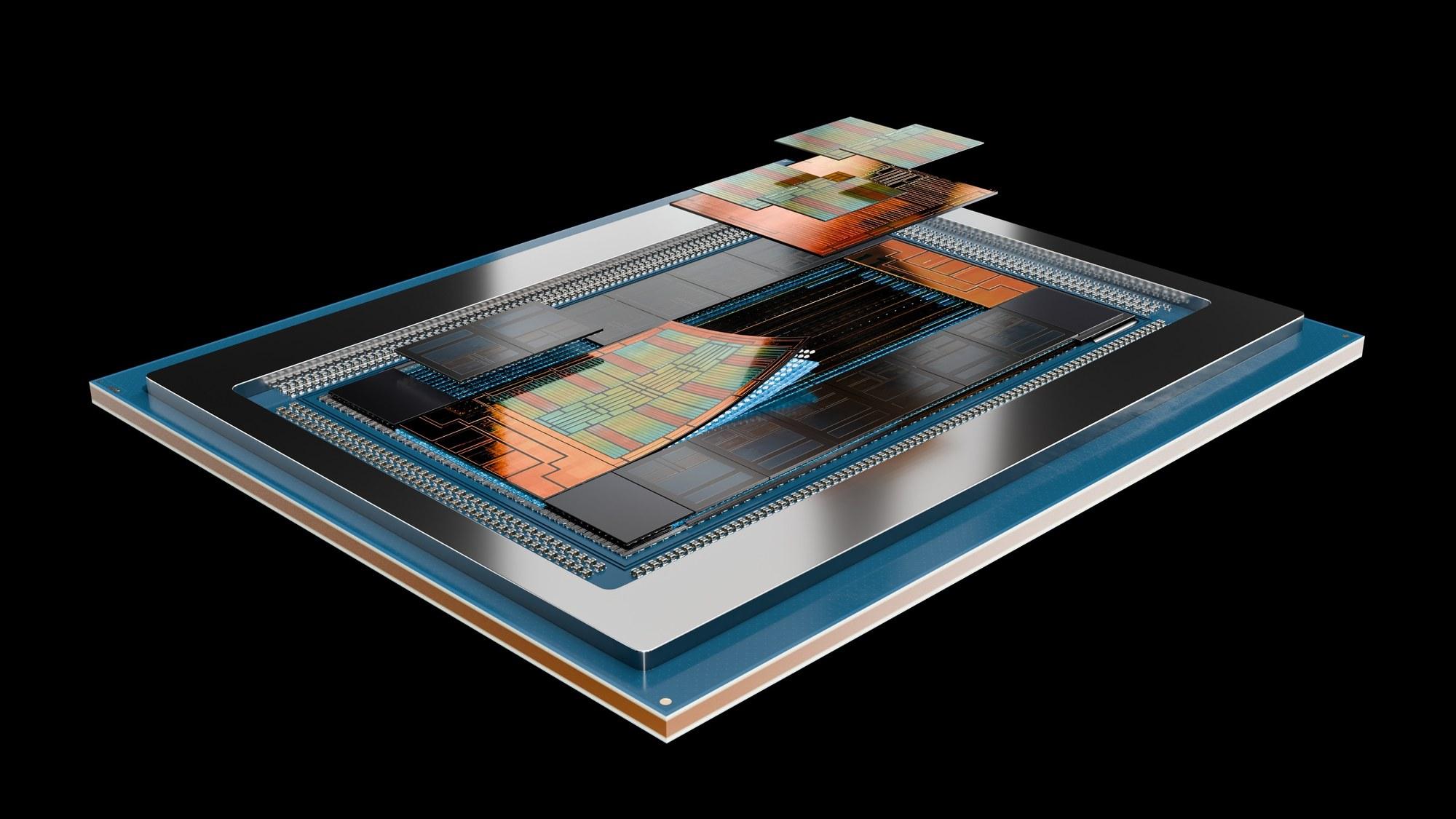
AMD's illustration of the expanded die components of the Instinct MI455X, the GPU behind the 21,333 tokens-per-second claim AMD made on Nov. 12.
Image: AMD
Source · Press image from the AMD newsroom, used for news reporting.
AMD said on Nov. 12, 2026 that its Instinct MI455X GPU, running in a Helios rack, reached 21,333 tokens per second per GPU on the DeepSeek-R1 model, which AMD puts at up to 30% more throughput than NVIDIA's latest published Vera Rubin result.
The figure is AMD's own claim from its own testing, not an independent measurement and not an MLCommons submission. AMD's newsroom post says its Performance Labs ran the test in October 2026 on an AMD-tested MLPerf Inference Offline configuration, and compared the result with NVIDIA's published MLPerf Inference v6.1 entry for the Vera Rubin NVL72 rack in the Closed Division, entry 6.1-0106, which AMD says it retrieved from MLCommons on Nov. 11. MLCommons published the v6.1 results on Sept. 16, so Nov. 11 is AMD's retrieval date, not the date of NVIDIA's result. TheElec, the Korean trade outlet that reported the announcement, relays the same figures.
AMD gives no precision setting, batch size or concurrency level for its run, and it does not state NVIDIA's per-GPU figure. The Offline scenario has no response-time target, unlike the Server and Interactive scenarios MLCommons also runs, so it shows peak aggregate throughput rather than the latency a user sees. Dividing 21,333 by 1.3 gives about 16,400 tokens per second per GPU, a figure we derived as the lowest NVIDIA per-GPU result consistent with AMD's "up to 30%."
How AMD's per-GPU throughput claim is built
MLPerf Inference entries for rack-scale systems report one total for the whole machine, so a per-GPU figure is that total divided by the number of GPUs in the entry. AMD states a per-GPU number for its own system but not for NVIDIA's, so the 30% rests on a division AMD does not show.
AMD's 21,333 tokens per second per GPU comes from its own October test, and it names no precision, batch size or software stack. NVIDIA's Vera Rubin entries were published on Sept. 16 in the preview category. Until MLCommons lists an MI455X result, the claim shows what AMD measured, not what a buyer can reproduce.
Why AMD points to memory bandwidth
AMD attributes the lead to bandwidth. It says Helios offers up to 20% more high-bandwidth memory (HBM) bandwidth than a Vera Rubin GPU, plus higher scale-up bandwidth, the links that join GPUs inside one rack. Both comparisons are AMD's own calculations from published specifications, and AMD's footnote compares against NVIDIA's current bandwidth listing. The MI455X is listed at 23.3 TB/s and 432 GB of HBM4, against 19.2 TB/s and 288 GB on NVIDIA's current Rubin listing; NVIDIA's own pages gave a higher Rubin bandwidth figure earlier in 2026, a change Voltgrid reported as a vendor-paper lead with no independent bandwidth test. AMD does not say which bandwidth NVIDIA's hardware ran at in the entry it compared against.
On the vendors' own listings, the MI455X shows 23.3 TB/s and 432 GB against 19.2 TB/s and 288 GB for Rubin; these are listed specs, not independent measurements.
Graphic: Voltgrid News
For a single rack, AMD's figures as relayed by TheElec are 72 MI455X GPUs, 31 TB of HBM4, up to 1.7 PB/s of memory bandwidth and 260 TB/s of scale-up bandwidth.
MI450X and MI430X
The same announcement added a cheaper Helios option. The MI450X carries 288 GB of HBM4 per GPU and, AMD says, the same core compute, memory bandwidth, scale-up and scale-out connectivity as the MI455X. Customers can pick either part for Helios, with the MI455X offering more headroom for larger models, longer contexts or higher concurrency.
AMD also shared details of the MI430X, aimed at scientific computing, with native 64-bit (FP64) math, 432 GB of HBM4 and up to 23.3 TB/s. AMD said its research on 47 workload configurations across 11 applications and benchmarks explored where FP64 emulation can help and where scientific codes depend on native FP64 hardware.
What is not confirmed yet
No independent result for the MI455X on this workload has been published. We found no NVIDIA response, and no MLCommons entry for AMD's figure, in coverage through Nov. 17. NVIDIA's MLPerf Training v6.1 results from Nov. 16 cover a different benchmark suite and do not answer this claim. AMD has not said at what batch size, precision or latency target its 21,333 tokens per second was reached, and those settings decide whether it carries over to production serving. Watch for an MLCommons-listed MI455X submission, or a rerun by an independent lab, as the check on AMD's numbers.
Sources
- Published
- Sources
- 2 cited