Vera Rubin MLPerf Training v6.1: NVIDIA Claims Up to 2x GB300 per GPU
NVIDIA's Vera Rubin NVL72 debuted in MLCommons' Training v6.1 round. NVIDIA claims up to 2x per GPU over GB300, and over 10x throughput per watt on a separate test that is provisional and not load-matched.
3 min read
Follows NVIDIA Rubin HBM4 Slows to 19.2 TB/s as AMD MI455X Leads on Paper
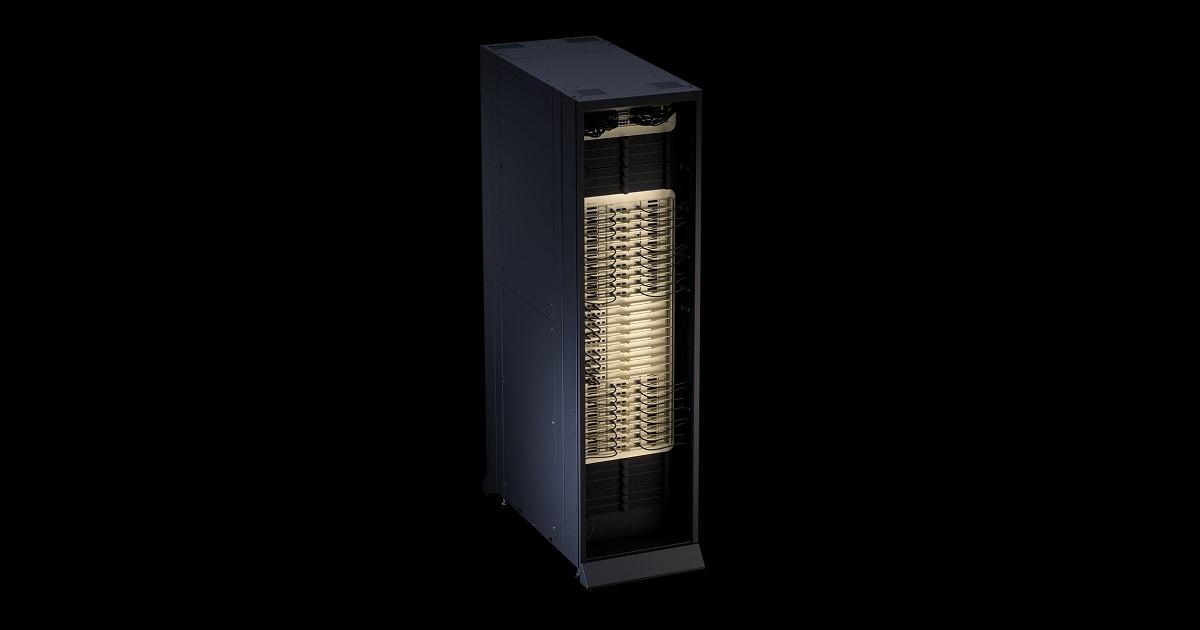
NVIDIA's Vera Rubin NVL72 rack, the system behind the MLPerf Training v6.1 results.
Image: NVIDIA
Source · Press image from the NVIDIA website, used for news reporting.
NVIDIA's Vera Rubin NVL72 made its debut in MLPerf Training v6.1 on November 16, 2026. NVIDIA said it delivered up to 2x the per-GPU performance of an optimized GB300 NVL72 on DeepSeek-V3 at 1,024 GPUs each, in the closed division (4.14 against 8.03 minutes). On its other six benchmarks, NVIDIA's ratios were 1.4x to 1.6x at matched GPU counts. All are NVIDIA's comparisons of MLCommons entries.
The 2x figure is NVIDIA's own comparison of MLCommons entries, not a ranking MLCommons published. MLCommons, the consortium that runs MLPerf, said the round drew 153 systems and 250 results from 24 organizations, and that it included Rubin-generation GPUs and Google's TPUv7 (Ironwood) for the first time. The release adds context to Voltgrid's earlier coverage of Rubin's memory specs: it is the first published MLPerf Training data on the platform.
What MLCommons and NVIDIA Reported for Vera Rubin
On the DeepSeek-V3 test, NVIDIA said Vera Rubin NVL72 scaled from 256 to 1,024 GPUs at above 97% efficiency, cutting time to train from 16 minutes to about 4. The largest runs used older parts: NVIDIA said its GB300 NVL72 ran DeepSeek-V3 in 1.38 minutes on 10,240 GPUs across 160 racks, and that Microsoft Azure's 10,240-GPU GB200 NVL72 entry tied it. MLCommons put the round's largest system at 10,240 accelerators and counted 12 systems with 1,000 or more. NVIDIA also said Vera Rubin had the fastest time on six of the seven benchmarks and that NVIDIA platforms were the only ones to submit all seven, both vendor claims. MLCommons added two tests this round: DLRMv4-HSTU, a recommender, and a Qwen3.5-397B post-training workload using reinforcement learning.
AMD said it entered five of the seven benchmarks on Instinct MI355X and MI350X. In its own write-up, AMD listed Llama 2 70B LoRA fine-tuning at 6.98 minutes on 8 MI355X GPUs and DLRMv4 at 4.63 minutes on 64 MI355X GPUs in a Crusoe entry. NVIDIA's matched-count ratios for those tests were taken at 72 and 128 GPUs, so the two sets cannot be ranked against each other.
How MLPerf Per-GPU Comparisons Work
MLPerf Training measures how long a system takes to train a model to a fixed quality target. To compare generations, NVIDIA divides performance by GPU count and sets Vera Rubin NVL72 against an optimized GB300 NVL72 at the same number of GPUs, in the closed division, where the model and rules are fixed. On DeepSeek-V3 at 1,024 GPUs it reported 4.14 minutes against 8.03, which it calls up to 2x. Its other six ratios run from 1.4x to 1.6x.
NVIDIA's claimed per-GPU ratios, built on MLCommons entries at matched GPU counts in the closed division, peak at 2x on DeepSeek-V3.
Graphic: Voltgrid News
The ratios are NVIDIA's, built on MLCommons entries, and each applies only to its benchmark and GPU count. They do not average into one speed-up, and the Endpoints power result below is a separate suite whose Rubin entry is still provisional.
Vera Rubin's Per-Watt Claim and Its Caveats
The figure with the most weight for data-center planners came from a separate suite, MLPerf Endpoints v1.0, on the Kimi K3 model. NVIDIA says Vera Rubin NVL72 delivers more than 10x the throughput per watt of GB300 NVL72 at the same response speed, a comparison it makes at a shared minimum of 50 tokens per second per user. Its own table shows 41,414.2 tokens per second at 100.89 kW of operating power on 32 Rubin accelerators, against 2,210.4 tokens per second at 60 kW on 48 GB300 accelerators, as NVIDIA reported them.
Two caveats limit that comparison. First, the Rubin result is provisional, pending MLCommons verification; the GB300 result is verified. Second, the runs used very different loads: 1,024 concurrent queries against 48, with a P90 time to first token of 4,673.9 ms against 2,305.1 ms. Both met NVIDIA's floor of 50 tokens per second per user. A buyer sizing a power envelope should wait for the verified entry and a comparison at matched concurrency.
The next data point to watch is the verified Endpoints entry, and whether AMD or Google submits to the same Kimi K3 test so per-watt figures can be compared across vendors.
Sources
- 01MLCommons Releases MLPerf Training v6.1 Results, Spotlighting Recent Advances in AI TrainingMLCommons (GlobeNewswire)manilatimes.net
- 02NVIDIA Vera Rubin NVL72 Achieves up to 2x Blackwell Ultra Performance in MLPerf Training v6.1NVIDIA Technical Blogdeveloper.nvidia.com
- 03MLPerf Training benchmark suite: benchmarks in v6.1MLCommonsmlcommons.orgas read on Nov 16, 2026
- 04NVIDIA Sweeps MLPerf Training and Endpoints as Vera Rubin Debuts With Leading PerformanceNVIDIAblogs.nvidia.com
- 05Technical Deep Dive into AMD MLPerf Training v6.1 ResultsAMD ROCm Blogsrocm.blogs.amd.com
- Published
- Sources
- 5 cited