BIS Remote Access Rule Requires AI Chip Licenses for 5 Countries
BIS's interim final rule, RIN 0694-AK50, released Nov. 16, also requires a license for data centers giving over 12,000,000 aggregate TPP to firms in Macau or Country Group D:5.
3 min read
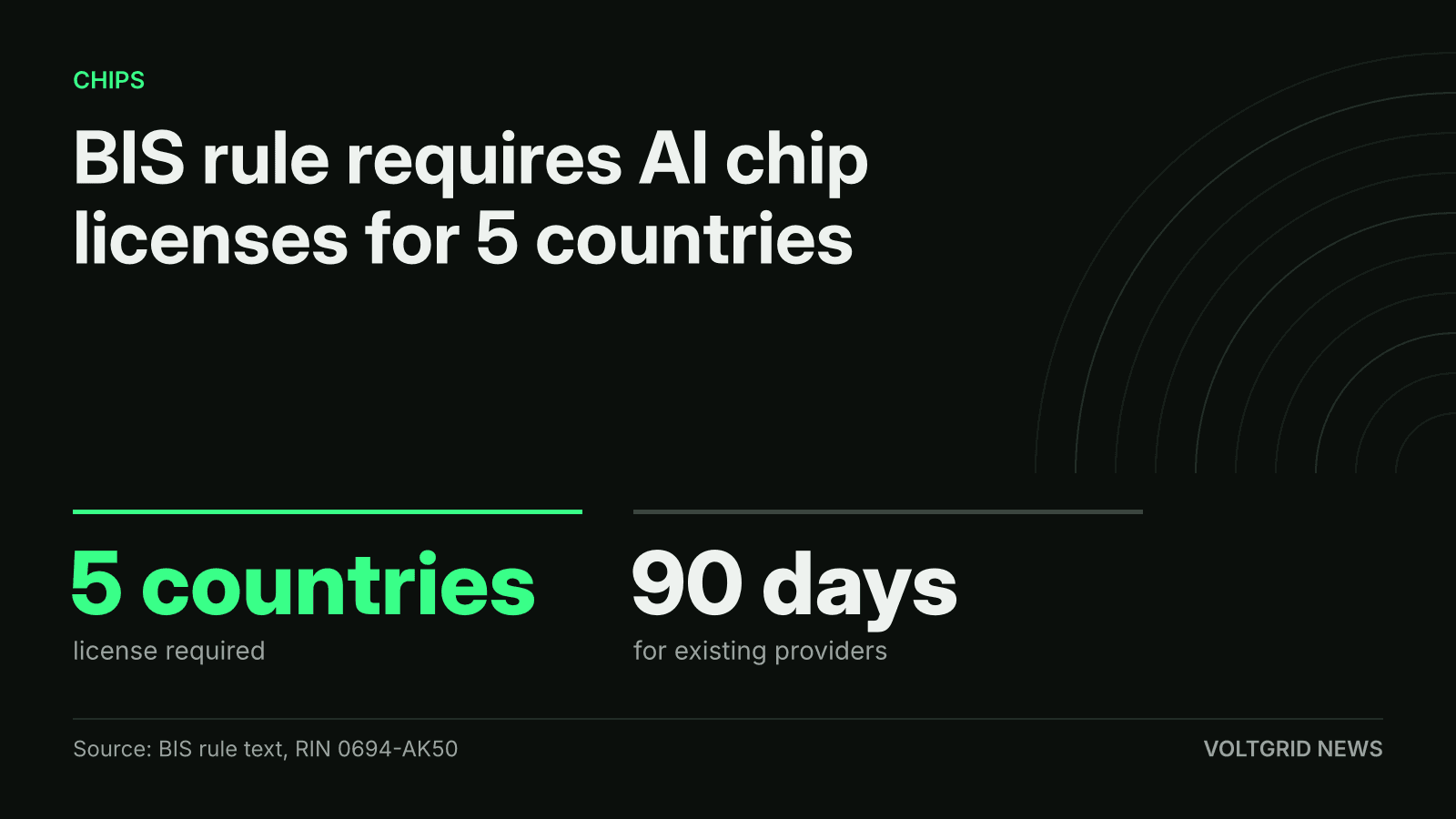
The BIS interim final rule, RIN 0694-AK50, requires licenses for advanced chips to five named countries and gives existing providers 90 days.
Graphic: Voltgrid News
The U.S. Commerce Department's Bureau of Industry and Security (BIS) released its remote access rule, an interim final rule, on Nov. 16, 2026 that requires licenses for advanced AI chips going to Indonesia, Malaysia, Singapore, Thailand and Brazil, and restricts overseas data centers that supply compute to China-headquartered companies.
The rule, RIN 0694-AK50, is titled "Addressing Remote Access to Advanced Semiconductors" in the text BIS put on display. In its press release, BIS said the rule was written by and at the direction of the Treasury Department and the National Security Council. The rule text had no Federal Register date or docket number filled in. When checked, it was not on the Federal Register's public inspection list. It takes effect on the day it is published there, with comments due 60 days later through regulations.gov.
What the rule does
The rule text sets out four changes. The first is a new license requirement, in a new section 744.24 of the Export Administration Regulations (EAR). It bars knowingly exporting, reexporting or transferring covered chips and servers to a data center anywhere that will give more than 12,000,000 "aggregate TPP" of compute to companies headquartered in Macau or a Country Group D:5 destination. TPP is total processing performance, the EAR's chip-performance measure, and the rule counts it across one site or across "linked data centers", including digitally linked ones. Data centers that already serve such customers must obtain a license within 90 days of the effective date. Commercial recommender systems, such as those used by online retailers or social media companies, are exempt.
A data center giving more than 12,000,000 aggregate TPP to firms headquartered in Macau or Country Group D:5 needs a license; existing providers have 90 days.
Graphic: Voltgrid News
The second change adds a license requirement for advanced chips going to the five named countries, plus any country the Commerce Secretary later designates after consulting the Secretary of State or the national security adviser. BIS calls them countries with a "higher-than-normal risk of diversion". The requirement does not apply to buyers headquartered in the U.S., or whose ultimate parent is, provided they meet new reporting requirements under section 743.10.
The third change tightens the presumptions that chip fabricators and packagers face when they ship advanced-node logic chips for designers in restricted destinations. The fourth formally rescinds the Biden-era AI Diffusion Rule regulations; BIS says that rule was never enforced and that it announced the rescission in May 2025.
Why it matters
Until now, export controls followed the physical chip. A Chinese company could rent GPU capacity from a data center in Southeast Asia and train models there without a chip crossing into China. CNBC called it Commerce's first policy response to the Nvidia scandal that CNBC said led CEO Jensen Huang to resign last week. Reuters reported the rule arrived as President Donald Trump left for an Asia trip that includes a meeting with Chinese President Xi Jinping.
For operators, the 12,000,000 TPP line becomes a compliance number. A cloud or colocation operator in the five countries must track its customers' headquarters and ultimate owners, and the rule text asks data centers, foundries and chip exporters to perform due diligence on ownership. BIS also said it will watch for countries that tolerate evasion.
Background
On Nov. 13 we reported the export ledger showing no new curb. On Nov. 11 we covered Lutnick's reported stalling of a third crackdown, and on Nov. 12 Chinese AI firms reportedly rushing to secure overseas NVIDIA capacity. CNBC wrote that Treasury Secretary Scott Bessent said on Friday that Commerce had not placed Singapore-based Megaspeed on the Entity List.
What is not confirmed yet
The Federal Register publication date, which sets the effective date and the comment deadline, is not known, and the docket and regulations.gov ID are blank in the text BIS posted. We did not find a statement from NVIDIA or the governments of the five countries. Reuters reported no chip-performance threshold for "advanced semiconductors". The rule is an interim final rule, so the final text may change after comments.
Sources
- Published
- Sources
- 2 cited